
Barricades and Bullets: Capitalizing on Geopolitical Volatility in Energy and Defense
The stalled Russia-Ukraine peace talks have ignited a new era of geopolitical volatility, transforming energy and defense sectors into high-stakes arenas of investment opportunity. As sanctions escalate and military spending surges, portfolios must adapt to capitalize on prolonged conflict and supply chain disruptions. This article outlines how to position investments for profit—and protection—in this turbulent landscape.
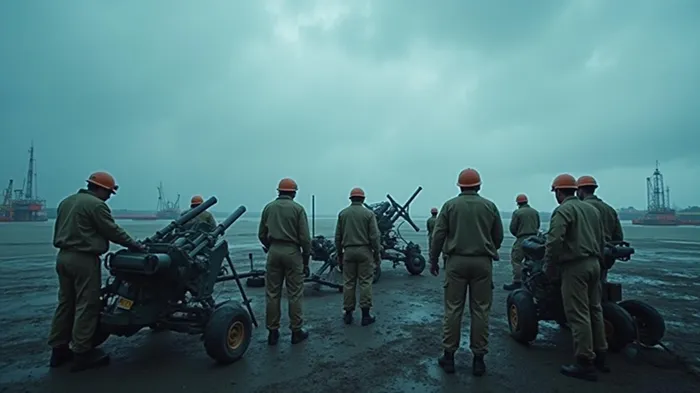
1. Defense Spending: The New Gold Rush
The Russia-Ukraine war has catalyzed a historic military spending boom. NATO members collectively increased defense budgets to $1.5 trillion in 2024, with 18 nations hitting the 2% GDP spending threshold—a record. Germany, once restrained, now allocates €88.5 billion annually, while Poland’s defense budget reached 4.2% of GDP, fueling procurement of advanced systems like South Korean K2 tanks and K9 howitzers.
The demand for artillery, drones, and cyber defense is skyrocketing. Germany’s €7.1 billion in direct support to Ukraine alone highlights the urgency. Meanwhile, Russia’s asymmetric warfare tactics—including drone swarms and hypersonic missiles—force NATO to modernize rapidly.
Investment Play:
- ETFs: The First Trust ISE Cyber Security ETF (HCYB) and SPDR S&P Aerospace & Defense ETF (XAR) capture this trend.
- Equities: Look to Raytheon Technologies (RTX) (missile systems), Northrop Grumman (NOC) (cyber defense), and Rheinmetall (RHM.DE) (ammunition contracts).
2. Black Sea Energy: A Volatile Pressure Cooker
The Black Sea has become the epicenter of energy supply risks. Russia’s control of 80% of the region’s gas reserves and its sabotage of pipelines like Nord Stream 1 have left Europe’s energy infrastructure perpetually exposed. EU sanctions on Russian LNG transshipments and the indefinite suspension of Nord Stream 2 have forced reliance on U.S. LNG and renewable projects.
Yet, storage levels remain perilously low—33.7% full post-winter 2025—while Russia’s occupation of Crimea blocks Ukrainian LNG exports. European TTF gas prices, though temporarily muted by mild weather, could spike again if conflict reignites or storage refills falter.
Investment Play:
- ETFs: The United States Natural Gas Fund (UNG) and Energy Select Sector SPDR Fund (XLE) offer direct exposure.
- Commodities: Natural gas futures (NG) and uranium (U3O8) are critical to energy resilience.
3. Sanction-Proofing via Critical Minerals
The U.S.-Ukraine Critical Minerals Deal, formalized in April 2025, unlocks a $12.5 trillion trove of Ukrainian lithium, rare earths, and uranium—all vital for defense tech and renewables. This “minerals-for-military” pact shields investors from Chinese dominance in supply chains while insulating Ukraine from sanctions through U.S. tech and infrastructure projects.
Ukraine’s Kruta Balka lithium deposits and Donbas rare earth reserves position it as a geopolitical battery, with U.S. firms like Chevron and Halliburton now prioritizing reconstruction of mining infrastructure.
Investment Play:
- ETFs: The Global X Lithium & Battery Tech ETF (LIT) and VanEck Rare Earth/Strategic Metals ETF (REMX).
- Equities: Albemarle (ALB) (lithium), Freeport-McMoRan (FCX) (copper/rare earths), and Cameco (CCJ) (uranium).
Hedging Against the Unseen
The prolonged conflict demands diversified hedging strategies:
1. Sector Rotation: Shift allocations toward defense and energy while trimming equities exposed to China’s tech dominance.
2. Geographic Focus: Prioritize firms with NATO/EU contracts, such as European defense giants BAE Systems (BAESY) and Safran (SAF.PA).
3. Currency Hedges: Use USD-denominated ETFs (e.g., PowerShares DB USD Index Bullish ETF (UUP)) to counter euro volatility.
Final Call to Action
The Russia-Ukraine stalemate is not ending soon. Investors who ignore the defense and energy sectors risk obsolescence. Now is the time to:
- Deploy capital into ETFs like XAR, XLE, and LIT for broad exposure.
- Target equities with direct conflict exposure (e.g., RHM.DE, ALB).
- Hedge with natural gas futures and geopolitical ETFs to mitigate downside.
The next phase of this war will be fought not just on battlefields, but in boardrooms and stock markets. Position your portfolio now—or risk being left behind.







Comentarios
Aún no hay comentarios