
Bargain-Hunting in BDCs: Why Two 10%+ Yielding Business Development Companies Are Now Buy-And-Hold Opportunities
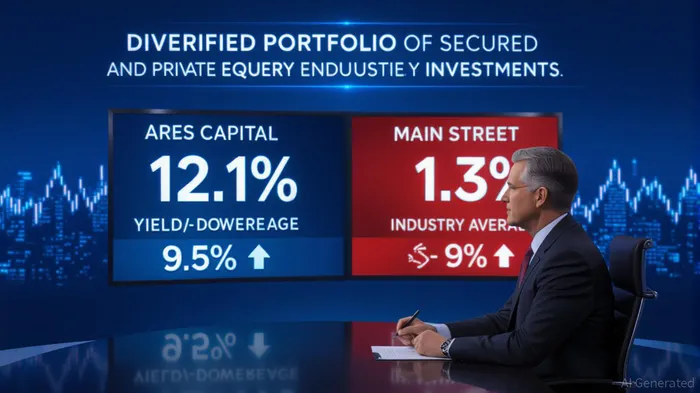
In the high-yield alternative space, business development companies (BDCs) have long been a cornerstone for income-focused investors seeking downside protection and capital appreciation. As of August 2025, two BDCs—Ares Capital (ARCC) and Main Street Capital (MAIN)—stand out as compelling buy-and-hold opportunities. Both offer yields exceeding 8% and 3.28%, respectively, but their disciplined lending strategies, conservative balance sheets, and robust risk management make them uniquely positioned to deliver risk-adjusted returns in a tightening credit environment.
Ares Capital: A Fortress of Conservative Leverage and High-Yield Returns
Ares Capital's Q2 2025 results underscore its strength as a BDC with a focus on senior secured lending. The company declared a $0.48-per-share dividend (8.46% yield), supported by a debt-to-equity ratio of 0.98x and $6.8 billion in available liquidity. Its loan portfolio, valued at $27.9 billion, has a weighted average grade of 3.1 and a mere 1.2% of assets in non-accruals at fair value.
Ares' lending strategy is laser-focused on high-quality borrowers: 82% of new commitments in Q2 2025 were first lien senior secured loans, with 92% of these floating rate instruments. This structure not only aligns with rising interest rates but also ensures strong recovery prospects in downturns. The portfolio's weighted average yield of 9.9% at amortized cost reflects its ability to generate income in a low-growth economy.
Critically, Ares has maintained a 3% quarter-over-quarter growth in total portfolio value and reported $117 million in net realized gains from its equity co-investments. Its conservative leverage and diversified exposure across 247 private equity sponsors suggest resilience against macroeconomic shocks. For income investors, Ares' yield is not a gamble—it's a calculated outcome of disciplined underwriting and proactive liquidity management.
Main Street Capital: A Low-Cost Engine of Middle-Market Growth
Main Street Capital's Q1 2025 performance highlights its unique value proposition: a 16.5% annualized return on equity, a debt-to-equity ratio of 0.81, and a 1.2% operating expenses-to-assets ratio. The company's focus on lower middle market (LMM) and private loan portfolios—$2.6 billion and $1.9 billion at fair value, respectively—has driven a 1.2% increase in NAV to $32.03 per share.
Main Street's lending strategy is equally compelling. 94.7% of its private loan portfolio is invested in first lien senior secured debt, with a median net senior debt-to-EBITDA ratio of 2.6x. This conservative leverage profile, coupled with strong interest coverage (3.0x EBITDA-to-interest expense), ensures borrower stability. The company's $1.3 billion in liquidity and investment-grade credit ratings (BBB- from Fitch and S&P) further reinforce its safety margin.
While Main Street's yield (3.28%) is lower than Ares', its cost-efficient operations and high returns on equity make it an attractive long-term play. The company's supplemental dividends and monthly payout structure (e.g., $0.75 total for Q2 2025) provide consistent income, supported by a distributable net investment income of $1.07 per share.
Risk Mitigation in a High-Rate Environment
Both BDCs have navigated the 2025 rate hiking cycle with agility. Ares' floating rate exposure (92% of senior secured commitments) and Main Street's focus on secured lending protect against interest rate volatility. However, Main Street's involvement in the Main Street Lending Program (MSLP)—a government-backed initiative with $1.42 billion in credit losses as of May 2025—introduces a nuanced risk. Unlike its own private loan portfolio, MSLP loans are back-loaded with 70% balloon payments due in late 2025, creating a “financial cliff” for borrowers.
For Main Street, this exposure is minimal, as its own portfolio is distinct from the MSLP. The company's conservative leverage, strong liquidity, and focus on asset-backed lending mean its risk profile remains favorable. Meanwhile, Ares' lack of exposure to the MSLP and its emphasis on private equity sponsors further insulate it from broader middle-market distress.
Why These BDCs Are Buy-And-Hold Opportunities
The case for Ares and Main Street rests on their ability to balance yield with downside protection. Ares' 8.46% yield is supported by a core earnings per share of $0.50 and a 1.2% non-accrual rate, while Main Street's 3.28% yield is underpinned by a 19.3% trailing twelve-month return on equity and a 1.2% expense ratio. Both companies have upsized credit facilities and diversified borrower bases, ensuring flexibility in a shifting economic landscape.
For income-focused investors, the key is to prioritize risk-adjusted returns. Ares' higher yield and Main Street's operational efficiency represent two facets of this strategy. While Ares leans on high-yield senior secured loans, Main Street's lower-cost structure and middle-market focus offer complementary advantages.
Investment Advice
- Ares Capital (ARCC) is ideal for investors seeking a high-yield, high-conviction BDC with a focus on private equity-backed borrowers. Its 8.46% yield and strong liquidity make it a core holding for aggressive income portfolios.
- Main Street Capital (MAIN) suits investors prioritizing capital preservation and steady income, with its 3.28% yield and conservative leverage profile. Its operating efficiency and middle-market expertise make it a defensive play in a volatile market.
In a world where bond yields are peaking and equity valuations remain stretched, Ares and Main Street offer a compelling alternative: high-yield, low-risk income with upside potential. For long-term investors, these BDCs are not speculative bets—they're strategic allocations in a diversified, risk-managed portfolio.







Comentarios
Aún no hay comentarios