
Barfresh Food Group (BRFH): Supply Chain Turnaround and Scalable Growth in the Education Food Market
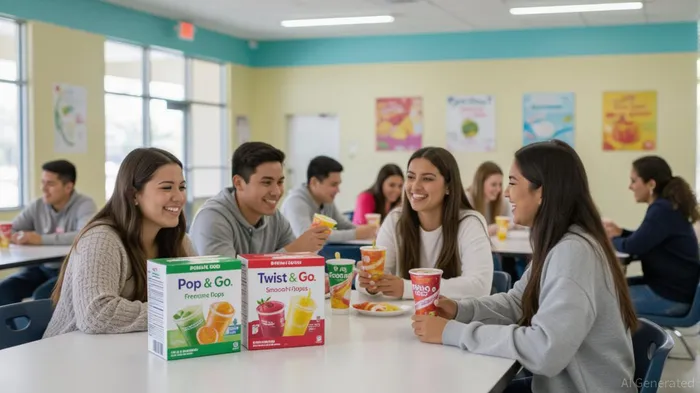
The U.S. education food market is a $100+ billion industry, driven by a growing emphasis on healthier school meals and the need for scalable, nutritious solutions. Barfresh Food GroupBRFH-- (BRFH) has positioned itself as a key player in this high-growth niche, leveraging its patented single-serve beverage technology and strategic manufacturing expansion to address a critical gap in the K-12 market. However, the company's journey has not been without challenges. Recent supply chain bottlenecks and margin pressures have tested its operational resilience. Now, as BarfreshBRFH-- navigates a pivotal transition period, investors are watching closely to see if its investments in capacity expansion and margin normalization can unlock long-term value.
A Strategic Supply Chain Overhaul: From Bottlenecks to Breakthroughs
Barfresh's recent supply chain strategy has been a double-edged sword. From 2023 to 2025, the company embarked on a bold initiative to expand manufacturing capacity by onboarding two new co-manufacturing partners. While this move was necessary to meet surging demand—particularly in the education sector—it initially caused temporary inefficiencies. For example, gross margins fell to 31% in Q1 2025 (from 41% in Q1 2024) and 31.1% in Q2 2025 (from 34.8% in Q2 2024), due to trial costs, production ramp-up delays, and logistics challenges.
However, these pain points are now behind the company. By the end of Q2 2025, one co-manufacturer had completed equipment installation and began contributing to production. The second co-manufacturer is expected to follow suit by the end of the quarter, unlocking 400% more bottling capacity by January 2026. This expansion is critical for supporting the back-to-school demand surge in Q3 2025, a period that accounts for a significant portion of Barfresh's annual revenue. CEO Riccardo Delle Coste has emphasized that these improvements will create a “resilient and scalable manufacturing platform,” enabling the company to meet growing customer demand without sacrificing margins.
Education Market Dominance: A Niche with Massive Upside
Barfresh's focus on the K-12 education market is a masterstroke. With over 3,900 school contracts nationwide—serving nearly 2 million students—the company has carved out a 5% market penetration in the education channel. This figure is minuscule relative to the sector's size, leaving ample room for growth. Barfresh's products, including the USDA-compliant Twist & Go Smoothies and the recently launched Pop & Go Freeze Pops, are uniquely positioned to capitalize on the shift toward healthier, ready-to-consume options in schools.
The company's strategic partnerships, such as its collaboration with Revolution Foods (the second-largest school meal provider in California), further solidify its market position. Additionally, Barfresh's distribution network now covers 95% of the U.S., and its recurring revenue model—schools reorder beverages annually—creates a stable, predictable cash flow. This is a rare advantage in a sector often plagued by volatility.
Margin Normalization and EBITDA Recovery: The Road to Profitability
The most compelling argument for long-term value creation lies in Barfresh's path to margin normalization. While Q2 2025 gross margins dipped to 31.1%, the company expects this to improve sharply in H2 2025 as the new co-manufacturers operate at full capacity. Management has also revised its FY 2025 revenue guidance to $12.5–$14 million (17–31% YoY growth), reflecting confidence in the second-half rebound.
Adjusted EBITDA losses have already shown improvement, narrowing to $600,000 in Q2 2025 from $682,000 in Q2 2024. With production inefficiencies resolved and logistics costs stabilizing, Barfresh is on track to achieve positive adjusted EBITDA in H2 2025. The company's liquidity position—bolstered by a current ratio of 1.96 and $1.3 million in cash and receivables—provides a buffer as it scales operations.
Investment Thesis: A High-Growth Play with Clear Catalysts
Barfresh's story is one of transformation. The company has weathered short-term margin pressures to build a scalable, capital-efficient platform. Its education market dominance, combined with a pipeline of innovative products (e.g., lunch-daypart Pop & Go Pops), positions it to capture a larger share of the $100+ billion institutional foodservice market.
For investors, the key catalysts are:
1. Margin normalization in H2 2025 as manufacturing bottlenecks resolve.
2. Revenue growth acceleration driven by the back-to-school season and new product adoption.
3. Long-term margin expansion from the 2026 bottling capacity upgrade, which will reduce per-unit costs and improve gross margins.
Risks and Considerations
Barfresh's path to profitability is not without risks. The education market is highly competitive, with larger players like PepsiCoPEP-- and Coca-ColaKO-- also vying for institutional contracts. Additionally, the company's reliance on co-manufacturing partners introduces operational risks if production delays recur. However, Barfresh's product differentiation, regulatory compliance, and recurring revenue model provide a durable moat.
Conclusion: A Compelling Long-Term Bet
Barfresh Food Group is at a pivotal inflection pointIPCX--. Its supply chain turnaround, education market expansion, and margin normalization trajectory align with a compelling long-term value proposition. While the stock remains volatile due to its early-stage growth profile, the company's strategic execution and strong market positioning make it an attractive play for investors seeking exposure to the high-growth institutional foodservice sector.
For those with a 3–5 year horizon, Barfresh represents a rare opportunity to invest in a company that is not only solving a critical problem (healthy school meals) but also building a scalable, margin-positive business. As the company's CEO aptly stated, “The investments we're making today are laying the foundation for a stronger 2025 and beyond.” With margin normalization and capacity expansion on the horizon, the time to act may be now.





Comentarios
Aún no hay comentarios