
Barclays' Strategic Move into Regulated Stablecoin Infrastructure: Institutional Validation and the Path to Mainstream Adoption
Barclays' recent equity investment in Ubyx, a U.S.-based stablecoin infrastructure firm, marks a pivotal moment in the evolution of tokenized money. By taking its first stake in a stablecoin infrastructure company, the global bankBANK-- is signaling its recognition of stablecoins as a foundational element of the next-generation financial ecosystem. This move, announced in July 2025, aligns with broader trends of institutional validation and regulatory innovation, positioning BarclaysBCS-- at the forefront of a transition toward tokenized money's mainstream adoption.
Institutional Validation of Stablecoin Infrastructure
Barclays' investment in Ubyx represents more than a financial bet-it is a strategic endorsement of stablecoin infrastructure as a critical layer of modern finance. Ubyx's role as a clearing house for stablecoins, enabling seamless settlement and redemption across different issuers and blockchains, addresses a key barrier to adoption: interoperability. By investing in this infrastructure, Barclays is not merely diversifying its portfolio but actively participating in the creation of a system where stablecoins can function as "interchangeable cash" rather than fragmented payment instruments. According to the report, Barclays' move underscores the sector's maturation, as traditional financial players shift from skepticism to strategic integration.
This institutional validation is amplified by the broader 2025 context, where stablecoins have become a focal point for institutional adoption. According to a report by RWA.xyz, stablecoins are increasingly seen as a bridge between traditional finance and blockchain-native systems, with their stability and efficiency appealing to risk-averse institutions. Barclays' move underscores the sector's maturation, as traditional financial players shift from skepticism to strategic integration.
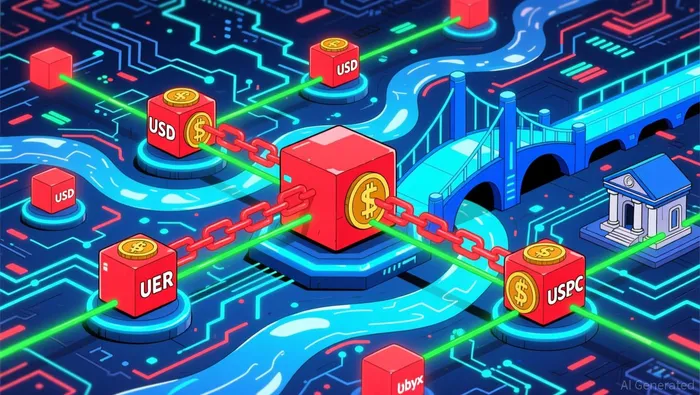
Ubyx's Role in Enabling Interoperability and Redemption
Ubyx's innovation lies in its shared redemption network, which allows users to deposit any stablecoin into their existing bank accounts, regardless of the issuer or blockchain. This capability is critical for treating stablecoins as cash equivalents, with full-value redemption on demand. For businesses, this means stablecoins can be used for real-time transactions without the friction of converting between competing tokens or fiat.
Barclays' cautious approach-avoiding direct token issuance while gaining exposure to the sector's expansion- reflects a calculated strategy to mitigate regulatory and operational risks while capitalizing on growth opportunities. The bank's investment also highlights the importance of infrastructure in scaling tokenized money. As Arjun Vir Singh notes in a LinkedIn analysis, Ubyx's whitepaper emphasizes the need for a universal clearing layer to unlock stablecoins' potential as a global payment medium.
Regulatory Tailwinds and the GENIUS Act
The U.S. regulatory environment has played a crucial role in enabling this shift. The passage of the GENIUS Act in 2025 provided a federal framework for stablecoin issuers, fostering broader acceptance within traditional financial systems. This legislative progress has reduced uncertainty for institutions like Barclays, allowing them to engage with stablecoin ecosystems while adhering to existing compliance standards.
The GENIUS Act's emphasis on innovation-friendly regulation aligns with Barclays' strategy of exploring digital money within regulatory boundaries. As stated in a Barclays Private Bank report, the bank views stablecoins as a "new generation of financial infrastructure" that can coexist with traditional systems, provided they operate under clear oversight. This regulatory clarity has accelerated institutional participation, with North American institutions and ETFs driving significant transaction activity in 2025.
Tokenized Money's Path to Mainstream Adoption
Barclays' investment in Ubyx is part of a larger narrative: the gradual mainstreaming of tokenized money. Stablecoins now facilitate trillions of dollars in global finance, with their blockchain-native efficiency appealing to both institutional and retail users. The bank's stake in Ubyx positions it to benefit from this growth while contributing to the development of a resilient infrastructure.
Moreover, the move reflects a broader industry shift. As Chainalysis notes in its 2025 adoption report, stablecoins are no longer confined to crypto-native use cases. They are increasingly integrated into traditional financial workflows, from cross-border payments to asset tokenization. Barclays' strategic engagement with Ubyx signals its intent to lead this transition, leveraging its institutional credibility to accelerate adoption.
Conclusion
Barclays' foray into regulated stablecoin infrastructure through Ubyx is a landmark event in the evolution of tokenized money. By investing in interoperability, redemption, and regulatory alignment, the bank is not only validating the sector's potential but also laying the groundwork for stablecoins to become a cornerstone of global finance. As the GENIUS Act and institutional demand continue to drive adoption, Barclays' strategic move underscores the inevitability of tokenized money's integration into mainstream financial systems.





Comentarios
Aún no hay comentarios