
Banner Bank's Q3 2025 Performance: Navigating Rising Rates with Strategic Growth Catalysts
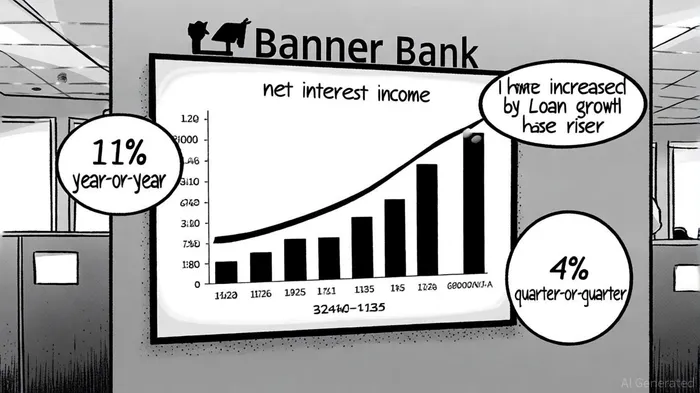
Banner Bank (BANR) has demonstrated resilience in a rising interest rate environment, with Q3 2025 results underscoring its ability to balance profitability, credit discipline, and strategic expansion. The bank reported net income of $53.5 million, or $1.54 per diluted share, driven by an 11% year-over-year increase in net interest income to $150.0 million. This performance reflects a net interest margin of 3.98% on a tax-equivalent basis, up from 3.92% in Q2 2025, signaling effective rate sensitivity management, according to a StockTitan report.
Loan Growth and Deposit Stability: Twin Engines of Momentum
Banner's loan portfolio expanded to $11.54 billion at quarter-end, a 4% increase from September 30, 2024, with commercial real estate and construction lending as key drivers, the StockTitan report noted. This growth is supported by a robust deposit base, which rose to $14.02 billion, with core deposits accounting for 89% of total deposits. Such stability is critical in a high-rate environment, where funding costs remain a key concern for regional banks. The low cost of core deposits allows BannerBANR-- to maintain a competitive net interest margin while extending credit at attractive spreads, as the StockTitan report also highlights.
Analysts highlight the bank's geographic positioning as a catalyst for sustained growth. With a strong presence in high-growth regions like the Pacific Northwest and California, Banner is well-placed to capitalize on population and economic expansion outpacing national averages, according to a Simply Wall St analysis. This strategic footprint, combined with a focus on technology and manufacturing hubs, reinforces its ability to attract commercial clients and cross-sell services, as noted by Simply Wall St.
Strategic Investments and Operational Efficiency
Banner's 2025 growth strategy emphasizes digitization and cost optimization. The bank has allocated 9% more to IT expenses year-over-year, aiming to reduce branch and back-office costs while expanding digital offerings, according to a Panabee report. These initiatives, though accompanied by short-term costs (e.g., $919,000 in Q2 2025 for facility exits), are expected to yield long-term efficiency gains, the Panabee report adds. A strong capital position-tangible common equity at 9.28% of tangible assets-provides a buffer against execution risks, the Panabee report further notes.
However, challenges persist. Non-performing assets increased by 26% year-to-date to $49.8 million, with construction and land development sectors showing signs of stress, according to the Panabee report. The allowance for credit losses coverage of non-performing loans fell to 373%, down from 421%, raising questions about risk management in a potential economic slowdown.
Valuation and Analyst Outlook
Despite these risks, analysts remain optimistic. A fair value estimate of $73.40 per share, compared to the current price of $63.99, suggests undervaluation, per Simply Wall St. This premium is partly driven by expectations of 5% annualized loan growth in 2025 and a dividend increase to $0.50 per share, reflecting confidence in earnings resilience, as reported by StockTitan. However, historical analysis of BANR's earnings release performance from 2022 to 2025 reveals a mixed pattern: while short-term price reactions are neutral, the stock has tended to underperform by -3.6% cumulative excess return by Day 30, with a win rate below 35% after ~20 days, according to an event-study back-test.
Conclusion: Balancing Opportunity and Caution
Banner Bank's Q3 2025 results highlight its ability to thrive in a rising rate environment through disciplined credit management, strategic geographic expansion, and operational efficiency. While risks in asset quality and funding costs require monitoring, the bank's strong capital position and analyst-driven valuation optimism position it as a compelling candidate for sustained outperformance. Investors should watch for further progress in digitization and credit quality metrics as key catalysts.





Comentarios
Aún no hay comentarios