
Banking Sector Digital Transformation: Strategic Workforce Optimization and Shareholder Value Creation in 2025
Workforce Reallocation: From Routine to Strategic Roles
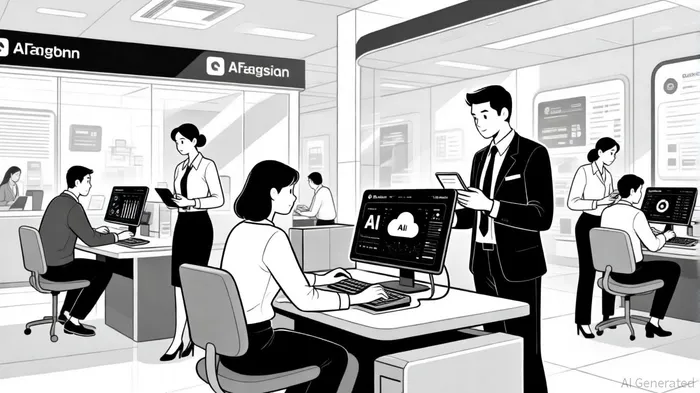
Digital transformation in banking is fundamentally altering the composition of workforces. Traditional roles focused on manual processes are being replaced by positions requiring expertise in AI, cloud computing, and data analytics. For instance, Sherwin Williams' implementation of OracleORCL-- Fusion reduced manual effort by 95%, freeing employees to engage in higher-value tasks, as reported by Outlook India. Similarly, Diriyah Company's adoption of SAPSAP-- Private Cloud Solutions demonstrated how digital tools can streamline HR management and enhance agility, according to OneArabia.
Banks are following suit, reallocating resources to roles that leverage automation and analytics. According to an EY report, institutions that adopt fluid talent models-emphasizing cross-functional collaboration and digital-first mindsets-are 6.5 times more likely to achieve significant productivity gains. This shift not only reduces operational costs but also positions banks to innovate rapidly in response to market demands.
Shareholder Value: The Financial Impact of Digital Transformation
The financial benefits of digital transformation are becoming increasingly measurable. The global business software and services market, a cornerstone of digital initiatives, is projected to grow from $574.66 billion in 2024 to $1.48 trillion by 2033, driven by AI and cloud integration, according to a GlobeNewswire release. Banks investing in these technologies are seeing tangible returns: Deutsche Bank's private banking division reported a 4% year-over-year revenue increase in Q3 2025, attributed to streamlined operations and enhanced customer personalization, per WealthBriefingAsia.
Moreover, peer effects in digital adoption are amplifying returns. A study of 114 Chinese commercial banks found that a one-unit increase in a peer bank's digitalization index led to a 0.151-unit rise in a focal bank's index, underscoring the competitive imperative to innovate, according to an MDPI study. This ripple effect is translating into improved shareholder valuations, as digitally agile banks outperform peers in profitability and resilience.
Case Studies: Quantifiable Outcomes and Strategic Insights
Several banks have demonstrated the direct link between workforce reallocation and shareholder value. Exchange Bank, for example, achieved a 17% increase in net interest income and a 25% rise in non-interest income during Q3 2025, driven by cost reductions and AI-powered operational efficiency, as reported by Yahoo Finance. Similarly, HSBC's mindfulness and AI-driven content platforms improved employee engagement metrics by 30–83%, correlating with a 50% reduction in error rates and stronger financial performance, according to the EY report referenced above.
The role of strategic partnerships cannot be overlooked. FPT Corporation's collaboration with Clearlake Capital to deliver AI-powered solutions in private equity highlights how banks can leverage external expertise to accelerate digital transformation. Such partnerships not only enhance technological capabilities but also align with shareholder value creation through scalable, high-impact innovations.
Conclusion: The Path Forward
The banking sector's digital transformation is no longer a competitive advantage but a necessity for survival. By reallocating workforces toward digital expertise and adopting precision-driven strategies, banks are unlocking operational efficiencies and financial gains. However, success hinges on continuous investment in employee reskilling, ethical AI deployment, and agile operating models. Institutions that master these elements will not only secure their market relevance but also deliver sustained shareholder value in an increasingly digital world.







Comentarios
Aún no hay comentarios