
Banking's $8T On-Chain Defense: Flow, Cost, and the March MVP
The initiative targets a staggering $8 trillion in combined assets from five major regional banks. This includes Huntington BancsharesHBAN--, First HorizonFHN--, M&T Bank, KeyCorpKEY--, and Old National Bank, which are pooling their customer base to build a shared tokenized deposit network. The sheer size of this deposit pool represents the core financial flow the project aims to defend and modernize.
The direct competitive threat comes from unregulated stablecoins, which operate without FDIC insurance and rely on selling reserve assets for liquidity. In contrast, the new network will tokenize traditional bank deposits, preserving their insured status and access to central bank facilities. This positions the banks' digital money as a safer, more stable alternative for on-chain transactions.
The network's initial focus is a closed loop, meaning money will move only among the customers of these five participating banks. This controlled start prioritizes security and regulatory alignment, but it also defines the first phase of a potential infrastructure upgrade for commercial bank money.
The Infrastructure: Cost, Speed, and the March MVP
The chosen platform is ZKsync's Prividium, a private, permissioned Layer-2 built on the ZKsyncZK-- technology stack and anchored to EthereumETH--. This architecture gives the banks a compliant, high-performance environment where sensitive transaction data stays confidential, while all activity is ultimately settled and secured on the public Ethereum chain.
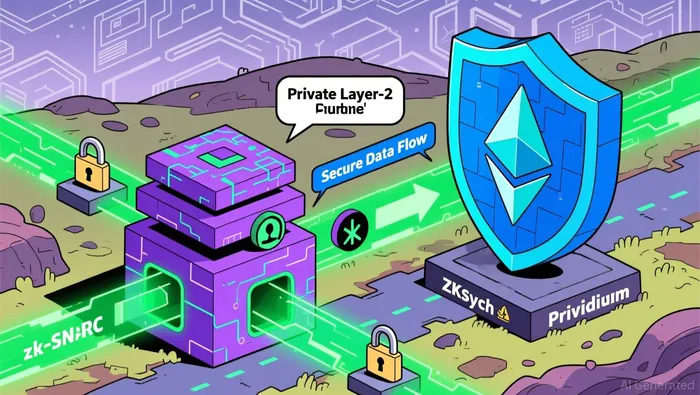
Performance targets are aggressive. Prividium is designed to support up to 10,000 transactions per second with fees under $0.01, aiming for near-zero costs. These specs are critical for the network to function as a viable, low-cost alternative to both traditional banking rails and unregulated stablecoins.
The timeline is tight. A minimum viable product is set for release in March, followed by a pilot program in the third quarter. The full commercial rollout is targeted for the fourth quarter. This rapid cadence underscores the banks' urgency to establish a foothold in on-chain payments before the competitive landscape solidifies.
The Financial Flow: Investment, Volume, and Competitive Edge
The project's financial viability hinges on a single, critical flow metric: the volume of tokenized deposits must grow rapidly to justify the $3M to $15M in infrastructure investment per bank. This is a high-stakes bet on adoption. The initial closed-loop network among five regional banks offers a controlled start, but its value proposition depends entirely on scaling transaction volume to achieve the near-zero cost and high throughput promised by the ZKsync Prividium platform.
The competitive edge is clear and structural. By retaining FDIC-insured deposits within the regulated banking system, the network directly counters the deposit drain posed by unregulated stablecoins. Stablecoins lack a lender of last resort and rely on selling reserves for liquidity, a vulnerability that tokenized deposits, backed by central bank facilities, do not share. This regulatory moat is the core financial defense being built.
The key near-term milestone is recruitment. The initial five banks are mid-sized regional lenders, not the global systemically important banks (GSIBs) like JPMorgan that already have their own products. For the network to evolve from a niche pilot into a true infrastructure upgrade, it must attract more participants. Success here will determine whether the platform can achieve the interoperability and scale needed to challenge established stablecoin dominance.





Comentarios
Aún no hay comentarios