
The Bank of Japan's Policy Tightrope: How Delayed Rate Hikes Reshape Global Capital Flows
The Bank of Japan (BOJ) has long been a linchpin of global monetary policy, its decisions rippling across markets from Tokyo to New York. In 2025, the central bank's cautious approach to rate hikes-balancing inflationary pressures against global uncertainties-has triggered a seismic shift in investor positioning. As the BOJ navigates a delicate path between tightening and restraint, its actions are reshaping capital flows, particularly in Japan's bond market and emerging Asia. This analysis unpacks the mechanics of this reallocation, its sectoral implications, and the broader risks for global markets.
The BOJ's Tightrope: Policy Normalization Amid Uncertainty
The BOJ's July 2025 monetary policy statement signaled a pivotal shift, raising its core inflation forecast to 2.7% for fiscal 2026, up from 2.2%, according to a Southwest Journal report. This revision, coupled with a 0.5% policy rate (the highest since 2008), reflects growing confidence in Japan's economic recovery. However, delays in further hikes-driven by U.S. tariff threats and a fragile global economy-have created a policy vacuum. Governor Kazuo Ueda has emphasized a "cautious approach," with analysts projecting a potential 0.75%–1.0% rate by year-end, the Southwest Journal reported.
This hesitation has had immediate consequences. Japan's bond market, long a haven for ultra-low yields, has seen 10-year JGB yields surge to 1.665% in September 2025-the highest since 2008, the Southwest Journal reported. Foreign investors, who sold a net ¥2 trillion of JGBs in a single week, are recalibrating portfolios amid expectations of tighter policy, the Southwest Journal added. Meanwhile, the BOJ's reduced bond purchases and yield curve control measures have exacerbated volatility, with 40-year JGB yields hitting 3.689% in May, according to a CNBC analysis.
Capital Flight and the Carry Trade Unwind
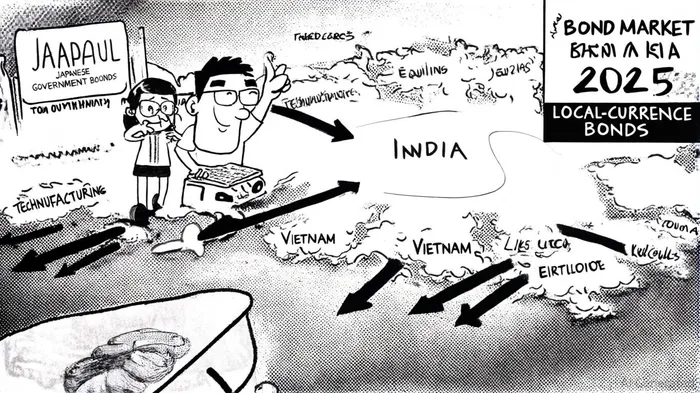
The unwinding of the yen carry trade-a strategy where investors borrow in low-yielding yen to fund higher-yielding assets-has accelerated capital reallocation. As the BOJ delays hikes, the yield differential between Japan and emerging markets narrows, prompting investors to seek higher returns elsewhere. In May 2025, foreign inflows into Asian bonds reached $15.29 billion, the highest in nearly a decade, the Southwest Journal reported. Countries like South Korea ($8.2 billion), India, and Vietnam emerged as key beneficiaries, the Southwest Journal added.
This shift is not uniform. Sectoral allocations reveal a strategic pivot toward manufacturing and technology. For instance, Vietnam's advanced manufacturing sector attracted $27 billion in renewable energy and semiconductor investments between 2020–2023, according to EDB insights, while South Korea's logistics and industrial sectors saw a 72% YoY increase in Q2 2025, CNBC reported. These trends align with global supply chain reconfigurations, as firms diversify production away from China amid U.S. tariff pressures, as noted by EDB insights.
Emerging Asia's New Era: Growth and Risks
Emerging Asia's appeal is bolstered by macroeconomic discipline and demographic tailwinds. India's GDP growth, driven by digital infrastructure and consumption, has outpaced global averages, the Southwest Journal reported, while Indonesia and Malaysia leverage their strategic positions in regional supply chains, according to EDB insights. However, the influx of capital is not without risks. JPMorgan warns of a "sudden stop" in flows to economies like Malaysia and South Africa, citing vulnerabilities to U.S. rate hikes and geopolitical shocks, in a Reuters report.
Japan's own fiscal challenges compound these risks. With public debt exceeding 250% of GDP, rising bond yields threaten to destabilize the world's third-largest economy, CNBC reported. The BOJ's delayed normalization has also eroded its credibility, with Goldman Sachs noting Japan has become a "net exporter" of bearish shocks to global bond markets, Reuters added.
Conclusion: A Fragile Equilibrium
The BOJ's delayed rate hikes have created a fragile equilibrium: Japan's bond market grapples with volatility, while emerging Asia enjoys a temporary capital windfall. However, this reallocation is contingent on the BOJ's ability to normalize policy without triggering a fiscal crisis. For investors, the key lies in hedging against both the risks of a prolonged BOJ pause and the potential for abrupt policy normalization. As the yen carry trade unwinds and sectoral shifts accelerate, the next phase of global capital flows will hinge on the BOJ's next move-and the world's readiness to adapt.







Comentarios
Aún no hay comentarios