
Bank Earnings and Inflation: Assessing the 2026 Inflection Point
The coming week presents a classic inflection point for financial markets. Three specific catalysts will converge to test the sustainability of the 'pro-growth' environment that has taken hold. First, the fourth-quarter 2025 bank earnings season kicks off on January 13 with JPMorgan ChaseJPM--, followed by the other major lenders. Second, the final major inflation print for the year, the December 2025 Consumer Price Index, is scheduled for release on January 15. Third, the Federal Reserve's current funds rate target range of 3.50% to 3.75% reflects a 175 basis point easing cycle since September 2024. Together, these events will determine the pace of Fed policy normalization and the trajectory for sector rotation.
The core investment question is straightforward: Can the economic engine keep accelerating, or will the soft landing prove fragile? The banks' reports will be the first real-world test. After two years of margin expansion driven by high rates, their focus is now on loan volume growth and investment banking prowess as the federal funds rate sits in the 3.50% to 3.75% range. Strong results here would confirm the transition to an expansion phase, validating the market's already-priced-in optimism. Weakness, however, would signal that the "normalizing" of Net Interest Income is proving more difficult than expected, potentially undermining confidence in the broader economic rebound.
This earnings test lands directly on the heels of the final 2025 inflation data. The December CPI is the last major piece of the puzzle before the Fed's 2026 policy decisions. If it shows inflation cooling further toward the 2% target, it would strengthen the case for continued easing. If it stalls or surprises to the upside, it could force a reassessment of the Fed's expected path. The central bank's own projections, as seen in the December 2025 Dot Plot, already show a wide range of forward expectations, from a hawkish 3.875% to a dovish 2.625% long-run policy rate. The data from this week will help narrow that uncertainty.
The bottom line is that these three events create a compressed timeline for decisive signals. The bank earnings will reveal the health of the financial sector's pivot, the CPI will confirm the inflation narrative, and the Fed's current policy stance provides the baseline for what's next. The market's forward view hinges on whether these pieces align to support a steady, dovish policy path and a broad-based economic expansion. Any divergence could trigger a swift recalibration of expectations.
Earnings Drivers: Margin Resilience and the M&A Engine
The structural shift in bank profitability is now clear. After two years of margin expansion driven by high rates, the industry is pivoting to volume-driven growth. This transition is being powered by two distinct engines: a revival in investment banking, and a resurgence in core loan activity.
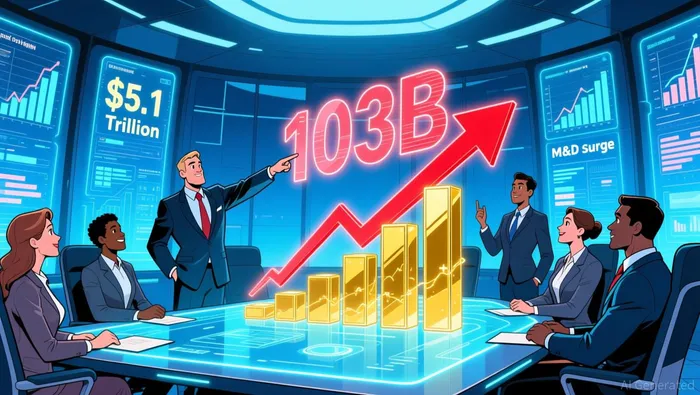
The first engine is the M&A market. The 2025 dealmaking frenzy, with global M&A volume surging to $5.1 trillion, up 42% from the prior year, has become a critical revenue pillar. This wasn't a one-off spike but a sustained acceleration, with global investment banking revenue rising 15% year-over-year to nearly $103 billion-the second-highest level since 2021. Analysts point to this as a "perfect recipe" for Q4 earnings, citing an improving IPO calendar, elevated trading activity, and, most importantly, a surge in M&A. For the "Big Four," this means a direct boost to fees and markets revenue, providing a buffer against any softening in net interest margins.
The second engine is the return of loan growth. With the Fed's policy pivot, banks are shifting focus from interest rate sensitivity to volume. Analysts expect this year's results to be bolstered by both broad loan growth and expansion in net interest margin. The catalysts are multifaceted: pro-growth policies, lighter regulations, and changes to capital rules are all expected to fuel demand. This is already visible in commercial lending, where Bank of AmericaBAC-- reported a 13% growth in the final months of 2025. The earnings season will test whether this volume expansion is broad-based and durable, or merely a cyclical rebound.
Together, these drivers signal a move from a defensive posture to an aggressive expansion phase. The "Big Four" are investing heavily to capture this shift, with JPMorganJPM-- funneling capital into AI and digital ecosystems like its Apple Card portfolio. The market is watching for confirmation that these investments are translating into scalable revenue growth. If the Q4 reports show strong, diversified profit growth driven by both dealmaking and lending, it will validate the sector's inflection. Any stumble in either engine would raise questions about the sustainability of the transition and the broader economic rebound.
Policy Pathway: The Fed's 2026 Agenda and Regulatory Shifts
The forward policy trajectory is now the central question. The Cleveland Fed's latest inflation nowcast provides a clear signal: the deceleration trend is continuing. Its projection for the headline CPI in January 2026 stands at 2.24%, down from 2.57% in December and 2.70% in October. This steady cooling, even with the October data missing due to a government shutdown, reinforces the narrative that inflation is on a path toward the Fed's 2% target. It sets a favorable backdrop for the central bank's next moves.
The most likely path, as outlined by market strategists, is for the Fed to bring rates down from the current 3.50% to 3.75% range toward 3% over the course of 2026. This would represent a further 25 to 50 basis points of easing. The timing is expected to be gradual, with a likely pause early in the year. The actual pace will be contingent on incoming economic data, particularly the labor market and the final 2025 CPI print due this week. The Fed's own projections, as seen in the December 2025 Dot Plot, already show a wide range of forward expectations, from a hawkish 3.875% to a dovish 2.625% long-run policy rate. The data from this week will help narrow that uncertainty and guide the committee's first moves.
Yet a significant element of uncertainty is introduced by the change in leadership. Federal Reserve Chairman Jay Powell's term expires on May 15, 2026. The selection of a new chair is not merely a procedural formality; it introduces a potential shift in policy tone. The Fed's communications have been a key tool for managing expectations, and a new governor may bring a different emphasis on inflation or growth. This transition creates a natural period of recalibration in the second quarter, where the market will watch for any change in the Fed's messaging as much as its next rate decision.
The bottom line is a path of gradual easing, but one with a built-in inflection point in the spring. The data supports a dovish tilt, but the change in chairmanship adds a layer of unpredictability. For investors, this means the "belly of the yield curve" may offer attractive opportunities, as the Fed seeks to normalize policy without derailing the economic expansion. The coming months will test whether the central bank can navigate this transition smoothly, with the January CPI nowcast providing the first concrete data point of the new year.
Catalysts, Scenarios, and Key Watchpoints
The coming week's data will serve as the ultimate stress test for the 2026 inflection thesis. The primary catalyst is the final major inflation print of the year: the December 2025 Consumer Price Index, scheduled for release on January 15. This report will be the last major piece of the puzzle before the Federal Reserve's next meeting, providing the clearest signal on whether the disinflation trend is accelerating or stalling as the central bank contemplates its next move.
Key watchpoints will determine if the 'pro-growth' environment is being confirmed or if risks emerge. First, the consistency of bank earnings beats will be critical. The sector's pivot to volume-driven growth, powered by a 42% surge in M&A volume to $5.1 trillion in 2025, must translate into sustained profit growth. Analysts expect this dealmaking frenzy to be a "perfect recipe" for Q4 results, but the market will scrutinize whether fee revenue is durable or a cyclical peak. Second, the labor market data released earlier this month-the Job Openings and Labor Turnover Survey for November 2024-sets a baseline for economic health. Its findings on hiring and turnover will inform expectations for consumer demand and credit quality.
The market's reaction to these data points will signal the dominant narrative. A strong CPI print that aligns with the Cleveland Fed's nowcast, coupled with solid bank earnings and stable labor data, would confirm the soft-landing thesis and likely support continued Fed easing. However, any sign of sticky inflation or a stumble in the M&A engine could trigger a reassessment. As one analyst noted, a slowdown in job growth could dent consumer demand, while a combination of tariffs and fiscal stimulus could reduce rate cut expectations. The coming days will separate the structural inflection from a fragile, data-dependent rally.





Comentarios
Aún no hay comentarios