
Bank of China's 30 Billion Yuan Bond Issuance and Its Implications for China's Debt Market
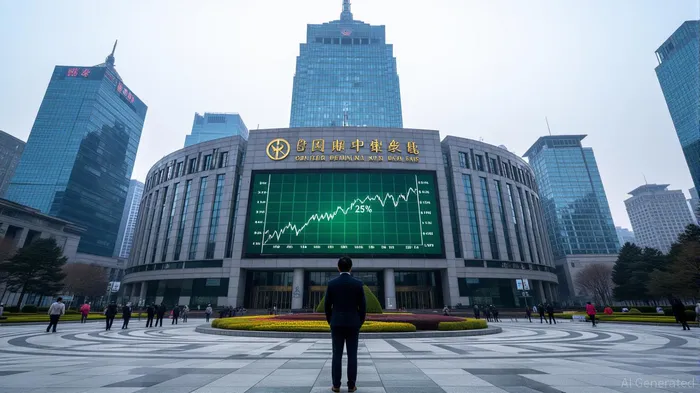
China's debt market is at a critical inflection pointIPCX-- in 2025, shaped by the interplay of accommodative monetary policy, structural economic challenges, and aggressive fiscal expansion. The recent 30 billion yuan bond issuance by the Bank of China—part of a broader RMB 1.3 trillion ultra-long bond program—has become a focal point for investors and policymakers alike. This move, while signaling confidence in China's ability to access capital at favorable terms, also raises pressing questions about debt sustainability, market dynamics, and the long-term trajectory of the world's second-largest economy.
Macroeconomic Signals: A Delicate Balance
China's 10-year government bond yield has hovered near 1.93% in early 2025, with analysts forecasting a decline to 1.68% by Q2 2025. This projection reflects a combination of factors: the People's Bank of China's (PBoC) accommodative stance, including a 20-basis-point cut in the medium-term lending facility (MLF) rate and a 10-basis-point reduction in the loan prime rate (LPR), as well as a structural slowdown in growth. The yield is now approaching the 2% threshold, a level last seen during the 2020 pandemic-era stimulus.
The decline in yields is not merely a reflection of monetary policy but also a response to shifting investor sentiment. With China's long-run growth rate projected to decelerate further in 2025, demand for safe-haven assets—particularly government bonds—has surged. This is compounded by a flight of capital from equities to fixed income, as equity markets struggle with underperformance driven by weak private-sector demand and geopolitical risks. However, the PBoC's recent reluctance to deepen rate cuts has led to a surge in bond supply, exacerbating downward pressure on yields.
Debt Sustainability: A Double-Edged Sword
The Bank of China's bond issuance is part of a larger fiscal strategy to fund strategic national priorities, including technology innovation and infrastructure projects. In 2025, the central government's fiscal deficit is officially targeted at 4% of GDP, but when accounting for special sovereign bonds and local government borrowing, the effective deficit swells to 9.9% of GDP. This expansion is justified by Beijing's emphasis on its asset base—public sector net assets reached 184 trillion yuan ($25 trillion) by 2023, or 136% of GDP—allowing the government to argue that its debt burden is manageable.
Yet, the reality is more complex. China's augmented government debt—encompassing central and local liabilities—reached 124% of GDP in 2024, up from 86.3% in 2019. Local governments, already strained by declining land sale revenues (down to 4.9 trillion yuan in 2024 from a peak of 8.7 trillion in 2021), are increasingly reliant on bond refinancing programs. The 10 trillion yuan ($1.4 trillion) local debt refinancing initiative, while providing temporary relief, does little to address the root causes of fiscal stress, such as weak private-sector consumption and an ailing property market.
The central government's reliance on ultra-long bonds (20–50 years) to fund industrial modernization projects introduces both opportunities and risks. These bonds, with yields as low as 1.97% in 2025, are attractive to institutional investors seeking long-term returns. However, their scale—projected to reach 1.3 trillion yuan in 2025—raises concerns about market saturation and the potential need for PBoC intervention to maintain liquidity. The central bank has already reduced its bond purchases, shifting the burden to regional banks and institutional investors, which may struggle to absorb the growing supply.
Strategic Implications for Investors
For investors, the Bank of China's bond issuance and the broader fiscal strategy present a nuanced landscape. On one hand, the low-yield environment and the government's strong asset base suggest that Chinese sovereign debt remains a relatively safe bet, particularly compared to the rising rates in the U.S. and Europe. The 30-year government bond yield in 2025, at 1.97%, is 190 basis points below U.S. Treasuries, making it an attractive option for global investors seeking yield in a low-interest-rate world.
On the other hand, the structural challenges—deflationary pressures, weak private-sector demand, and the risk of misallocated capital—pose significant risks. The PBoC's tightening of liquidity management in early 2025, including a pause in bond purchases, has already led to a shift in investor behavior. Regional banks and institutional investors, while absorbing the increased bond supply, may face profitability constraints as spreads narrow. This could ripple through the broader financial system, particularly if economic growth fails to meet the 5% target.
Investment Advice: Navigating the Crossroads
Investors should adopt a cautiously optimistic stance toward China's debt market in 2025. The Bank of China's bond issuance, while part of a strategic push for industrial modernization, should be viewed through the lens of both opportunity and risk.
- Allocate to Long-Term Sovereign Bonds with Caution: The ultra-low yields on Chinese government bonds make them an attractive hedge against global volatility, but investors should monitor the PBoC's liquidity interventions and the potential for yield normalization as economic conditions evolve.
- Diversify Exposure to Regional Banks: As the burden of bond absorption shifts to regional banks, investors may consider selective exposure to well-capitalized institutions with strong balance sheets. However, this requires careful due diligence to avoid underperforming regional lenders.
- Monitor Structural Reforms: The government's emphasis on sustainable finance—green bonds, carbon-neutral projects, and asset-based fiscal strategies—offers long-term growth potential. Investors should prioritize projects aligned with these initiatives, which are more likely to withstand economic headwinds.
- Beware of Local Government Debt Risks: While the 4.4% increase in special local government bond quotas provides temporary relief, the structural decline in land sales and the lack of private-sector demand suggest that local fiscal sustainability remains fragile. Avoid overexposure to local government-backed debt without robust collateral.
In conclusion, the Bank of China's 30 billion yuan bond issuance is a microcosm of China's broader economic strategy: a balancing act between aggressive fiscal stimulus and long-term structural reform. While the immediate outlook for the debt market appears stable, the sustainability of this approach will depend on the government's ability to translate capital into productive investment and navigate the risks of overleveraging. For investors, the key lies in aligning portfolios with the most resilient segments of this evolving landscape.







Comentarios
Aún no hay comentarios