
Bank of Canada Cuts Rates Amid Tariff Turmoil
Generado por agente de IATheodore Quinn
miércoles, 12 de marzo de 2025, 9:55 am ET3 min de lectura
The Bank of Canada's decision to cut interest rates in response to the shifting trade war with the United States has sent ripples through the financial markets. As the central bank navigates the complex landscape of stubborn inflation, economic growth, and the looming threat of U.S. tariffs, investors are left wondering what the future holds. Let's dive into the details and explore the implications of this move.
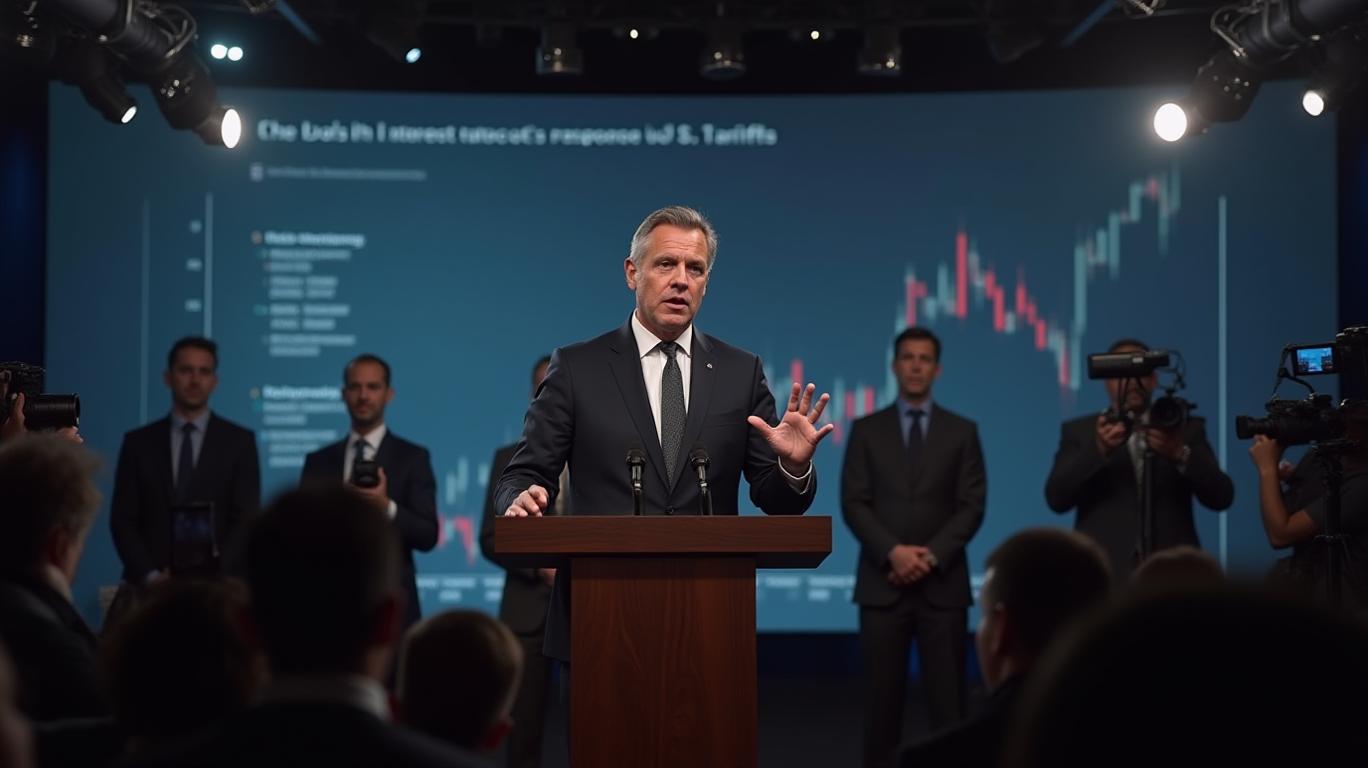
The Bank of Canada's decision to cut rates by a quarter-point on Wednesday was widely expected by economists. The central bank has been in a difficult position, trying to balance the need to support economic growth with the risk of inflationary pressures. As Randall Bartlett, Desjardins Group deputy chief economist, put it, "It’s a very difficult position for the Bank of Canada to be in." The exact nature of the tariffs imposed by U.S. President Donald Trump on March 4 has been shifting with a series of pauses and amendments, making it hard to predict the long-term impact. Bartlett notes, "Who knows what this could look like from day-to-day? It’s almost anyone’s guess."
The Bank of Canada governor Tiff Macklem has warned that if tariffs are broad-based and long-lasting, "there won’t be a bounce back" in the Canadian economy as there was during the recovery from the COVID-19 pandemic. He explained that the central bank can’t lean against both weak growth and rising inflation tied to a tariff shock at the same time. Instead, the central bank plans to use its policy rate to help "smooth" the impact on the economy while keeping inflation expectations well anchored to the two per cent target.
Andrew Grantham, senior economist with CIBC Capital Markets, suggests that while the central bank "can’t solve the tariff issue" with rate cuts, it can help the economy transition through the turbulence. CIBC expects the bank to deliver a quarter-point cut on Wednesday, lowering the benchmark rate to 2.75 per cent, with more cuts to follow this year if trade uncertainty lasts.
Bartlett expects the Bank of Canada to err on the side of providing a bit of support to the Canadian economy with a 25-basis-point cut, but hold back from anything larger as it waits to see how long tariffs stay in place in the coming weeks. He warns that the central bank will be constrained in how low it can take its policy rate, in part because of the flagging Canadian dollar. The loonie is vulnerable not only to hits from the trade war but also to a widening differential between policy rates in Canada and the U.S. If the Bank of Canada drops its policy rate too sharply, the loonie could fall as well, leading to a bigger surge in inflation on food and other goods imported from the U.S.
The potential long-term economic implications of the Bank of Canada's decision to cut rates in response to U.S. tariffs are multifaceted, particularly for sectors heavily reliant on cross-border trade. One of the key concerns is the impact on inflation. As noted by Randall Bartlett, Desjardins Group deputy chief economist, "Inflation is likely to rise in the near-term from the trade disruptions." This rise in inflation could be exacerbated if the Bank of Canada drops its policy rate too sharply, leading to a fall in the Canadian dollar (loonie). Bartlett warns, "The loonie is vulnerable not only to hits from the trade war, but also to a widening differential between policy rates in Canada and the U.S." A weaker loonie could lead to a bigger surge in inflation on food and other goods imported from the U.S., further complicating the economic landscape.
Another significant implication is the potential for job losses in hard-hit sectors. Bartlett points out, "Job losses in hard-hit sectors could quickly pile up if those industries don’t receive tariff reprieves." This could lead to a structural change in the economy, as Bank of Canada governor Tiff Macklem warned, "If tariffs are broad-based and long-lasting, 'there won’t be a bounce back' in the Canadian economy as there was during the recovery from the COVID-19 pandemic." This structural change could result in long-term economic stagnation or even a recession, as Desjardins expects Canada would fall into a recession by mid-year if steep tariffs remain in place.
Moreover, the Bank of Canada's ability to use its policy rate to smooth the impact on the economy while keeping inflation expectations well anchored to the two per cent target is constrained. Macklem explained, "The central bank can’t lean against both weak growth and rising inflation tied to a tariff shock at the same time." This constraint could limit the effectiveness of monetary policy in mitigating the long-term economic implications of the tariffs.
In summary, the Bank of Canada's decision to cut rates in response to U.S. tariffs is a cautious move aimed at supporting economic growth while managing inflationary pressures. The central bank's plan to use its policy rate to smooth the impact on the economy while keeping inflation expectations well anchored to the two per cent target is a delicate balancing act. However, the potential for a falling Canadian dollar to exacerbate inflationary pressures and the risk of job losses in sectors reliant on cross-border trade are significant challenges that the Bank of Canada must navigate in the coming months.



Divulgación editorial y transparencia de la IA: Ainvest News utiliza tecnología avanzada de Modelos de Lenguaje Largo (LLM) para sintetizar y analizar datos de mercado en tiempo real. Para garantizar los más altos estándares de integridad, cada artículo se somete a un riguroso proceso de verificación con participación humana.
Mientras la IA asiste en el procesamiento de datos y la redacción inicial, un miembro editorial profesional de Ainvest revisa, verifica y aprueba de forma independiente todo el contenido para garantizar su precisión y cumplimiento con los estándares editoriales de Ainvest Fintech Inc. Esta supervisión humana está diseñada para mitigar las alucinaciones de la IA y garantizar el contexto financiero.
Advertencia sobre inversiones: Este contenido se proporciona únicamente con fines informativos y no constituye asesoramiento profesional de inversión, legal o financiero. Los mercados conllevan riesgos inherentes. Se recomienda a los usuarios que realicen una investigación independiente o consulten a un asesor financiero certificado antes de tomar cualquier decisión. Ainvest Fintech Inc. se exime de toda responsabilidad por las acciones tomadas con base en esta información. ¿Encontró un error? Reportar un problema




Comentarios
Aún no hay comentarios