
Bank of America's Strategic Move into Stablecoin Custody and Its Implications for Fintech and Digital Asset Infrastructure
The institutionalization of stablecoin markets is accelerating, driven by regulatory clarity and the strategic ambitions of legacy financial giants. Bank of America's (BoA) foray into stablecoin custody and issuance, announced in 2025, epitomizes this shift. With CEO Brian Moynihan confirming the bank's readiness to launch a U.S. dollar-backed stablecoin once the GENIUS Act and related legislation pass, BoA is positioning itself at the intersection of traditional finance and digital innovation. This move not only signals the maturation of stablecoin infrastructure but also reshapes the competitive landscape for custody-focused fintech firms, creating both challenges and opportunities.
Regulatory Tailwinds and Institutional Momentum
The U.S. regulatory environment has become a critical enabler for stablecoin adoption. The Office of the Comptroller of the Currency (OCC) recently issued OCC guidance allowing national banks to offer crypto custody and stablecoin services without prior approval, provided they maintain robust risk management frameworks. This development has emboldened institutions like BoA, JPMorganJPM--, and CitigroupC-- to advance their stablecoin strategies. For example, BoA's collaboration with Ethereum-a platform hosting over 50% of circulating stablecoins-highlights its recognition of blockchain's role in scaling digital assets, as CoinPedia observes.
The GENIUS Act, currently under Senate review, further reduces uncertainty by proposing a federal framework for stablecoin issuance, including reserve requirements and anti-money laundering (AML) standards. As stated by a report from Unlock-BC, BoA is explicitly waiting for this legislation to finalize its infrastructure before launching a stablecoin. This regulatory alignment is critical: it not only legitimizes stablecoins as a financial tool but also institutionalizes their role in cross-border payments, treasury management, and decentralized finance (DeFi).
Competitive Dynamics: Banks vs. Fintechs
While BoA's entry raises the stakes, custody-focused fintechs are adapting through innovation and collaboration. Fireblocks and Circle, for instance, have partnered to provide institutional-grade custody solutions for stablecoins, leveraging Circle's network and Fireblocks' security infrastructure, according to a Circle press release. Similarly, Fiserv's launch of FIUSD-a stablecoin integrated with its existing banking infrastructure-demonstrates how fintechs are embedding stablecoins into traditional payment ecosystems, as reported by FintechTris.
However, the scale and regulatory expertise of banks like BoA pose a significant challenge. With $3.26 trillion in assets and 40 million digital banking users, BoA's stablecoin could disrupt existing market leaders like TetherUSDT-- (USDT) and USD Coin (USDC), which together control ~85% of the $260 billion stablecoin market, according to Fintech Weekly. A report by CoinPedia notes that BoA's stablecoin would likely function as a "transactional device," enabling faster, lower-cost transfers for its vast client base. This could erode fintechs' first-mover advantages unless they pivot to niche services or forge alliances with banks.
Stripe's acquisition of Bridge, a stablecoin orchestration platform, for $1.1 billion in February 2025 underscores the urgency for fintechs to innovate (the fintechweekly analysis referenced above also discusses this acquisition). By integrating stablecoin capabilities into its payment infrastructure, Stripe aims to compete with banks in cross-border transactions. Yet, as highlighted by American Banker, fintechs remain unburdened by legacy systems, allowing them to iterate faster than traditional institutions.
Technological Synergies and Market Opportunities
The collaboration between banks and fintechs is not mutually exclusive. Custodia Bank and Vantage Bank's recent tokenization of U.S. demand deposits into Avit™ stablecoins-compliant with BSA/AML/OFAC regulations-illustrates how fintechs can enable banks to experiment with blockchain while maintaining compliance, per a Custodia Bank press release. Such partnerships could become a blueprint for scaling stablecoin adoption, with banks handling custody and fintechs providing technological agility.
Moreover, the rise of tokenized deposits and fiat-to-crypto conversion services, as seen in Citigroup's strategy, signals a broader trend: stablecoins are becoming a bridge between legacy systems and decentralized finance, a point emphasized by Stablecoin Insider. For fintechs, this opens opportunities in treasury solutions, liquidity management, and DeFi integration. However, success will depend on their ability to differentiate from banks' growing capabilities.
Conclusion: A New Era for Digital Asset Infrastructure
Bank of America's stablecoin ambitions reflect a pivotal moment in the institutionalization of digital assets. As regulatory frameworks solidify and market infrastructure evolves, stablecoins are transitioning from speculative tools to foundational elements of global finance. For custody-focused fintechs, the path forward lies in balancing innovation with strategic collaboration. Those that can align with banks like BoA while maintaining agility in product development will likely thrive in this redefined ecosystem. 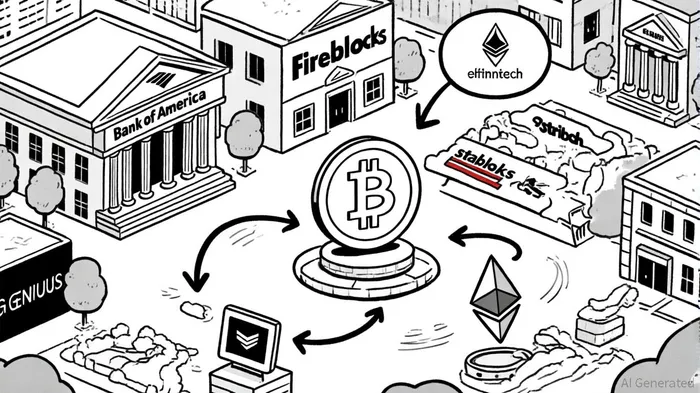







Comentarios
Aún no hay comentarios