
Bank of America's Recent Stock Decline: Strategic Entry or Cautionary Signal for Long-Term Investors?
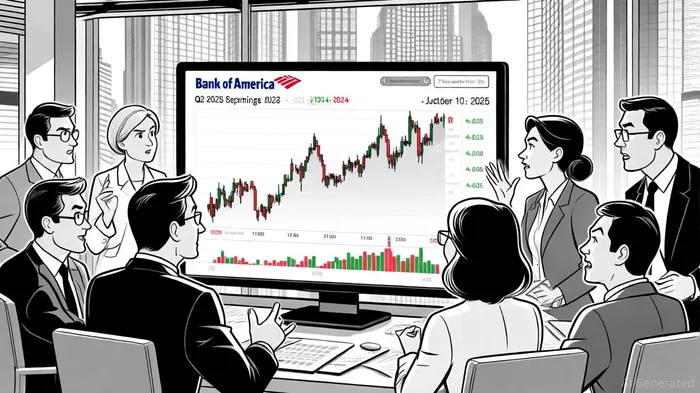
Bank of America's (NYSE:BAC) stock price has experienced a notable decline in late 2025, raising critical questions for long-term investors. After closing at $49.33 on September 5, 2025-a 2% drop from its previous close-the stock has continued to trade in a volatile range, dipping to $48.65 by October 10 amid broader macroeconomic uncertainties, according to a MarketBeat alert. This dip, coupled with mixed analyst sentiment and evolving financial metrics, demands a nuanced evaluation of whether the decline represents a strategic entry point or a cautionary signal.
Financial Performance: Mixed Signals Amid Structural Challenges
Bank of America's Q2 2025 earnings revealed a contraction in operating margins to 15.2% (down from 16.49% in 2023) and a net income margin decline to 14.1%, according to Monexa's analysis. These trends reflect broader industry pressures, including a 6% year-over-year drop in investment banking fees due to sluggish deal activity, according to a Finviz report. However, the bank has taken proactive steps to bolster investor confidence, including a $40 billion stock buyback program and a 25% increase in quarterly dividends to $0.28 per share in July 2025, as noted by the MarketBeat alert.
The recent stock price volatility-despite these measures-suggests lingering concerns. For instance, the MarketBeat alert reported trading volume on September 5 plummeted by 72% compared to the average session volume, signaling reduced short-term liquidity and cautious positioning. Meanwhile, the stock's 10-day price swing from $52.57 to $48.65 underscores sensitivity to macroeconomic narratives, including fears of Trump-era tariffs, a weakening labor market, and delayed Federal Reserve rate cuts, which the Finviz report also highlighted.
Historical data from 2022 to October 2025 reveals that BAC's stock has generated an average 30-day cumulative excess return of +2.5% relative to the S&P 500 following earnings reports, according to a backtest report. While this outperformance lacks statistical significance at the 95% confidence level, win-rate trends improve after day 6, peaking around day 20. These findings suggest that a buy-and-hold strategy post-earnings could capture modest gains over medium-term horizons, though short-term volatility remains a risk.
Valuation Metrics: A Tale of Two Perspectives
Bank of America's valuation metrics present a complex picture. Its trailing twelve months (TTM) P/E ratio of 14.53 as of September 9, 2025, exceeds both its 10-year average (12.08) and the industry average (13.71), as reported by the MarketBeat alert. This premium valuation, while supported by a 20% increase in P/E compared to prior quarters, also outpaces peers like Wells Fargo (13.53) and Citigroup (14.17), per the Finviz report. Analysts at Barclays and Morgan Stanley have raised price targets to $58 and $55.23, respectively, citing optimism about core revenue streams and operating leverage, a point the MarketBeat alert highlighted. Conversely, UBS maintains a "Hold" rating, warning that BAC's valuation may now be stretched, according to the MarketBeat alert.
The debt-to-equity ratio of 1.21 (as of June 30, 2025) further complicates the outlook. While within the bank's historical range (0.90–1.22), it ranks worse than 72.33% of its peers, amplifying risks related to interest rate sensitivity and liquidity constraints, the Finviz report found. In contrast, its ROE of 9.46%-though improved from a 12-month average of 8.32%-lags behind JPMorgan Chase's 16.16% and Wells Fargo's 11.36%, highlighting inefficiencies in capital utilization noted in the Finviz coverage.
Macro Risks and Strategic Resilience
The broader macroeconomic environment remains a double-edged sword. While Bank of America's CEO, Brian Moynihan, has signaled no immediate plans to step down and announced a $1.69 billion UK investment (expected to create 1,800 jobs), the bank faces regulatory headwinds. For example, it has warned of potential instability if stablecoin legislation favors crypto exchanges over traditional banks, a risk detailed in the MarketBeat alert. Additionally, the White House's proposed executive order penalizing banks for politically motivated customer dropouts could disrupt fee income streams, another concern highlighted by the MarketBeat alert.
Yet, the stock's recent dip may offer a discount for long-term investors. The consensus price target of $55.23 implies a potential 12% upside from its October 10 closing price of $48.65. This optimism is partly fueled by the bank's $40 billion buyback program, which could enhance shareholder value if earnings stabilize. However, the risk-reward calculus hinges on macroeconomic clarity: a delayed rate cut cycle or prolonged deal-making slump could exacerbate margin pressures, a point emphasized in the Finviz coverage.
Conclusion: A Cautious Opportunity
Bank of America's stock decline in late 2025 reflects a confluence of sector-specific challenges and macroeconomic uncertainties. While its valuation appears rich relative to historical averages and peers, the bank's capital return initiatives and strategic investments in growth markets (e.g., the UK) suggest a commitment to long-term resilience. For investors with a 3–5 year horizon, the current price may represent a strategic entry point-provided they are prepared to weather near-term volatility tied to interest rates, regulatory shifts, and investment banking headwinds.
However, the high debt-to-equity ratio and subpar ROE relative to peers underscore the need for disciplined risk management. Investors should monitor Q4 2025 earnings closely for signs of margin stabilization and track the Federal Reserve's rate-cut timeline. In a market where patience is rewarded, Bank of America's dip could prove to be a calculated opportunity-but one that demands vigilance.





Comentarios
Aún no hay comentarios