
Banco Bradesco's Digital Reinvention and Valuation Edge: A Case for Long-Term Investment in Brazil's Evolving Financial Sector
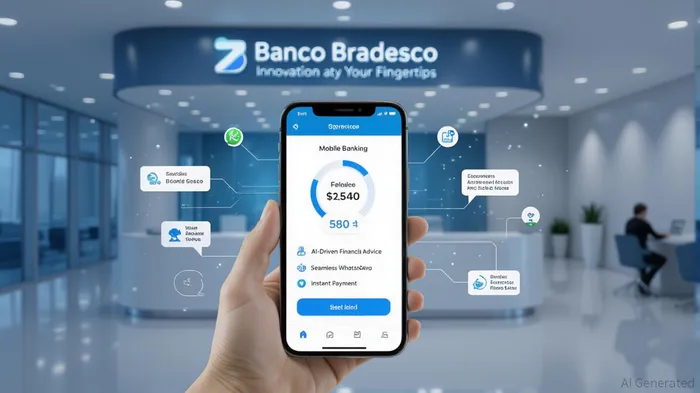
In the heart of Brazil's digital banking revolution, Banco BradescoBBDO-- (BBD) stands out as a rare blend of traditional financial strength and cutting-edge innovation. With a market capitalization of $68 billion and a price-to-book (P/B) ratio of 0.95—well below the sector average of 1.5—Bradesco has emerged as a compelling undervalued play for investors seeking exposure to Latin America's largest economy. But what makes this 93-year-old institution a long-term value proposition in an era of fintech disruption and macroeconomic headwinds?
Strategic Consolidation: From Cost-Cutting to AI-Driven Growth
Bradesco's recent Q2 2025 results reveal a company that has mastered the art of strategic consolidation. By migrating its analytics infrastructure to Tableau Cloud, the bank slashed campaign data-gathering time by 83% and reduced operating costs by $1.6 million annually. This shift not only improved operational efficiency but also enabled real-time decision-making, a critical edge in Brazil's hyper-competitive banking landscape. The bank's AI-powered chatbots, with a 90% customer retention rate, and smart WhatsApp payments—transferring funds in under 10 seconds—have redefined user experience, driving a 12% year-over-year improvement in its efficiency ratio to 49.7%.
These initiatives are part of a broader digital transformation that has diversified Bradesco's revenue streams. Insurance, pensions, and capitalization bonds now contribute 30% of total income, up from 18% in 2022. The insurance segment alone generated BRL30 billion in premiums in Q2 2025, a 32.7% YoY surge. This diversification insulates the bank from interest rate volatility, a critical factor in Brazil's high-inflation environment.
Financial Resilience Amid Macroeconomic Challenges
Despite Brazil's slowing GDP growth and stubborn inflation, Bradesco delivered a 15% YoY revenue increase to $9.91 billion in Q2 2025, with net interest income (NII) rising 13.7%. Its return on average equity (ROAE) jumped to 14.6% from 11.4% a year earlier, outpacing peers like Itaú Unibanco (ITUB) and SantanderBSBR-- Brasil (SANB4). The bank's 13.0% Tier I Basel ratio—a buffer against potential downturns—further underscores its financial discipline.
Bradesco's loan portfolio expanded 4.9% YoY, driven by a 30% surge in SME lending—a segment the bank has aggressively targeted through tailored digital solutions. This focus on high-growth, lower-risk segments aligns with Brazil's economic rebalancing toward small businesses and e-commerce.
Valuation Metrics and Market Momentum
At $2.8097 per share as of August 1, 2025, BBD trades at a trailing P/E of 8.43 and a forward P/E of 6.98, suggesting a discount to future earnings. Its P/B ratio of 0.95 implies the market is undervaluing its book equity, which has grown steadily despite Brazil's economic turbulence. Analysts have taken notice: a recent “Buy” rating from Spark with a $3.20 price target highlights the stock's upside potential, particularly as digital adoption in Brazil accelerates.
While the stock's 5-year return of 9.41% lags the benchmark's 28.69%, its YTD gain of 55.45%—versus the IBOVESPA's 10.10%—signals a turnaround. This momentum is fueled by Bradesco's strategic pivot to digital services and its ability to maintain profitability in a high-interest-rate environment.
Risks and the Road Ahead
No investment is without risk. Brazil's fiscal uncertainties and the central bank's 13.75% benchmark interest rate remain headwinds. However, Bradesco's proactive approach—such as 109% coverage of restructured loans via provisions and a 14.3% market share in payroll-deductible loans—demonstrates its resilience. The bank's revised 2025 guidance, which now projects 9%-13% growth in insurance and pension income, reflects confidence in its diversified model.
Investment Thesis: Buy and Hold
For long-term investors, Bradesco offers a rare combination of low valuation, strategic agility, and financial resilience. Its digital-first approach positions it to capture Brazil's $1.2 trillion fintech market, which is projected to grow at 18% annually. At current levels, the stock appears undervalued relative to its 10-year average annual return of 14% and its robust ROAE. While short-term volatility is inevitable, Bradesco's track record of navigating macroeconomic cycles—coupled with its AI-driven efficiency—makes it a compelling buy for portfolios seeking exposure to Brazil's digital banking boom.
In a market where digital transformation is no longer optional but existential, Banco Bradesco has not only kept pace—it has redefined the rules. For investors willing to look beyond near-term macro noise, this is a stock with the potential to deliver outsized returns over the next decade.







Comentarios
Aún no hay comentarios