
BANANA: Strategic Buying Opportunity Amid Key Support Holding and Emerging Supply Chain Tailwinds
The global banana market has entered a pivotal phase in late 2025, marked by robust price action confirmation and a confluence of policy-driven and supply chain catalysts. With the global price of bananas reported at $1,050.23 per metric ton as of December 2025, and U.S. import prices from Central and South America stabilizing at $1.157 per kilogram, the asset appears to be consolidating above critical support levels. This analysis explores how Fairtrade minimum price adjustments, U.S. tariff exemptions, and logistical advancements in banana-producing regions are creating a compelling strategic buying opportunity for investors.
Price Action Confirmation: Fairtrade Support Levels Holding Strong
Fairtrade International's updated minimum prices for bananas in 2025 have provided a clear floor for the market. The 6% increase at the Ex Works level and 4.6% increase at the FOB level-effective from January 1, 2026-were designed to offset rising production costs and ensure fair compensation for farmers. These adjustments build on prior years' trends: in 2023, Fairtrade prices surged by up to 11% at Ex Works and 7% at FOB, while 2024 saw more moderate gains of 0–4% at Ex Works and mixed results at FOB (−1% to −5%) according to data.
The December 2025 price of $1,050.23 per metric ton comfortably exceeds the 2024 FOB minimums, suggesting strong institutional support for the asset. This is further reinforced by the introduction of a $1-per-box development premium in 2024, which has incentivized sustainable practices and stabilized supply-side fundamentals. For investors, this indicates a structural floor beneath banana prices, reducing downside risk while positioning the market for potential upside from policy and supply chain shifts.
Policy-Driven Catalysts: U.S. Tariff Exemptions and Affordability Gains
A critical catalyst for banana affordability in 2025 has been the U.S. government's decision to exempt bananas and other agricultural products from reciprocal tariffs. Announced in November 2025 as part of trade agreements with major suppliers like Ecuador and Guatemala, this policy shift aims to counteract a 5.4% price surge driven by earlier tariffs. While experts caution that retail price reductions may be modest- estimates suggest a 2.6% cost savings for consumers-the removal of trade barriers has already stabilized import flows and reduced volatility.
The Trump administration's broader trade recalibration reflects a strategic pivot toward affordability, particularly as U.S. consumers face inflationary pressures. By exempting bananas- a staple with no domestic substitute-the policy ensures continued access to competitively priced imports. This not only supports demand but also mitigates the risk of supply shocks, which had previously driven banana prices up by 6.9% year-over-year in September 2025.
Supply Chain Tailwinds: Infrastructure and Innovation Driving Efficiency
Beyond policy, logistical improvements in banana-producing regions have emerged as a key tailwind. Investments in port facilities and logistics hubs in Latin America and Southeast Asia have reduced export lead times, while Ecuador's favorable weather and technological adoption have boosted exports by over 3% in 2025. 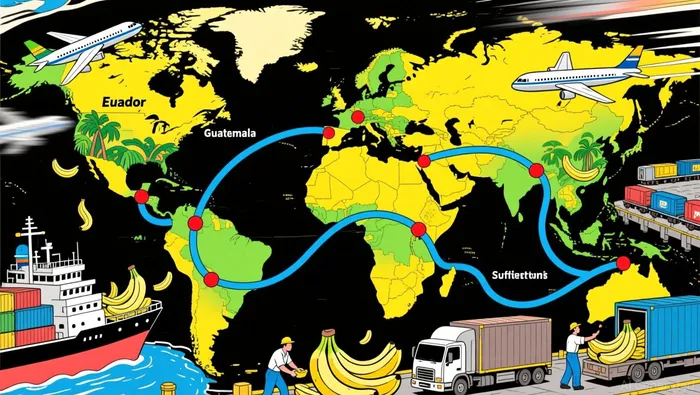 Precision agriculture and pest management innovations have further enhanced yield stability, reducing production costs and reinforcing supply resilience.
These advancements are critical in an industry historically vulnerable to weather disruptions and disease outbreaks. By addressing bottlenecks and improving productivity, the sector is better positioned to meet global demand without triggering price spikes. For investors, this translates to a more predictable and scalable supply chain, reducing the risk of sudden price corrections.
Conclusion: A Confluence of Support and Catalysts
The banana market in late 2025 presents a rare alignment of structural support and dynamic catalysts. Fairtrade's price floors have anchored the asset above critical levels, while U.S. tariff exemptions and supply chain innovations are creating a favorable environment for sustained growth. For investors, this represents a strategic entry point-a market where fundamentals are not only holding but accelerating.
As the industry transitions into 2026, the interplay of policy, sustainability, and logistics will likely drive further value creation. With global prices consolidating above key support levels and tailwinds intensifying, BANANA emerges as a compelling case study in agricultural market resilience.







Comentarios
Aún no hay comentarios