
The Balancer Hack and Tornado Cash: A Wake-Up Call for DeFi Security and Regulatory Preparedness
The Balancer Hack: A Security Crisis in Plain Sight
In September 2023, the Balancer protocol suffered a catastrophic exploit, with attackers draining $128 million from liquidity pools by leveraging a vulnerability in its smart contract code. Despite prior audits and security reviews, the hack revealed how even well-established DeFi platforms remain susceptible to sophisticated attacks. The incident followed a troubling pattern: similar breaches at Cetus ProtocolCETUS-- and Curve Finance highlighted the fragility of legacy code in an ecosystem where total value locked (TVL) has surged to $150 billion.
This vulnerability is not merely technical but systemic. Developers and industry experts have since emphasized the need for continuous code audits and proactive cybersecurity measures. As one Curve Finance engineer noted, "A single line of flawed code can unravel millions of dollars in assets." The hack has intensified calls for regulatory intervention, with proposals like the U.S. GENIUS Act and the EU's Digital Operational Resilience Act (DORA) pushing for identity-linked smart contracts to curb illicit activity.
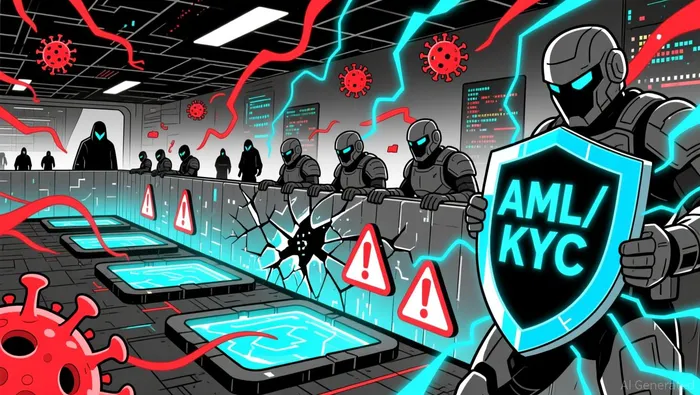
Tornado Cash Sanctions: Privacy vs. Compliance in the Crosshairs
The U.S. Treasury's 2022 sanctions against Tornado Cash-a decentralized mixer designed to anonymize cryptocurrency transactions-marked a turning point in DeFi regulation. OFAC cited the protocol's role in laundering over $7 billion in illicit funds, including proceeds from the Axie InfinityAXS-- hack and North Korea-linked cyberattacks according to policy analysis. The sanctions triggered an immediate 75% decline in Tornado Cash's transaction volume and user base as reported in technical analysis, but the legal and philosophical battle that followed exposed deeper tensions.
A Texas court's 2025 ruling that smart contracts cannot be sanctioned as "property" dealt a blow to OFAC's authority, arguing that code should be protected as free speech. While this decision emboldened the DeFi community, it also created regulatory ambiguity. The partial recovery of Tornado Cash's activity-marked by a 70% surge in its native token, TORN-reflects renewed investor confidence but also underscores the difficulty of curbing illicit use without stifling innovation.
The Regulatory Tightrope: Innovation or Overreach?
The Balancer Hack and Tornado Cash saga have accelerated global regulatory efforts to address DeFi's risks. The EU's DORA, for instance, mandates operational resilience standards for blockchain protocols, while the U.S. is exploring ways to embed KYC requirements directly into smart contracts according to industry reports. These measures aim to prevent money laundering and systemic shocks but risk alienating DeFi's core user base, which values pseudonymity.
The recent conviction of Tornado Cash co-founder Roman Storm for operating an unlicensed money transmission service further complicates the landscape. Developers now face a precarious balancing act: innovate without violating evolving compliance norms. As one industry analyst put it, "DeFi's future hinges on its ability to reconcile privacy with accountability."
Investment Implications: Preparing for the Next Wave
For investors, the lessons are clear. DeFi protocols lacking rigorous security audits or regulatory alignment are increasingly exposed to existential risks. Conversely, projects integrating AML/KYC frameworks-such as identity-verified liquidity pools or compliance-driven oracles-may gain a competitive edge. The Balancer Hack and Tornado Cash case studies illustrate that systemic risks in DeFi are no longer theoretical; they are material and growing.
Conclusion: A New Era of Responsibility
The DeFi revolution cannot thrive on innovation alone. As the Balancer Hack and Tornado Cash saga demonstrate, the sector's survival depends on addressing security flaws and embracing regulatory preparedness. For investors, this means prioritizing protocols that treat compliance as a feature, not an afterthought. For regulators, it requires crafting frameworks that protect users without stifling the decentralized ethos. The path forward is narrow, but the stakes-both financial and societal-are too high to ignore.







Comentarios
Aún no hay comentarios