
Baker Hughes' Strategic Win with NextDecade Signals a Critical Inflection Point in U.S. LNG Expansion
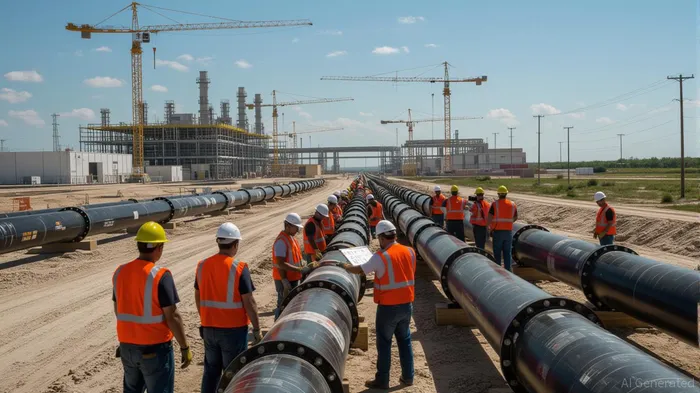
The recent contract win by Baker HughesBKR-- for NextDecade's Rio Grande LNG Facility marks a pivotal moment in the U.S. liquefied natural gas (LNG) sector, underscoring both the company's strategic positioning and the broader energy transition's momentum. By securing a framework agreement to supply gas turbines and compressors for Trains 4 through 8 of the Texas facility, Baker Hughes has not only solidified its role in a critical infrastructure project but also aligned itself with the surging global demand for cleaner energy. This deal, valued in the billions when considering the full scope of Trains 4–8, reflects the company's ability to capitalize on the U.S. LNG boom while navigating the complexities of decarbonization.
A Strategic Win with Long-Term Implications
The Rio Grande LNG expansion, which will add 18 million tonnes per annum (MTPA) of liquefaction capacity once completed, is emblematic of the U.S. LNG industry's trajectory. Baker Hughes' provision of Frame 7 gas turbines and centrifugal compressors for Train 4 replicates the technology used in the first three trains, ensuring operational consistency and reliability [1]. This approach minimizes technical risks, a critical factor in an industry where project delays and cost overruns are common. The partnership with Bechtel Energy Inc., the project's engineering firm, further reinforces confidence in the project's execution [1].
For investors, this contract is more than a short-term revenue boost. It positions Baker Hughes as a key enabler of U.S. LNG exports, which are projected to dominate global supply by 2030. According to J.P. Morgan Research, the U.S. is expected to produce over a third of the world's LNG by that year, driven by abundant natural gas reserves, low construction costs, and a skilled labor force [3]. Baker Hughes' role in this expansion aligns with its broader strategy to pivot toward high-margin energy transition markets, as evidenced by its recent $13.6 billion acquisition of Chart Industries—a move that vertically integrates its offerings in LNG and hydrogen technologies [3].
U.S. LNG Market Dynamics and Energy Transition Synergies
The U.S. LNG market is at a crossroads. While global supply is expected to grow by 350 billion cubic meters by 2030, the U.S. is uniquely positioned to lead this expansion. Deloitte's 2025 Oil and Gas Industry Outlook highlights the Permian Basin's role in alleviating takeaway constraints, enabling new pipeline projects to support LNG exports [1]. Additionally, rising demand for natural gas in power generation—particularly for data centers, which are projected to consume 9% of U.S. electricity by 2030—further strengthens the case for LNG infrastructure [1].
Baker Hughes' recent financial performance underscores its ability to capitalize on these trends. In Q2 2025, the company reported adjusted EBITDA of $1.21 billion, a 7% year-over-year increase, driven by robust demand in LNG and data center sectors [2]. Its Industrial & Energy Technology (IET) segment, which includes LNG projects, now accounts for a growing share of revenue, with analysts projecting $12.5–14.5 billion in IET orders for 2025 [1]. This shift is critical, as the energy transition accelerates and traditional oilfield services face headwinds from declining upstream spending.
Competitive Positioning and Investment Risks
Baker Hughes' competitive edge lies in its technological expertise and strategic acquisitions. The integration of Chart Industries' cryogenic and hydrogen technologies has expanded its capabilities in decarbonization, a key differentiator in an industry increasingly scrutinized for emissions [3]. By targeting a $1.5 trillion LNG market, the company is leveraging Chart's global project footprint—already present in 90% of LNG projects—to scale its offerings in emerging markets like Africa and the Middle East [3].
However, risks remain. The LNG market faces potential oversupply by 2030, with new projects adding 200 MTPA of capacity, according to a recent analysis [2]. Project execution risks, including delays and limited long-term offtake agreements, could dampen returns. For Baker Hughes, the challenge will be balancing growth in LNG with its pivot to lower-carbon solutions. While LNG is a transitional fuel, its long-term viability depends on the pace of renewable adoption and carbon capture technologies.
Conclusion: A Catalyst for Energy Transition and Shareholder Value
Baker Hughes' NextDecadeNEXT-- contract is more than a single deal—it is a catalyst for the company's transformation into an energy transition leader. By securing a role in one of the U.S.'s largest LNG projects, the company is aligning itself with the global shift toward cleaner energy while diversifying its revenue streams. The acquisition of Chart IndustriesGTLS-- and the recent $1.7 billion in LNG-related orders further reinforce this trajectory [1].
For investors, the key takeaway is clear: Baker Hughes is well-positioned to benefit from the U.S. LNG boom and the energy transition's dual imperatives of reliability and sustainability. While challenges such as market oversupply and project execution risks persist, the company's technological depth, strategic acquisitions, and focus on high-margin markets make it a compelling long-term investment. As the Rio Grande LNG expansion progresses, so too will Baker Hughes' role in shaping the future of global energy.





Comentarios
Aún no hay comentarios