
Baker Hughes' Strategic Spin-Off: A Catalyst for Reinvigorating Energy Innovation
The energy sector stands at a crossroads, with traditional hydrocarbon giants grappling to reconcile their legacy assets with the urgent demands of decarbonization. Baker HughesBKR--, the Houston-based industrial conglomerate, has long epitomized this tension. Its recent strategic pivot-a proposed spin-off of core business units-signals a bold attempt to reallocate capital, reposition within a fragmented energy transition, and reinvigorate innovation. While specifics on the 2024–2025 execution remain opaque, the broader logic of the move aligns with industry-wide pressures to adapt or stagnate.
Capital Reallocation: From Commodity to Premium
BakerHughes' spin-off strategy, though unconfirmed in recent filings or press releases, reflects a familiar playbook among industrial firms: divesting commoditized operations to fund high-margin, future-facing technologies. Historically, the company has oscillated between oilfield services and industrial diversification, often with mixed results. The current iteration, however, appears more deliberate. By isolating its conventional oil and gas operations, Baker Hughes could unlock liquidity to reinvest in digital energy solutions, carbon capture, and hydrogen infrastructure-sectors where it has already laid groundwork according to industry trends.
This approach mirrors strategies adopted by peers like Schlumberger and Halliburton, which have similarly sought to streamline portfolios amid declining E&P budgets. The logic is straightforward: in a world where institutional investors increasingly demand alignment with net-zero targets, capital tied to declining hydrocarbon demand must be redirected toward growth areas. For Baker Hughes, this means prioritizing technologies that serve both the "old" and "new" energy economies, such as enhanced oil recovery paired with carbon sequestration. 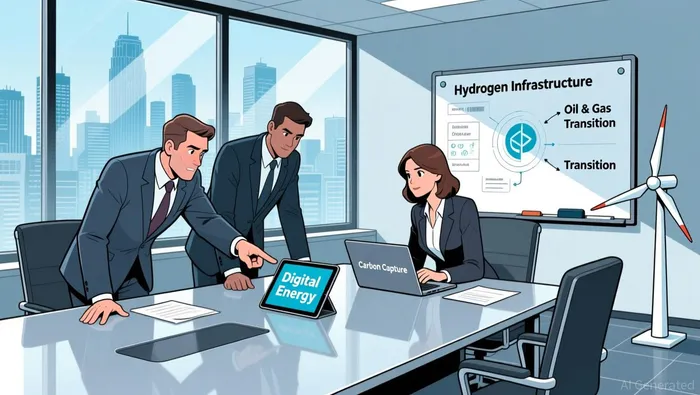
Sector Repositioning: Navigating a Fragmented Transition
The energy transition is neither linear nor monolithic. It is a mosaic of competing technologies, regulatory regimes, and market dynamics. By spinning off its traditional operations, Baker Hughes positions itself to target niches where it can exert influence. For instance, its digital oilfield division-already a leader in predictive analytics and automation-could gain sharper focus, enabling deeper integration with renewable energy grid management systems.
This repositioning also addresses a critical vulnerability: the company's historical identity as an oilfield services provider. While that heritage remains relevant in the short term, it risks overshadowing its capabilities in clean technology. A spin-off could allow Baker Hughes to rebrand as an energy-agnostic innovator, appealing to a broader investor base. This mirrors the trajectory of companies like Siemens Energy, which have successfully carved out hybrid identities bridging fossil fuels and renewables.
Energy Transition Alignment: Promise and Peril
The spin-off's success hinges on its ability to credibly commit to decarbonization. Analysts have long noted that corporate restructurings often prioritize short-term shareholder value over long-term sustainability goals according to analyst critiques. For Baker Hughes, the challenge will be ensuring that capital reallocation does not merely prop up transitional technologies but accelerates the shift to zero-emission solutions.
A key test will be its investment in hydrogen and geothermal energy-sectors where it has shown early promise but lacks the scale of competitors like Plug Power or Orsted. Without aggressive R&D spending and strategic partnerships, the spin-off risks becoming a "green" veneer for business-as-usual operations. Conversely, if executed with discipline, it could catalyze innovation in areas such as modular nuclear reactors or AI-driven grid optimization, where Baker Hughes holds latent expertise.
Conclusion: A High-Stakes Reimagining
Baker Hughes' spin-off represents more than a corporate restructuring; it is a statement of intent in an era of energy upheaval. By reallocating capital away from declining assets and repositioning for a fragmented transition, the company aims to transform itself from a relic of the hydrocarbon age into a pioneer of the next. Whether this vision materializes will depend on its ability to balance pragmatism with ambition-a task that demands both strategic clarity and operational rigor.
For investors, the spin-off offers a case study in industrial reinvention. In a sector where adaptability is survival, Baker Hughes' success could redefine the boundaries of what an energy innovator looks like in the 21st century.
Industry trends indicate that firms like Schlumberger and Halliburton have similarly prioritized digital and decarbonization-focused divisions in recent years.
Analyst critiques often highlight the risk of "greenwashing" in corporate energy transitions, where structural changes lack substantive environmental impact.





Comentarios
Aún no hay comentarios