
Bajaj Housing Finance's New 2-Year Bond Issuance and Its Strategic Implications
India's housing finance sector is undergoing a transformative phase in 2025, driven by structural reforms, favorable monetary policy, and surging demand for affordable housing. Bajaj Housing Finance Limited's recent 2-year bond issuance-priced at a 5.75% coupon rate and rated AAA by Crisil-has drawn significant attention as a benchmark for credit quality and yield efficiency in the sector. This analysis evaluates the strategic implications of Bajaj's issuance, contextualizing its pricing dynamics, creditworthiness, and alignment with broader market trends.
Credit Quality: A AAA-Backed Play on Stability
Bajaj's 5.75% coupon bond, maturing on April 21, 2025, is secured, non-convertible, and rated AAA by Crisil, reflecting the company's robust financial health and operational discipline, as noted in the Bajaj 5.75% bond. This rating is critical in a sector where credit risk remains a concern for investors. For context, India's housing finance market, valued at ₹33 trillion, is projected to grow at a CAGR of 15-16% through FY30, supported by improved asset quality and declining non-performing assets (GNPAs at 2.2% as of March 2024), according to a housing finance market projection. Bajaj's strong balance sheet-evidenced by a 24% year-on-year AUM increase to ₹1.26 trillion in Q2 FY26 and net profit growth of 53.85% to ₹586.68 crore-further underpins its credit profile, as documented in coverage of Bajaj AUM growth.
The bond's secured structure and AAA rating position it as a low-risk alternative to other HFCs, which have seen varying credit metrics. For instance, NIDO Home Finance recently issued debentures with coupon rates up to 11.00%, reflecting higher perceived risk, as reported in data on HFC bond issuances. Bajaj's ability to secure a sub-6% coupon underscores its market confidence and disciplined cost of capital.
Pricing Dynamics: Leveraging RBI Rate Cuts and Investor Appetite
The issuance's pricing is closely tied to India's broader monetary environment. The Reserve Bank of India (RBI) cut benchmark rates by 100 basis points between February and June 2025, reducing borrowing costs for corporates, as outlined in Indian bond market trends. This easing, combined with improved corporate creditworthiness (driven by IBC reforms), has made bonds like Bajaj's more attractive.
Bajaj's 5.75% coupon is notably competitive against government bond yields. As of October 2025, the India 2-Year Bond Yield stood at 5.65%, while Bajaj's coupon exceeds this by 10 bps, offering a yield premium without sacrificing credit quality (see the India 2-year yield). This spread reflects the sector's risk-return trade-off: investors demand a small premium for taking on corporate credit risk compared to sovereign bonds.
Moreover, the bond's greenshoe option of ₹5 billion (added to the base ₹10 billion issue size) indicates strong institutional and retail demand. With FPIs investing ₹1.21 trillion in corporate bonds in FY25 and digital platforms democratizing access, Bajaj's issuance taps into a liquidity-rich market.
Yield Opportunities: A Sector in Expansion Mode
India's housing finance sector is a magnet for capital, with HFC bond issuances surging 44% year-on-year to ₹45,700 crore in H1FY25 (Deccan Chronicle data). Bajaj's 5.75% coupon aligns with the sector's average yield range of 9-12% for longer-term instruments but stands out for its short duration and low-risk profile. For comparison, LIC Housing Finance's 7.57% October 2029 bond yielded 7.65% in secondary markets, as noted in the LIC Housing Finance bond, while NHB's 10-year bonds fetched 7.14%.
The strategic value of Bajaj's issuance lies in its alignment with macroeconomic tailwinds. Government programs like the Pradhan Mantri Awas Yojana (PMAY) have spurred affordable housing demand, with the segment accounting for 34% of the total market (₹10.6 trillion in outstanding loans as of Q3 FY24), as discussed in affordable housing trends. Bajaj's focus on tier-2/3 cities-where 60% of India's housing market lies-positions it to capitalize on this growth while maintaining disciplined risk management.
Strategic Implications: Balancing Growth and Competition
While Bajaj's bond issuance is a tactical win, the company faces intensifying competition from banks and NBFCs. For example, HDFC Housing Finance offers home loans starting at 8.75%, and banks like SBI and ICICI have competitive rates with faster rate transmission, according to a home loan rate comparison. However, Bajaj's digital infrastructure, low NPAs (0.29% gross), and parentage under Bajaj Finance Limited provide a structural edge.
The issuance also supports Bajaj's liquidity needs as it scales. With gross disbursements up 32% year-on-year to ₹15,900 crore in Q2 FY26, the company requires cost-effective funding to sustain growth, as reported in the Q2 disbursements. By locking in a 5.75% coupon, Bajaj secures favorable terms amid a tightening credit environment, where HFCs' cost of funds rose to 7.6% in FY24.
Conclusion: A Benchmark for the Sector
Bajaj Housing Finance's 2-year bond issuance exemplifies the maturation of India's housing finance market. Its AAA rating, competitive coupon, and alignment with macroeconomic trends make it a compelling addition to fixed-income portfolios. For investors, the bond represents a rare combination of yield, safety, and sectoral growth potential. As the market projects ₹11 trillion in corporate bond issuances for FY26, Bajaj's disciplined approach sets a benchmark for peers navigating this dynamic landscape.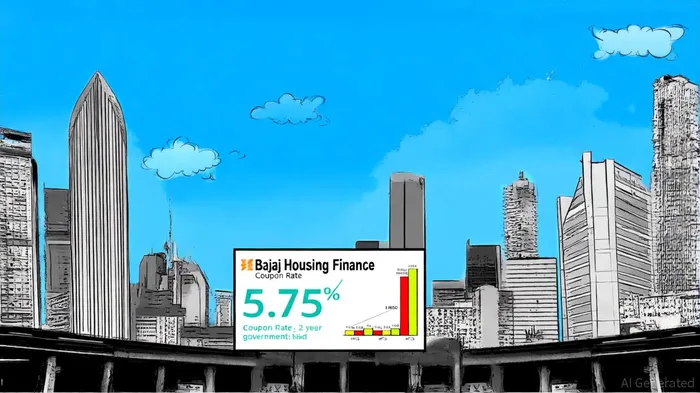







Comentarios
Aún no hay comentarios