
Bajaj Auto's Resilience and Strategic Diversification: A High-Conviction Long-Term Play in India's Mobility Evolution
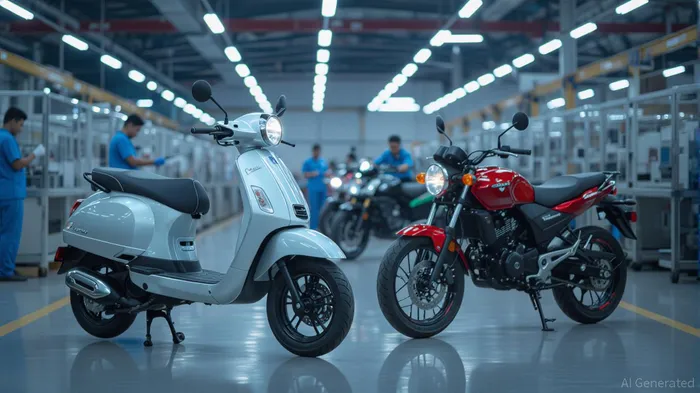
In the face of a volatile global economy and a domestically challenged Indian two-wheeler market, Bajaj Auto has emerged as a case study in resilience. The company's ability to navigate macroeconomic turbulence—ranging from foreign exchange volatility to domestic demand softness—while accelerating its pivot to electric vehicles (EVs) and maintaining a balanced product portfolio, positions it as a compelling long-term investment. For investors seeking exposure to India's evolving mobility landscape, Bajaj Auto's strategic diversification offers a blueprint for sustainable growth.
Navigating Global and Domestic Headwinds
Bajaj Auto's FY25 performance underscores its adaptability. While domestic sales dipped 13% in July 2025, reflecting broader industry challenges like subdued consumer demand and competitive pressures in the 125cc+ segment, the company's export business rebounded sharply. Total exports surged to 1.86 million units in FY25, a 13% year-to-date increase, driven by double-digit growth in motorcycles and commercial vehicles. The LATAM region, in particular, became a breakout market, achieving record motorcycle sales, while Asia and West Africa also posted robust gains.
Domestically, the company is recalibrating its strategy. The launch of the Freedom CNG motorcycle—a world-first innovation offering 102 km/kg range and 26% lower CO2 emissions—addresses both cost-conscious and environmentally aware consumers. Meanwhile, the Union Budget 2025's revised income threshold for tax rebates is expected to gradually stimulate discretionary spending, a tailwind for Bajaj's premium and mass-market offerings.
EV Leadership: A Cornerstone of Future Growth
Bajaj Auto's EV strategy is nothing short of aggressive. In FY26, the company plans to allocate 60% of its ₹700 crore capex to its EV business, with ₹420 crore earmarked for R&D and new product launches. This focus is paying off: the Chetak electric scooter, now the top-selling EV in India, sold 260,033 units in FY25—a 125% jump from FY24. The Chetak 35 series, with its floorboard battery design and 950W charger, has captured 21.8% of the E2W market, while the rebranded GoGo E3W line grew 376% in FY25, contributing ₹5,500 crore in EV revenue (20% of total sales).
The company's R&D pipeline is equally impressive. A new floorboard platform for E2Ws, advanced battery technology, and solutions to rare earth magnet shortages highlight Bajaj's commitment to cost optimization and supply chain resilience. These innovations are critical as India's EV market, projected to grow at a 25% CAGR through 2030, becomes increasingly competitive.
Balancing Mass-Market and Premium Offerings
Bajaj Auto's dual strategy—combining affordability with premium differentiation—ensures it caters to both price-sensitive and aspirational consumers. In the mass-market segment, models like the Pulsar series and Qute four-wheeler dominate with aggressive pricing and extensive dealership networks. The company's 78% market share in three-wheelers further anchors its domestic footprint.
Conversely, the premium segment is bolstered by the integration of KTM and Husqvarna, which offer high-performance motorcycles like the Pulsar NS 400 and Dominar 400. These models, priced at a premium, serve as lifestyle statements and contribute to brand equity. Notably, Bajaj's EV lineup is also straddling both segments: the Chetak 3001, priced at ₹99,990, targets mass-market affordability, while higher-tier variants with advanced features cater to premium demand.
Export-Driven Resilience and Global Expansion
Exports remain a critical pillar of Bajaj's growth. The company's 40% export sales contribution—up 13% year-to-date in FY25—reflects its ability to capitalize on international demand. Brazil's Manaus plant, producing 20,000 units annually, and a 70% sales surge in the Philippines exemplify its regional diversification. Latin America, now a key growth driver, has offset domestic headwinds and provided a buffer against rupee strengthening.
However, margin pressures persist. Competitive pricing in export markets and input cost inflation—particularly from OBD2B compliance—necessitate continued cost discipline. Bajaj's focus on high-margin EVs and premium models will be crucial in maintaining profitability as global markets mature.
Investment Thesis: A High-Conviction Play
Bajaj Auto's strategic pillars—EV leadership, export resilience, and a balanced product portfolio—position it as a high-conviction long-term investment. Key catalysts include:
1. EV Market Capture: With 60% of FY26 capex allocated to EVs, Bajaj is well-positioned to outpace rivals in India's rapidly electrifying two- and three-wheeler segments.
2. Export Diversification: Growth in LATAM, Asia, and Africa provides a buffer against domestic volatility.
3. Premium Brand Equity: KTM and Husqvarna integration enhances margins and brand strength.
Risks include domestic demand stagnation and EV competition from startups like Ola Electric. However, Bajaj's R&D focus, supply chain agility, and first-mover advantage in CNG and EVs mitigate these concerns.
Conclusion
For investors, Bajaj Auto represents a rare combination of resilience and innovation. Its ability to adapt to macroeconomic headwinds while pioneering India's mobility transition—through EVs, CNG, and a dual-market product strategy—makes it a standout in the auto sector. As the company scales its EV ambitions and expands globally, its long-term growth trajectory appears firmly intact. In a market where adaptability is key, Bajaj Auto's strategic diversification is not just a survival tactic—it's a recipe for sustained outperformance.







Comentarios
Aún no hay comentarios