
Baidu’s CNY4.4 Billion Bond Offering: Strategic Refinancing and AI Expansion in a Low-Yield Environment
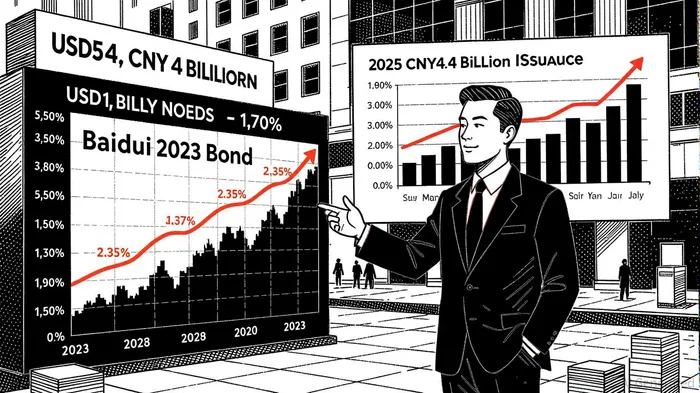
In a global capital markets landscape defined by persistently low interest rates and cautious investor sentiment, BaiduBIDU--, Inc. has executed a strategic refinancing maneuver with its recent CNY4.4 billion offshore RMB-denominated bond offering. Priced at a 1.90% coupon and maturing in 2029, the issuance underscores the company’s ability to secure favorable financing terms while aligning with its long-term ambitions in artificial intelligence (AI) and autonomous driving. This move, however, raises critical questions about the balance between capital structure optimization and the risks of overleveraging in a sector marked by high R&D costs and uncertain returns.
Strategic Refinancing in a Low-Yield Environment
Baidu’s latest bond offering reflects a calculated response to the current low-yield environment. By securing debt at 1.90%, the company has locked in historically competitive rates, a stark contrast to its 2022 USD700 million bond, which carried a 2.375% coupon [1]. This reduction in borrowing costs is not merely a function of macroeconomic conditions but a testament to Baidu’s improved credit profile and investor confidence in its AI-driven transformation. The offshore structure, governed by Regulation S of the U.S. Securities Act, further diversifies Baidu’s funding sources, mitigating currency and regulatory risks while appealing to non-U.S. investors seeking yield in emerging markets [1].
The proceeds from the offering will be allocated to general corporate purposes, including the repayment of existing indebtedness and interest payments [1]. This approach aligns with Baidu’s broader strategy to reduce its debt burden. As of December 31, 2023, the company maintained a debt-to-equity ratio of 0.62, a relatively balanced metric that suggests prudence in leveraging debt versus equity [1]. However, with total debt amounting to CNY77.115 billion—of which CNY69.801 billion is long-term borrowing—the new issuance will likely extend the maturity profile of its liabilities, reducing refinancing risks in the near term [1].
AI Expansion: A High-Stakes Bet on the Future
While the bond offering serves immediate financial needs, its strategic value lies in its role as a funding vehicle for Baidu’s AI ambitions. In 2024, the company allocated RMB22.1 billion—17% of total revenue—to R&D, with a significant portion directed toward AI Cloud, Apollo Go (autonomous driving), and the ERNIE series of large language models [1]. The proceeds from the CNY4.4 billion bond will further accelerate these initiatives, enabling Baidu to compete with global tech giants in the AI arms race.
This focus on AI is not speculative but operational. Baidu’s AI Cloud business, for instance, has already generated revenue through enterprise solutions, while Apollo Go’s autonomous ride-hailing services are expanding in major Chinese cities. The company’s ERNIE models, now in their fourth iteration, are being integrated into consumer products, enhancing user engagement and monetization potential. By securing long-term, low-cost capital, Baidu can sustain these high-margin, high-impact projects without diluting equity or overburdening short-term liquidity.
Shareholder Returns and Financial Prudence
Critics may argue that Baidu’s aggressive R&D spending and debt accumulation could strain its balance sheet. Yet, the company has demonstrated a disciplined approach to capital allocation. In 2024 alone, it returned USD1 billion to shareholders through buybacks, including USD356 million in the fourth quarter [1]. This dual focus on growth and returns suggests a mature understanding of investor expectations, particularly in a market where AI-driven narratives often struggle to translate into immediate profitability.
The March 2025 issuance of USD2 billion in bonds—part of which funded these shareholder returns—further illustrates Baidu’s ability to balance competing priorities [1]. By diversifying its debt instruments (including zero-coupon exchangeable bonds tied to Trip.com shares), the company mitigates refinancing risks while maintaining flexibility in capital deployment [2].
Conclusion: A Calculated Path Forward
Baidu’s CNY4.4 billion bond offering is more than a refinancing exercise; it is a strategic pivot in a low-yield world. By securing favorable terms, the company has positioned itself to optimize its capital structure while fueling AI innovation—a critical differentiator in an increasingly competitive tech landscape. However, the long-term success of this strategy will depend on Baidu’s ability to convert its R&D investments into scalable, profitable products. For investors, the key takeaway is clear: Baidu is betting on a future where AI drives growth, and its financial architecture is being reengineered to support that vision.
Source:
[1] Baidu Announces Pricing of CNY4.4 Billion CNY-Denominated Senior Notes [https://www.prnewswire.com/news-releases/baidu-announces-pricing-of-cny4-4-billion-cny-denominated-senior-notes-302549375.html]
[2] EX-10.2 [https://www.sec.gov/Archives/edgar/data/1329099/000119312525055604/d942864dex102.htm]





Comentarios
Aún no hay comentarios