
Baidu's AI Ecosystem and ERNIE X1.1: A Strategic Catalyst for Long-Term Growth
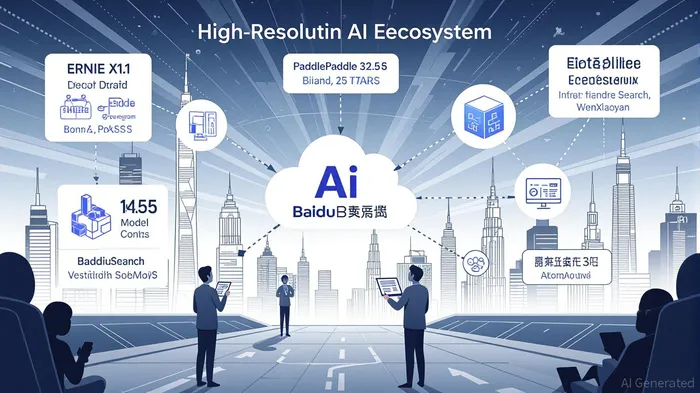
Baidu's recent advancements in AI infrastructure and developer ecosystem expansion position it as a formidable player in the global AI race. With the launch of ERNIE X1.1 and complementary tools like PaddlePaddle 3.2 and BaiduBIDU-- Comate 3.5S, the company is not only enhancing its technical capabilities but also strategically building a robust foundation for long-term growth. For investors, this represents a compelling case study in how a full-stack AI approach can drive both innovation and market dominance.
AI Infrastructure: Precision, Performance, and Cost Efficiency
Baidu's ERNIE X1.1 is a breakthrough in reasoning capabilities, offering a 34.8% improvement in factuality, a 12.5% boost in instruction following, and a 9.6% enhancement in agentic capabilities compared to its predecessor, ERNIE X1 [1]. These metrics place it on par with industry leaders like GPT-5 and Gemini 2.5 Pro while undercutting their operational costs by 99% [1]. The model's iterative hybrid reinforcement learning framework—combining mixed reinforcement learning and iterative self-distillation—ensures it remains adaptable to real-world use cases, from complex calculations to literary creation [1].
ERNIE X1.1's integration with Baidu's product ecosystem, including Baidu Search and the Wenxiaoyan app, further amplifies its utility. By embedding AI into core user-facing services, Baidu is not only improving user experiences but also creating a flywheel effect: enhanced search capabilities drive engagement, which in turn generates more data to refine the models. This closed-loop system is a hallmark of sustainable AI growth.
Developer Ecosystem: Scaling Through Openness and Tools
Baidu's strategy extends beyond models to a comprehensive developer ecosystem. The release of PaddlePaddle 3.2—with computational optimizations, parallel strategies, and native fault tolerance—has significantly improved training efficiency, supporting 23.33 million developers and 760,000 enterprises [1]. This framework's seamless integration with the PaddlePaddle-ERNIE ecosystem ensures that developers can leverage cutting-edge AI without reinventing the wheel.
The open-sourcing of ERNIE 4.5 under the Apache 2.0 license is another masterstroke. By offering 10 model variants (ranging from 0.3B to 424B parameters), Baidu is democratizing access to its AI stack while fostering innovation. The lightweight ERNIE-4.5-21B-A3B-Thinking model, optimized for complex reasoning with a 128K context window, further broadens the appeal to enterprises and researchers [1].
Complementing these efforts is Baidu Comate 3.5S, an AI coding assistant that enhances multi-agent collaboration. With over 10 million developers already using it, Comate 3.5S is a testament to Baidu's ability to turn AI into a productivity multiplier. By reducing the friction in software development, Baidu is not only accelerating its own product iterations but also empowering third-party developers to build on its ecosystem.
Competitive Positioning: Full-Stack vs. Specialized Playbooks
In the Chinese AI landscape, Baidu faces stiff competition from AlibabaBABA-- and Tencent. Alibaba's Tongyi Qianwen excels in enterprise integration, while Tencent's Hunyuan leverages its vast user base for AI-as-a-service. However, Baidu's full-stack approach—spanning infrastructure (PaddlePaddle), models (ERNIE series), applications (Qianfan, ApolloAPO-- Go), and tools (Comate)—creates a unique moat.
Unlike rivals focused on verticalized applications, Baidu's strategy prioritizes horizontal scalability. For instance, the Qianfan MaaS platform allows enterprise clients to deploy ERNIE X1.1 for tasks ranging from document Q&A to AI image generation, ensuring broad applicability. This versatility is critical in a market where AI adoption is still nascent but growing rapidly.
Long-Term Growth: A Flywheel of Innovation and Adoption
Baidu's 2025 roadmap underscores its commitment to long-term growth. By investing in data centers, cloud infrastructure, and next-generation models, the company is future-proofing its AI stack. The open-sourcing of ERNIE 4.5 and the planned integration into Baidu Search and Wenxiaoyan signal a dual focus: driving user engagement while fostering developer loyalty.
For investors, the key takeaway is clear: Baidu's AI ecosystem is not just a collection of tools but a strategic asset. The interplay between advanced models, developer-friendly frameworks, and real-world applications creates a self-reinforcing cycle of innovation and adoption. As AI becomes a cornerstone of global tech, Baidu's full-stack approach positions it to capture significant value.
Conclusion
Baidu's AI ecosystem, anchored by ERNIE X1.1 and bolstered by a thriving developer community, represents a strategic catalyst for long-term growth. By combining technical excellence with ecosystem-driven scalability, the company is not only competing with global giants but also redefining the AI landscape in China. For investors seeking exposure to the next phase of AI-driven disruption, Baidu's stock offers a compelling thesis rooted in innovation, execution, and strategic foresight.





Comentarios
Aún no hay comentarios