
BAE Systems' Strategic Shipbuilding Surge: Powering Through Global Defense Demand
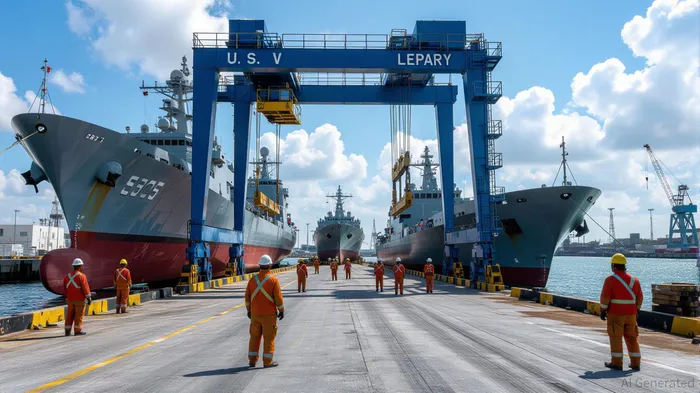
The global defense sector is undergoing a seismic shift, driven by escalating geopolitical tensions and a relentless push for modernization. As military expenditures climb to unprecedented levels, defense contractors like BAE Systems are accelerating investments in shipbuilding to meet surging demand. With 2025 marking a pivotal year for industrial expansion, BAE's strategic moves offer a compelling case study for investors navigating the intersection of defense growth and maritime innovation.
BAE Systems: A Dual-Pronged Approach to Capacity Expansion
BAE Systems has emerged as a linchpin in the global shipbuilding landscape, leveraging dual investments in the U.S. and U.K. to fortify its position. In 2025, the company laid the keel of HMS Dreadnought, the first of four nuclear-powered submarines for the Royal Navy's Dreadnought Class, at its Barrow-in-Furness shipyard[2]. This project, central to the UK's AUKUS partnership with Australia and the U.S., underscores BAE's role in advancing next-generation undersea capabilities[4].
Simultaneously, BAE is expanding its Jacksonville, Florida shipyard with a $250 million investment in a new shiplift and land-level repair complex[2]. This facility, designed to service U.S. Navy vessels and commercial ships, reflects the company's dual focus on defense and commercial markets. In the U.K., the completion of the Janet Harvey Hall in Glasgow—a shipbuild hall enabling the simultaneous construction of two Type 26 frigates—further amplifies BAE's capacity to deliver advanced surface combatants[2].
These initiatives align with a broader trend of industrial modernization. As Breaking Defense notes, the AUKUS submarine initiative hinges on “significant shipbuilding investment,” with BAE's U.K. facilities serving as critical nodes in this supply chain[4].
Global Defense Growth: A Tailwind for Shipbuilders
The urgency behind BAE's expansion is fueled by robust global defense spending. According to a report by MarketsandMarkets, global military expenditures reached $2.56 trillion in 2024 and are projected to hit $2.68 trillion in 2025, growing at a compound annual rate of 4.9%[1]. This surge is driven by heightened threat perceptions in regions like Asia, the Middle East, and Europe, where nations are prioritizing naval modernization to secure maritime trade routes and deter adversaries.
Notably, the defense sector's pivot toward multidomain operations has intensified demand for advanced naval platforms. Hypersonic technologies, autonomous systems, and AI-driven command structures are reshaping ship design, creating a niche for companies like BAE that can integrate cutting-edge capabilities into traditional platforms[1].
Navigating the Shipbuilding Industry's Contradictions
While the defense sector's optimism is well-founded, the broader shipbuilding industry faces a paradox. Despite a record $90 billion in new vessel orders in 2025—driven by commercial shipping giants like Maersk and MSC—revenue growth for the global shipbuilding sector is projected to decline by -1.2% in 2025[3]. This discrepancy highlights a looming overcapacity risk as new deliveries outpace demand[3].
However, defense-focused shipbuilders like BAE are insulated from these commercial headwinds. Their contracts, often secured through long-term government partnerships, provide stable revenue streams. For instance, the U.S. Navy's requirement to maintain and modernize its fleet—coupled with the UK's commitment to the Dreadnought Class—ensures sustained demand for BAE's services[2].
Strategic Implications for Investors
BAE's strategic investments position it as a key beneficiary of the defense sector's transformation. By expanding capacity in both the U.S. and U.K., the company is not only addressing immediate demand but also future-proofing its operations against geopolitical volatility. For investors, this dual focus on defense and commercial shipbuilding offers a balanced risk profile, with defense contracts providing stability and commercial ventures offering growth potential.
Moreover, BAE's alignment with global initiatives like AUKUS and its emphasis on technological integration—such as AI and autonomous systems—position it to capture market share in high-margin segments. As the defense industry shifts toward multidomain operations and unmanned systems, BAE's ability to innovate will be critical to sustaining its competitive edge[1].
Conclusion
The convergence of rising defense budgets, geopolitical instability, and technological innovation is creating a fertile ground for shipbuilders like BAE Systems. While the broader shipbuilding industry grapples with overcapacity risks, BAE's defense-centric strategy ensures a steady pipeline of high-value contracts. For investors, the company's 2025 expansion efforts represent a calculated bet on the future of maritime security—a sector poised to play a defining role in the 21st-century global order.







Comentarios
Aún no hay comentarios