
Babylon's Tokenomics Overhaul and Its Implications for Long-Term Value Accretion
Strategic Inflation Reduction: A Foundation for Stability
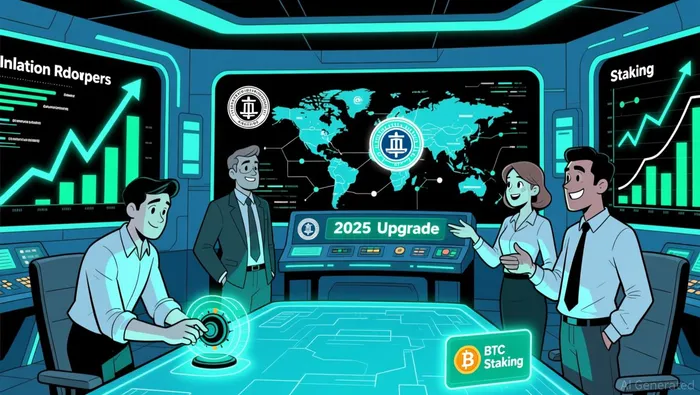
Babylon's decision to lower BABY's inflation rate from 8% to 5.5% directly addresses a critical vulnerability in many blockchain economies: excessive token dilution. By reducing the annual minting of new tokens, the protocol mitigates downward pressure on BABY's value while preserving staking rewards for participants. This adjustment is particularly significant in the context of institutional adoption, where predictability and capital efficiency are paramount. According to a report from Lookonchain, the 2.5 billion reduction in yearly token issuance creates a more defensible economic model, one that balances network security with token holder interests.
The inflation reduction is complemented by the introduction of co-staking, a mechanism that rewards users for simultaneously staking BTC and BABY. This dual-staking model not only enhances network security by leveraging Bitcoin's hashpower but also incentivizes BABY holders to lock their tokens for extended periods, further stabilizing supply dynamics. For institutions, co-staking offers a dual yield stream-BABY rewards and potential Bitcoin-based returns-without requiring them to relinquish custody of their assets.
Reward Optimization and Flexibility: The BTC Staking Extension
Babylon's BTC Staking Extension represents a technical innovation that directly addresses user flexibility. By allowing BTC stakers to extend their lock-up periods without unlocking their assets, the protocol reduces friction in participation while encouraging deeper engagement. This feature is particularly appealing to institutional players, who often require long-term, risk-managed strategies to align with regulatory and portfolio objectives.
The staking process itself is designed with institutional-grade security in mind. BTC is locked in time-locked Taproot outputs (UTXOs) on the BitcoinBTC-- blockchain, ensuring that stakers retain full control over their private keys as detailed in Babylon's documentation. Rewards are distributed in BABY tokens, with future plans to expand to multi-staking rewards from Bitcoin Supercharged Networks (BSNs). This layered approach-combining Bitcoin's security with Babylon's reward mechanisms-creates a hybrid model that bridges the gap between traditional finance and decentralized infrastructure.
Institutional Adoption: Compliance-Driven Partnerships
The 2025 upgrade's impact on institutional adoption is perhaps best illustrated by Babylon's partnership with Colossus Digital and Validation Cloud a strategic collaboration. This collaboration enables institutions to stake Babylon's tokens directly from custodial accounts, a critical requirement for entities bound by strict compliance frameworks. By integrating with Validation Cloud's SOC 2 Type II–certified infrastructure, Babylon offers institutions a 99.99% uptime guarantee, addressing a key barrier to entry in the staking space.
Analyst reports highlight that such partnerships unlock previously inactive institutional capital by resolving custody and regulatory concerns. For example, institutions can now generate on-chain yields across over 50 blockchain networks-including Babylon-without exposing their private keys to third parties. This development is particularly significant in a post-2025 landscape where institutional participation in crypto is increasingly contingent on compliance-ready infrastructure.
Analyst Insights: A Convergence of Economics and Infrastructure
While direct analyst quotes on Babylon's 2025 overhaul are sparse, broader industry trends underscore the protocol's strategic alignment with institutional priorities. As noted in a recent report by GlobeNewswire, the integration of custody-controlled staking solutions has become a "defining factor" in institutional onboarding. By reducing inflationary pressures and offering flexible, secure staking options, Babylon has positioned itself at the intersection of these trends.
Moreover, the protocol's emphasis on decentralization-evidenced by its support for 250 globally distributed Finality Providers as described in Babylon's documentation-aligns with institutional demands for resilient, open-source infrastructure. This focus on decentralization, combined with the economic safeguards of reduced inflation and optimized rewards, creates a flywheel effect: higher participation drives network security, which in turn attracts more institutional capital.
Conclusion: A Model for Sustainable Value Creation
Babylon's 2025 tokenomics overhaul exemplifies a forward-thinking approach to blockchain economics. By strategically reducing inflation, optimizing reward structures, and prioritizing institutional-grade compliance, the protocol has laid the groundwork for long-term value accretion. For investors, this represents a rare confluence of technical innovation and market readiness-a project that not only addresses internal economic challenges but also aligns with the external demands of a maturing crypto ecosystem.
As institutional adoption continues to accelerate, Babylon's ability to balance security, flexibility, and sustainability will likely serve as a benchmark for other blockchain projects seeking to bridge the gap between decentralized innovation and traditional finance.






Comentarios
Aún no hay comentarios