
Baazar Style Retail: Disrupting Fragmented Markets with Scalable EBITDA Efficiency
The global retail sector, valued at USD 27.26 trillion in 2025, is undergoing a seismic shift driven by e-commerce growth, omnichannel integration, and shifting consumer priorities, according to a Baazar Style Retail thread. Amid this transformation, Baazar Style Retail Ltd (BSRL) has emerged as a compelling case study in how a value-focused player can disrupt fragmented markets through strategic scalability and EBITDA efficiency. For investors, the company's journey offers critical insights into navigating a sector where 81.6% of U.S. retail sales still occur in physical stores, yet digital innovation continues to redefine competitive dynamics, according to retail statistics.
Strategic Expansion in a Fragmented Landscape
BSRL's operational playbook is anchored in two pillars: cluster-based store expansion and private label dominance. By targeting Tier 2-4 cities-where organized retail penetration remains low-the company has capitalized on untapped demand for affordable, curated fashion. This approach aligns with broader industry trends, per a JLL grocery tracker showing grocery-anchored retail in India's secondary cities with a 3.5% vacancy rate, underscoring the resilience of localized commerce. BSRL's 24% YoY revenue growth in Q3FY25 and 33% growth in 9MFY25, as noted in the ValuePickr thread, validates its ability to convert this potential into scalable value.
The company's focus on private labels-now accounting for 44% of total sales per the ValuePickr thread-further amplifies its margin structure. In a sector where 71% of retailers prioritize sustainability, according to a DataM Intelligence report, BSRL's private label strategy not only reduces dependency on third-party suppliers but also allows for tighter control over cost structures and brand identity. This is particularly relevant in India, where the value retail market is projected to grow from INR 2.65 lakh crore in FY2023 to INR 4.58 lakh crore by FY2027, according to the JLL grocery tracker.
EBITDA Efficiency: A Balancing Act
While BSRL's revenue growth is impressive, its EBITDA efficiency metrics tell a more nuanced story. Despite a 40.3% YoY rise in expenses to ₹377.15 crores reported in the ValuePickr thread, the company maintained a projected EBITDA margin of 13% for mature stores, per the JLL grocery tracker. This resilience is critical in a fragmented market where unit economics often struggle to scale. For context, Walmart's 2025 global net sales of USD 681 billion (noted in the retail statistics) are supported by a vastly different scale, but BSRL's ability to achieve double-digit EBITDA margins in a hyper-competitive Indian market demonstrates operational discipline.
However, challenges persist. A warehouse fire in Q1FY25 and festive season inventory pressures temporarily compressed margins, according to the JLL grocery tracker, while a Q4FY25 net loss of Rs 6.39 crore (reported in the retail statistics) highlights the risks of rapid expansion. These hiccups, though, appear to be short-term headwinds. The company's FY25 consolidated net profit of Rs 14.66 crore (as cited in the retail statistics) and plans to open 45–50 new stores by FY25, according to the JLL grocery tracker, suggest a long-term strategy focused on volume-driven margin normalization.
Market Disruption and Future Outlook
BSRL's disruption potential lies in its ability to merge digital agility with physical retail fundamentals. In a sector where 91% of chief economists anticipate weak U.S. growth (noted in the ValuePickr thread), consumers increasingly seek value-led propositions-a niche BSRL has mastered. Its cluster-based model reduces logistics costs and enhances customer retention, while AI-driven inventory management (a trend gaining traction globally, per Business Research Insights) ensures demand responsiveness.
Yet, the path forward is not without risks. Rising employee costs (up 34% YoY, reported in the retail statistics) and exceptional losses from operational incidents could test the company's financial flexibility. Investors must also weigh the broader macroeconomic context: India's value retail sector, while growing, remains sensitive to inflationary pressures and consumer spending cycles.
Conclusion: A High-Conviction Play in a Dynamic Sector
Baazar Style Retail's rapid expansion and EBITDA efficiency position it as a disruptor in a fragmented retail landscape. By leveraging Tier 2-4 market growth, private label margins, and scalable unit economics, the company is well-aligned with both local and global retail trends. For investors, the key question is whether BSRL can sustain its 13% EBITDA margins, as reported by the JLL grocery tracker, while scaling to 45–50 new stores. If successful, the company could mirror the trajectory of global giants like Costco, which thrive on value-driven, high-turnover models. However, prudence is warranted: the retail sector's volatility-exacerbated by economic uncertainty and operational risks-demands a balanced approach to capital allocation and risk management.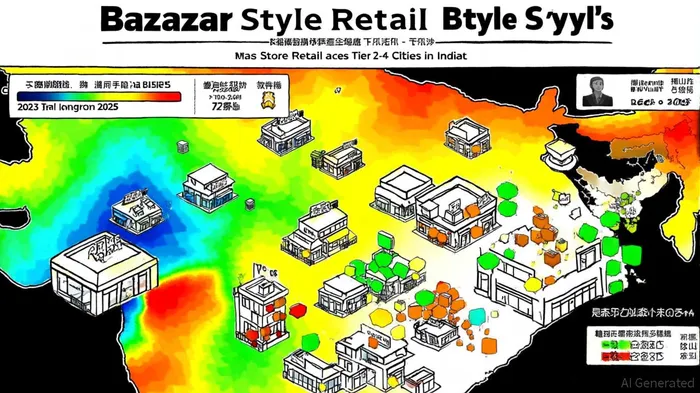







Comentarios
Aún no hay comentarios