
Axon Enterprise's Strategic Position in Public Safety and AI-Driven Innovation: Assessing Growth Sustainability and Competitive Differentiation
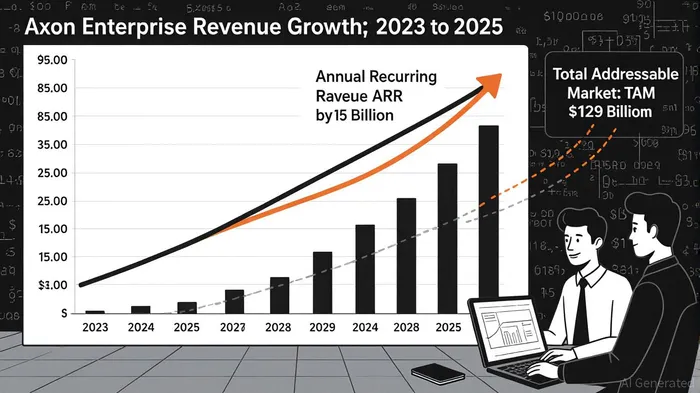
Axon Enterprise, Inc. (NASDAQ: AXON) has emerged as a defining force in the public safety technology sector, leveraging artificial intelligence (AI) to redefine law enforcement workflows and expand its market footprint. With a 33% year-over-year revenue surge to $669 million in Q2 2025 and annual recurring revenue (ARR) climbing 39% to $1.2 billion, the company's financial performance underscores its ability to scale amid a rapidly evolving landscape[1]. This growth is not merely quantitative but strategically anchored in AI-driven innovation, international expansion, and a recurring revenue model that strengthens customer retention. However, as AxonAXON-- accelerates its AI Era Plan, questions about transparency, regulatory risks, and competitive pressures demand closer scrutiny.
Financial Strength and Strategic Execution
Axon's Q2 2025 results reflect the success of its dual-pronged strategy: integrating AI into core products and expanding its software-as-a-service (SaaS) offerings. The Software & Services segment, now a critical growth engine, surged 39% year-over-year to $292 million, driven by tools like Draft One (AI-powered report automation) and Auto-Transcribe (voice-to-text for bodycam audio)[1]. These innovations have delivered measurable operational efficiency, with law enforcement officers saving 6–12 hours weekly on administrative tasks[2].
The company's financial resilience is further bolstered by a 124% net revenue retention rate, indicating robust customer loyalty and expansion within existing accounts[3]. Axon's forward guidance—projecting 2025 revenue between $2.65 billion and $2.73 billion (29% growth at the midpoint)—signals confidence in sustaining this momentum[1]. International markets, contributing $131 million in Q2 revenue (67% YoY growth), highlight Axon's ability to replicate its U.S. success globally[1].
Competitive Differentiation in AI-Driven Solutions
Axon's competitive moat lies in its integrated ecosystem of hardware, software, and AI. Products like TASER devices and body-worn cameras are now linked to cloud platforms such as Axon Evidence and Axon Records, creating a sticky environment where switching costs for law enforcement agencies are prohibitively high[4]. This ecosystem is further fortified by AI-native tools, including autonomous agents for video redaction and generative AI for report drafting.
The company's Total Addressable Market (TAM) has expanded to $129 billion in 2025, driven by AI adoption and forays into enterprise and international sectors[2]. Axon's leadership in AI-driven public safety is also evident in its market share: it ranks fourth in the global public safety software market with a 15.5% share, trailing MicrosoftMSFT-- and Motorola SolutionsMSI-- but outpacing Tyler Technologies[5]. Competitors like Motorola are embedding AI into dispatch systems, while Tyler TechnologiesTYL-- experiments with AI for case classification. Yet, Axon's first-mover advantage in AI-powered report automation—exemplified by Draft One—positions it as a category leader[5].
Challenges and Risks
Despite its strengths, Axon faces headwinds. The Electronic Frontier Foundation (EFF) has raised alarms about Draft One's lack of transparency, noting that the system deliberately discards original AI-generated drafts, complicating accountability and auditability. While Axon defends this design as a legal safeguard for law enforcement, critics argue it risks perpetuating bias or inaccuracies in policing. Such concerns could invite regulatory scrutiny, particularly as governments worldwide tighten AI governance frameworks.
Additionally, Axon's premium valuation—reflected in a P/E ratio of 214.47 and a market cap of $68.1 billion—hinges on continued revenue acceleration. While its 30%+ YoY growth trajectory is impressive, sustaining this pace will require navigating competitive pressures from both established rivals and emerging AI startups.
Conclusion: A Leader with Long-Term Potential
Axon Enterprise's strategic alignment with AI-driven public safety is a masterclass in innovation-led growth. Its financial performance, ecosystem stickiness, and TAM expansion validate its position as a market leader. However, the company must address transparency concerns and regulatory risks to maintain investor confidence. For now, Axon's ability to transform law enforcement through AI—while generating recurring revenue and expanding globally—cements its role as a pivotal player in the sector.





Comentarios
Aún no hay comentarios