
AvePoint's Strategic Share Sale: A Window of Opportunity in the SaaS Data Resiliency Sector?
The recent 13.3 million-share secondary offering by AvePointAVPT-- (Nasdaq: AVPT) has sparked debate among investors about its implications for the company's growth trajectory and market positioning. As a leader in SaaS-driven data resiliency and digital workplace transformation, AvePoint operates in a sector poised for expansion, driven by rising demand for cloud governance, AI-powered automation, and compliance solutions. This analysis evaluates whether the secondary offering reflects strategic foresight or investor caution, and whether AvePoint's technological advancements and market dominance justify its current valuation.
Secondary Offering: Liquidity or Strategic Fuel?
AvePoint's 13.3 million-share offering is a secondary issuance, meaning existing shareholders are selling their stakes rather than the company raising fresh capital[2]. While secondary offerings often raise concerns about dilution and shareholder confidence, the context here suggests a more nuanced narrative. The proceeds are intended to fund growth initiatives, reduce debt, and enhance liquidity for shareholders[2]. For a company like AvePoint, which has transitioned from a perpetual license model to a SaaS-centric strategy since 2014[2], this move aligns with its need to reinvest in innovation while maintaining financial flexibility.
The secondary nature of the offering also signals that AvePoint's leadership is prioritizing capital efficiency. By allowing shareholders to monetize their holdings, the company avoids issuing new shares that could dilute existing equity. This approach contrasts with primary offerings, which often raise red flags about over-leveraging or underperformance. Instead, AvePoint's strategy appears to balance investor liquidity with long-term growth, a critical factor in a sector where R&D and compliance certifications (such as FedRAMP) require sustained investment.
Strategic Pillars: AI, FedRAMP, and SaaS Dominance
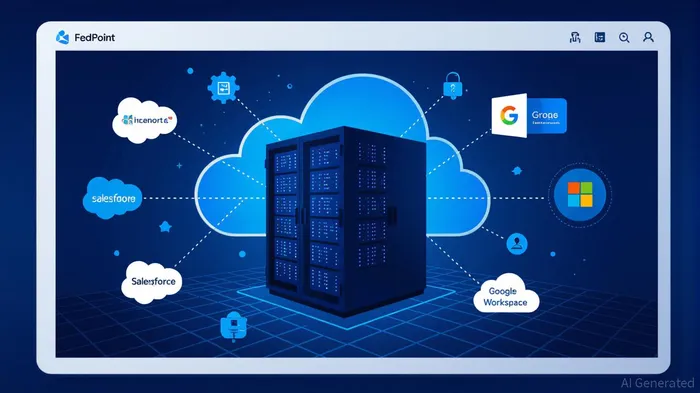
AvePoint's competitive edge lies in its ability to address two critical pain points for enterprises: data security and operational efficiency. The company's Confidence Platform integrates AI and machine learning to optimize cloud operations across MicrosoftMSFT-- 365, Google Workspace, and SalesforceCRM-- ecosystems[1]. This AI-driven approach not only streamlines workflows but also enhances threat detection, a growing concern as cyberattacks become more sophisticated.
A pivotal milestone in 2025 was AvePoint's FedRAMP (moderate) authorization for its Cloud Backup solution on Salesforce AppExchange[1]. This certification opens doors to government and enterprise clients requiring compliance with federal cybersecurity standards, a market segment with significant growth potential. Additionally, AvePoint's integration with Microsoft 365 Backup API[1] underscores its commitment to data resiliency, a feature that differentiates it in a crowded SaaS landscape.
The company's SaaS model, which now supports over 7 million cloud users[2], further strengthens its position. With recurring revenue streams and a customer base of 21,000+[2], AvePoint's transition to SaaS has proven resilient, even amid macroeconomic headwinds. Its 2020 revenue of $151.5 million—a 26% year-over-year increase[2]—demonstrates the scalability of its platform.
Investor Sentiment and Financial Health
Despite the secondary offering, AvePoint's stock price of $14.66 as of August 14, 2025, reflects a -2.2% decline[2], suggesting mixed investor sentiment. However, this dip may not directly correlate with the offering, as the sources do not explicitly link recent stock movements to the 13.3 million-share sale. Instead, the broader market's cautious approach to SaaS valuations—amid concerns about interest rates and economic slowdowns—likely plays a role.
AvePoint's financial health remains robust. Its 2021 public listing via a merger with Apex Technology Acquisition Corp. raised $492 million in gross proceeds[2], providing a strong capital base. The company's focus on debt reduction and reinvestment in AI and FedRAMP expansion[1] positions it to capitalize on long-term trends. Analysts have highlighted its leadership in multi-cloud governance, with GartnerIT-- reports recognizing its solutions as industry benchmarks[1].
Is This a Buy Opportunity?
The secondary offering, while potentially dilutive, should be viewed through the lens of AvePoint's strategic priorities. By allocating proceeds to AI innovation and compliance expansion, the company is addressing high-growth areas within the SaaS sector. Its FedRAMP authorization and Microsoft 365 integration[1] are particularly compelling, as they align with enterprise demand for secure, scalable solutions.
For investors, the key question is whether AvePoint's current valuation reflects these strengths. At $14.66 per share, the stock trades at a discount to its 2021 IPO price (which peaked at $18.00 post-merger[2]). This presents an opportunity for those willing to bet on its ability to execute its growth roadmap. However, risks remain, including competition from larger SaaS players and macroeconomic volatility.
Conclusion
AvePoint's secondary offering is best interpreted as a strategic tool to balance shareholder liquidity with growth ambitions. While the move may raise eyebrows in isolation, it aligns with the company's broader goals of AI integration, FedRAMP expansion, and SaaS dominance. For investors, the offering represents a window to assess whether AvePoint's technological edge and market positioning justify its current valuation. In a sector where data resiliency is non-negotiable, AvePoint's ability to innovate and comply with regulatory demands positions it as a compelling long-term opportunity—provided its execution matches its vision.





Comentarios
Aún no hay comentarios