
Avenue Supermarts' Q2 Earnings Performance and Strategic Positioning in India's Retail Sector
India's retail sector is a battleground of innovation, efficiency, and scale. Avenue Supermarts, the parent company of D-Mart, has long been a poster child for disciplined retailing in a fragmented market. Its Q2 FY2026 results, released on October 10, 2025, offer a window into how the company is navigating margin pressures, competitive threats, and the seismic shifts in consumer behavior. For investors, the question is whether D-Mart's operational rigor and strategic agility can sustain its growth in a sector projected to nearly double in size by 2030, according to a Deloitte forecast.
Operational Efficiency: A Double-Edged Sword
Avenue Supermarts reported a consolidated net profit of Rs 685.01 crore for Q2 FY2026, a 4% year-on-year increase, according to an NDTVProfit report. Revenue surged 15.5% to Rs 16,676.30 crore, driven by a combination of store expansion and higher footfall. However, the operating margin contracted to 7.28% from 7.57% in Q2 FY2025, the NDTVProfit report noted, a trend that reflects the company's deliberate choice to prioritize volume over margin.
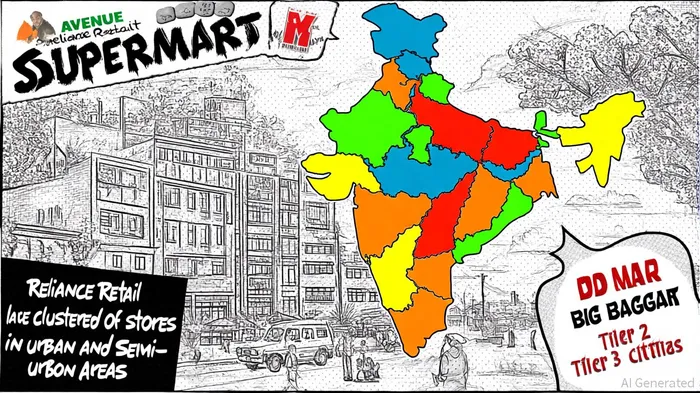
This margin compression is not a red flag but a calculated trade-off. D-Mart's cluster-based expansion strategy-opening stores in close proximity to reduce distribution costs-has historically kept its inventory turnover ratio robust at 14.61 in FY2024, per a growth strategy analysis. While this dipped slightly from 14.83 in FY2023, it remains a structural advantage over rivals like Reliance Retail, which operates a sprawling 19,340 stores but faces higher overheads, according to a LinkedIn deep dive. By owning 95% of its store properties, a MarketInsiders analysis notes, D-Mart avoids the rental escalations that plague competitors reliant on leases, a critical edge in a sector where real estate costs can erode profitability.
Margin Trends: Competing with Giants
The operating margin contraction in Q2 FY2026 must be contextualized against the broader retail landscape. Reliance Retail, India's largest organized retailer, maintained EBITDA margins between 8.2% and 8.5% in Q4 FY2025, according to a Financial Express study, a stark contrast to D-Mart's 6.4% EBITDA margin in the same period. This gap underscores the divergent strategies: Reliance leverages its conglomerate's supply chain and omni-channel integration, while D-Mart bets on hyper-local efficiency and everyday low pricing (EDLP).
Yet, D-Mart's margins are not under existential threat. Its focus on value-driven consumers-lower-middle and middle-class shoppers in urban and semi-urban areas, the MarketInsiders analysis suggests-has insulated it from the premiumization trends affecting luxury retailers. Moreover, the company's private-label product lines, which offer higher margins without sacrificing affordability, are a key differentiator. These products now account for 20% of sales, the growth strategy analysis reports, a figure that could rise as the company refines its product mix.
Growth Sustainability: Store Expansion vs. E-Commerce
Avenue Supermarts' Q2 results also revealed its aggressive expansion playbook. The company added eight new stores, bringing its total to 432 as of September 30, 2025, the Financial Express study reported. CEO-designate Anshul Asawa emphasized a strategic pivot to northern India, where same-store sales have outperformed urban centers, the Financial Express article noted. This regional diversification is critical: Tier 2 and Tier 3 cities now account for over 60% of e-commerce transactions, Deloitte projects, and D-Mart's physical presence in these markets positions it to capture cross-channel demand.
However, the company's e-commerce ambitions remain a work in progress. Its digital platform, DMart Ready, is still unprofitable but is projected to contribute 25% of total revenues by 2024, the growth strategy analysis projects. This aligns with broader industry trends-India's online retail market is expected to grow from $75 billion in 2024 to $260 billion by 2030, as Deloitte notes. For D-Mart, the challenge is balancing the high costs of last-mile delivery with its EDLP ethos. Unlike Reliance's JioMart, which uses dark stores for quick commerce, the LinkedIn deep dive explains, D-Mart's model relies on existing stores for fulfillment, a cost-effective but slower approach.
Competitive Positioning: A Retail Darwinism Play
D-Mart's strategic positioning is best understood in contrast to its rivals. Reliance Retail's scale and diversification give it an edge in categories like fashion and electronics, the LinkedIn deep dive observes, but its reliance on promotional pricing erodes margins. Future Retail's Big Bazaar, meanwhile, is mired in financial instability and lacks a coherent digital strategy, per the same LinkedIn analysis. D-Mart's sweet spot lies in its ability to combine operational efficiency with customer retention.
Private-label products, coupled with a curated product range focused on essentials, have fostered loyalty among price-sensitive shoppers, the MarketInsiders analysis argues. The company's recent shift to passing on GST rate reductions to customers further reinforces its EDLP positioning, the Financial Express study adds. Analysts project Avenue Supermarts to outpace the industry's 10% CAGR, with revenue growth of 17% and earnings growth of 19.5% from 2025 to 2028, the Financial Express article reports. However, short-term skepticism persists: some brokerages have downgraded the stock to "Hold" due to margin pressures and valuation concerns, the Financial Express article notes.
Long-Term Investment Potential
For long-term investors, Avenue Supermarts represents a compelling case of structural advantages meeting macroeconomic tailwinds. The company's asset-light expansion model-owning stores, minimizing inventory waste, and leveraging cluster logistics-positions it to scale profitably even as competition intensifies. India's retail sector is projected to grow to $1.93 trillion by 2030, a Deloitte projection, and D-Mart's focus on Tier 2/3 cities aligns with the demographic and geographic shifts driving this growth.
That said, risks remain. The e-commerce segment's profitability is uncertain, and rising input costs could pressure margins. Yet, as one analyst noted, "D-Mart's disciplined capital allocation and leadership transition under Anshul Asawa suggest a company that's prepared for the long game," the Financial Express article observed. For investors with a five- to seven-year horizon, the combination of operational resilience and strategic adaptability makes Avenue Supermarts a standout in India's retail evolution.







Comentarios
Aún no hay comentarios