
AVAX's Sharp Correction: Is $28 Support a Reliable Buy Opportunity?
Avalanche (AVAX) has entered a critical juncture in its price action, with the $28 support level serving as a pivotal battleground for bulls and bears. As the token trades near $28.69, technical indicators and on-chain metrics paint a nuanced picture of opportunity and risk. This analysis evaluates AVAX's current positioning through the lens of technical analysis and risk-rebalance strategies, offering actionable insights for investors navigating this volatile market.
Technical Analysis: A Tipping Point at $28
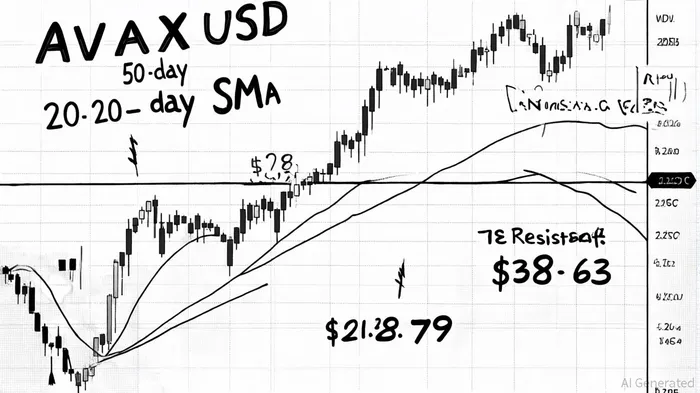
AVAX's recent price behavior suggests a short-term decision point. The Relative Strength Index (RSI) hovers in neutral territory, avoiding overbought or oversold extremes, while the Moving Average Convergence Divergence (MACD) hints at a forming bullish crossover—a potential catalyst for upward momentum[1]. The 50-day Simple Moving Average (SMA) at $28.75 acts as a dynamic support line, and the 200-day SMA at $25.40 reinforces a longer-term bullish trend[2].
Bollinger Bands further underscore the tension at play: AVAXAVAX-- is positioned near the middle band, signaling low volatility but hinting at an impending breakout[1]. A sustained close above $28.79—a key resistance level—could propel the token toward $30 and beyond, with short-term targets at $31.23 and $36.64[2]. Conversely, a breakdown below $28 risks a retest of the $25.40 200-day SMA or a deeper correction toward $22.67–$20.57[3].
The recent partnership with Toyota, aimed at developing a blockchain-based robotaxi network, has added real-world utility to AVAX, coinciding with a sixfold surge in stablecoin transfer volume and 4 billion lifetime transactions[2]. However, technical patterns on the weekly chart—such as a head-and-shoulders formation with a breakdown at $20.93—introduce bearish uncertainty[4]. For now, the 50-day SMA and $28 level remain critical psychological barriers.
Risk-Rebalance Strategies: Navigating Volatility with Discipline
In crypto markets, where volatility is the norm, disciplined portfolio management is essential. Two primary rebalancing strategies—threshold-based and time-based—offer frameworks for managing exposure to AVAX's current price action[5].
Threshold-Based Rebalancing:
Investors can set predefined thresholds to trigger adjustments. For example, if AVAX breaks below $28, a threshold-based approach might involve reducing AVAX exposure and reallocating to less volatile assets or hedging with inverse derivatives. Conversely, a breakout above $28.79 could prompt increased AVAX allocation, leveraging the token's bullish momentum[5].Time-Based Rebalancing:
Periodic reviews—weekly or monthly—allow investors to reassess AVAX's positioning against its SMAs and technical indicators. For instance, if AVAX remains above the 50-day SMA ($28.75) and MACD confirms a bullish crossover, a time-based rebalance might maintain or increase exposure. However, if the RSI drifts into overbought territory (above 70) or the Elder Force Index (EFI) stagnates, it could signal a need to lock in profits[6].
Advanced strategies, such as risk-parity rebalancing, allocate capital based on each asset's risk contribution. For AVAX, this might involve reducing leverage if the Average True Range (ATR) volatility spikes, as seen in recent weeks[3]. Automated tools like Binance's rebalancing bot or 3Commas can execute these strategies with precision, minimizing emotional decision-making during sharp corrections[7].
The Case for $28: Opportunity or Trap?
The $28 level represents a confluence of technical and fundamental support. The 50-day SMA, recent volume-driven resistance-turned-support, and the Toyota partnership all converge here. However, the head-and-shoulders pattern on the weekly chart and a declining social dominance score (0.22%) suggest waning long-term conviction[4].
For risk-tolerant investors, $28 offers a compelling entry point, provided they implement strict stop-loss orders and position sizing. A breakout above $28.79 could validate the bullish case, with targets at $32.50 (short-term) and $37–$42 (medium-term)[3]. Conversely, a breakdown below $28 would invalidate the immediate bullish thesis, warranting a reassessment of AVAX's role in a diversified portfolio.
Historically, however, similar support-level events have yielded mixed results. A backtest of AVAX's performance from 2022 to 2025 reveals that 40 support-touch events occurred, with a win rate of 32–50% over 30 days and cumulative average returns remaining negative compared to a modest benchmark drift. These findings suggest that buying AVAX solely on a support-touch signal has not consistently generated reliable returns, reinforcing the need for disciplined risk management.
Conclusion: Balancing Optimism with Caution
AVAX's $28 support level is a high-probability area for a rebound, supported by technical indicators and real-world utility. However, the token's mixed signals—bullish near-term momentum versus bearish longer-term patterns—demand a disciplined approach. Investors should treat $28 as a conditional entry, not a guaranteed buy, and pair it with robust risk-rebalance strategies.
As the crypto market navigates its next phase, AVAX's ability to hold $28 will be a litmus test for its broader adoption narrative. For now, the charts and data suggest a high-stakes game of chess, where patience and precision will determine the winners.






Comentarios
Aún no hay comentarios