
AVAX's Institutional Bull Case: On-Chain Surge and Positioning Trends Signal a New Era
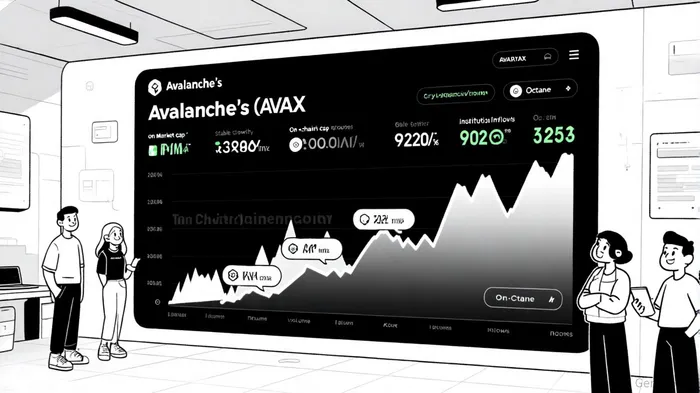
The crypto landscape in 2025 is witnessing a seismic shift in institutional adoption, and AvalancheAVAX-- (AVAX) is at the forefront of this movement. With a confluence of on-chain data, strategic upgrades, and institutional partnerships, AVAX's bull case is gaining unprecedented momentum. Let's dissect the evidence and assess why this LayerLAYER-- 1 blockchain is becoming a cornerstone of institutional crypto portfolios.
Institutional On-Chain Activity: A New Paradigm
Avalanche's real-world asset (RWA) market capitalization has surged by 58% to $305.25 million in 2025, driven by tokenization projects like New Jersey's $240 billion property deeds and Avalanche-based subnets for RWA loans [1]. This growth is notNOT-- just speculative—it's structural. Institutions like Franklin Templeton, Grove Finance, and Centrifuge are leveraging Avalanche's infrastructure for tokenized assets and stablecoin settlements, signaling a shift toward blockchain as a backbone for traditional finance [1].
Stablecoin activity further underscores this trend. In three months, stablecoin transfer volume on Avalanche surged sixfold, reflecting its role as a settlement layer for institutional-grade transactions [1]. Meanwhile, the Avalanche9000 (Etna) upgrade has slashed gas fees by 99.9%, enabling near-zero-cost subnet deployment and attracting developers and enterprises seeking scalable solutions [2]. These upgrades are not just technical wins—they're strategic moves to position Avalanche as the go-to platform for institutional-grade blockchain applications.
Derivatives Open Interest and ETF Catalysts
Derivatives open interest (OI) for AVAXAVAX-- has skyrocketed to $1.8 billion, a 15% increase in Q3 2025, indicating robust leveraged demand from institutional and retail traders [3]. This surge aligns with Grayscale's inclusion of AVAX in its updated Top 20 altcoin list for Q3 2025, reinforcing its status as a DeFi and Layer 1 ecosystem leader [3].
The potential approval of a spot AVAX ETF by Nasdaq could be the next catalyst. Bitwise's ETF filing, if successful, would open floodgates for institutional capital, mirroring the inflows seen in BitcoinBTC-- and EthereumETH-- ETFs [3]. Additionally, the Avalanche Card, a Visa-backed payment solution, is expanding AVAX's utility in traditional finance, further solidifying its value proposition [2].
Positioning Trends: Accumulation and Strategic Partnerships
Institutional positioning is evident in on-chain inflows. Over $3.26 million in net inflows were recorded on September 23, 2025, signaling renewed accumulation [3]. A $550 million treasury initiative led by Galaxy Digital and Kraken supports AVAX One, the first Nasdaq-listed entity centered on Avalanche, while partnerships with Apollo, JPMorgan, and BlackRock highlight its role in tokenizing real-world assets [3].
Network activity also tells a compelling story. Avalanche processed 11.9 million transactions in a single week, a 66% surge, driven by gaming, DeFi, and subnet activity [4]. Daily transactions hit 20 million, with strategic collaborations with Toyota and FIFA expanding its enterprise footprint [4].
Challenges and the Path Forward
Despite these positives, risks persist. A 33.93% drop in new Avalanche addresses and a 10% decline in active addresses raise questions about retail participation's sustainability [3]. However, the focus on institutional-grade infrastructure—such as dynamic fees introduced by the Octane upgrade—suggests Avalanche is prioritizing long-term scalability over short-term user growth [3].
The key to AVAX's success lies in maintaining its institutional momentum while addressing user engagement. If it breaks through the $27 resistance level, analysts project a move toward $40–$46, with a spot ETF approval acting as a tailwind [3].
Conclusion
Avalanche's bull case in 2025 is anchored in institutional adoption, on-chain innovation, and strategic positioning. With RWA tokenization, subnets, and ETF potential, AVAX is not just a Layer 1 blockchain—it's a bridge between traditional finance and Web3. For investors, the question isn't whether AVAX can scale—it's whether they're ready to ride the institutional wave.






Comentarios
Aún no hay comentarios