
Avalanche's Nasdaq Debut and AVAX Staking Strategy: A Catalyst for Institutional Adoption and Long-Term Value Creation
The recent Nasdaq listing of the Grayscale AvalancheAVAX-- Trust (AVAX) and its impending rebranding as the Grayscale AVAXAVAX-- Trust ETF marks a pivotal moment for Avalanche (AVAX). This development, coupled with a robust staking strategy and growing institutional interest, positions AVAX as a compelling case study in crypto's evolution toward mainstream adoption. Let's dissect the implications for long-term value creation and institutional-grade infrastructure.
Institutional Adoption via ETF: A Gateway to Mainstream Capital
Grayscale's filing to convert its Avalanche Trust into a spot ETF on Nasdaq is a strategic masterstroke. By offering a regulated vehicle for AVAX exposure, the ETF bridges the gap between crypto's volatility and traditional finance's risk-averse appetite. As of late September 2025, the trust manages $14.09 million in assets with a net asset value (NAV) of $11.88 per share [1]. While this figure pales compared to BitcoinBTC-- or EthereumETH-- ETFs, it signals a critical first step in institutional onboarding.
The proposed ETF's structure—leveraging CoinbaseCOIN-- Custody and BNY Mellon as custodians—addresses key institutional pain points: security, compliance, and liquidity. By aligning share prices with AVAX's market value, the ETF could mitigate arbitrage risks and attract capital from pension funds, endowments, and hedge funds [3]. This mirrors the success of Bitcoin ETFs, which saw inflows surge post-approval, and suggests AVAX could follow a similar trajectory.
Moreover, the competitive landscape is heating up. VanEck and other firms are also pursuing AVAX-linked ETFs, indicating a broader consensus on the token's institutional potential [1]. Regulatory momentum, fueled by the recent approvals of Bitcoin and Ethereum ETFs, further tilts the odds in AVAX's favor.
AVAX Staking Strategy: Building a Cash-Positive Ecosystem
While ETFs open the floodgates for capital, Avalanche's staking strategy is the bedrock of its long-term value proposition. AVAX One, a rebranded AgriFORCE Growing Systems, is raising $550 million to accumulate and stake AVAX tokens, aiming to generate revenue through native staking, liquid staking derivatives, and MEV (maximal extractable value) [2]. This initiative, backed by Galaxy Digital and Kraken, is not just about yield—it's about embedding AVAX into the fabric of institutional-grade infrastructure.
Staking AVAX directly supports the network's security and decentralization, while liquid staking tokens (LSTs) enable participants to retain liquidity. For AVAX One, this creates a cash-positive model from day one, with staking rewards compounding into a sustainable revenue stream. The project's ambition to expand its influence within the Avalanche ecosystem—through validator nodes, DeFi protocols, and cross-chain bridges—further cements AVAX's utility beyond speculative trading.
Institutional confidence is also bolstered by regulated custody solutions. Deutsche Börse's entry into AVAX custody services, alongside Grayscale's ETF, reduces operational risks for institutional investors [3]. These developments align with Avalanche's on-chain metrics: total value locked (TVL) and bridge inflows have surged, reflecting growing real-world adoption [3].
Market Performance Post-Listing: Volatility as a Feature, Not a Bug
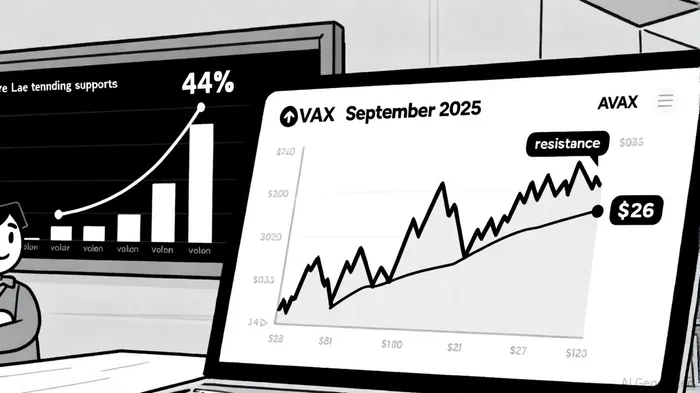
AVAX's price action in late September 2025 has been anything but boring. The token traded between $22.22 and $34.79, with a 44% spike in trading volume to $1.02 billion [1]. While volatility is often a red flag for traditional investors, it's a feature in crypto's innovation-driven markets. The recent 8.8% weekly surge suggests that AVAX is beginning to attract speculative and institutional capital simultaneously [4].
Technical indicators hint at a potential short-term rebound. A key resistance level forms at $26, with trendline support offering bullish momentum if the price breaks above this threshold [1]. Historical backtesting of similar price patterns—where AVAX closed above its 20-day resistance while holding above the 20-day support—reveals a compelling trend: in 59 such events from 2022 to 2025, the average cumulative excess return turned meaningfully positive after ~29 trading days, reaching 12.6% at +30D versus a 2.0% benchmark return. The win rate for these events rose to 58%, suggesting that confirmed resistance breaks followed by support holding tend to develop into medium-term rallies rather than immediate pops.
Long-Term Value Creation: The Institutional-Grade Ecosystem
The convergence of ETF-driven liquidity, staking-driven utility, and regulatory clarity creates a flywheel for AVAX's long-term value. Institutional adoption isn't just about capital—it's about credibility. When firms like Galaxy Digital and Deutsche Börse stake AVAX, they signal to the market that the token is a viable asset class.
Moreover, Avalanche's ecosystem is maturing. The rise of LSTs and MEV strategies demonstrates a shift from speculative trading to infrastructure-building. This mirrors Ethereum's transition from a speculative asset to a foundational layer for DeFi and NFTs. For AVAX, the path forward lies in replicating this trajectory while leveraging its unique advantages: faster finality, lower fees, and a growing validator network.
Conclusion: A New Chapter for AVAX
Avalanche's Nasdaq debut and AVAX staking strategy represent more than a technical upgrade—they're a blueprint for institutional adoption in crypto. The Grayscale AVAX Trust ETF, if approved, will democratize access to AVAX while aligning its price with broader market fundamentals. Meanwhile, staking initiatives like AVAX One's $550 million raise are building a cash-positive, self-sustaining ecosystem.
For investors, the key takeaway is clear: AVAX is no longer just a speculative altcoin. It's a token with institutional-grade infrastructure, regulatory momentum, and a staking-driven value proposition. As the lines between crypto and traditional finance blurBLUR--, AVAX is positioning itself at the intersection of innovation and legitimacy.





Comentarios
Aún no hay comentarios