
Autoworkers Retraining for Robot Revolution Amidst Labor Cost Concerns
PorAinvest
viernes, 5 de septiembre de 2025, 11:24 am ET1 min de lectura
GM--
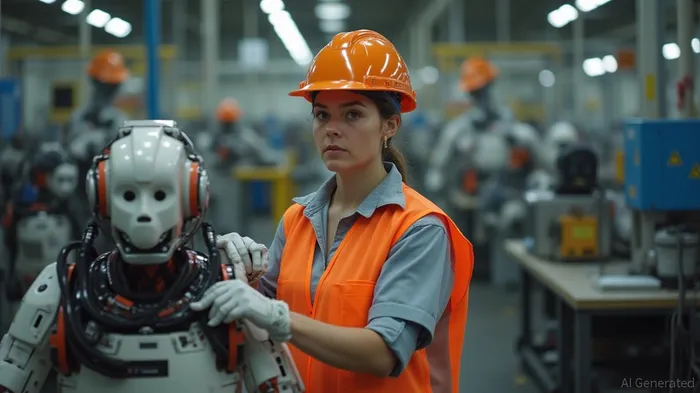
Annie Ignaczak, a former GM worker, is now part of the company's apprenticeship program, where she is learning to service robots. This new role reflects the industry's shift towards automation, which is being driven by high labor costs in the US. According to A3 President Jeff Burnstein, assembly lines are becoming a new frontier for robotics, while people remain essential to oversee and guide these systems [1].
The Canadian auto sector is also experiencing significant changes. In April 2025, the sector faced a 7.5% sales decline due to the delay of zero-emission vehicle (ZEV) targets and the expiration of EV incentives. Automakers like GM and Ford are facing increased production costs due to U.S. tariffs on Canadian goods, which have raised production costs by 4%-8% [2]. Despite these challenges, Canadian automakers are investing heavily in automation and EV battery production to strengthen their supply chains and reduce reliance on foreign suppliers.
Investors in the Canadian auto sector face a paradox: high potential in EV infrastructure and domestic production, juxtaposed with near-term risks from tariffs and policy uncertainty. Key opportunities include investments in EV charging infrastructure and strategic partnerships with Chinese EV manufacturers. Conversely, risks include tariff volatility and the need for credit risk diversification among EV credit providers [2].
As the auto industry navigates this crossroads, those who balance innovation with prudence will be best positioned to capitalize on the opportunities ahead. The Canadian auto sector's 2025 landscape is defined by duality: a push towards electrification and domestic resilience, tempered by the drag of U.S. tariffs and policy rollbacks. For investors, strategic agility is crucial—allocating capital to infrastructure and partnerships while hedging against regulatory and trade uncertainties.
References:
[1] https://www.facebook.com/a3automate/posts/autoworkers-are-retraining-for-the-age-of-automationat-gms-technical-learning-ce/1100139212268204/
[2] https://www.ainvest.com/news/strategic-reassessment-canadian-auto-sector-exposure-ev-policy-rollbacks-tariff-pressures-2509/
Autoworkers at General Motors are retraining to adapt to the increasing use of robots in the industry. Annie Ignaczak, a former GM worker, is now servicing robots as part of a company apprenticeship program. Experts predict more automation in the auto industry due to high labor costs in the US, but workers like Ignaczak are finding new opportunities in robot maintenance and management.
The automotive industry is undergoing a significant transformation, driven by the increasing adoption of automation. General Motors (GM) is at the forefront of this shift, as it retrains its workforce to adapt to the new realities of the industry. At GM's Technical Learning Center, employees who once performed repetitive tasks on the assembly line are now learning to maintain and service robots. This transition is part of a broader trend in the auto industry, where automation is becoming a critical component of production processes.Annie Ignaczak, a former GM worker, is now part of the company's apprenticeship program, where she is learning to service robots. This new role reflects the industry's shift towards automation, which is being driven by high labor costs in the US. According to A3 President Jeff Burnstein, assembly lines are becoming a new frontier for robotics, while people remain essential to oversee and guide these systems [1].
The Canadian auto sector is also experiencing significant changes. In April 2025, the sector faced a 7.5% sales decline due to the delay of zero-emission vehicle (ZEV) targets and the expiration of EV incentives. Automakers like GM and Ford are facing increased production costs due to U.S. tariffs on Canadian goods, which have raised production costs by 4%-8% [2]. Despite these challenges, Canadian automakers are investing heavily in automation and EV battery production to strengthen their supply chains and reduce reliance on foreign suppliers.
Investors in the Canadian auto sector face a paradox: high potential in EV infrastructure and domestic production, juxtaposed with near-term risks from tariffs and policy uncertainty. Key opportunities include investments in EV charging infrastructure and strategic partnerships with Chinese EV manufacturers. Conversely, risks include tariff volatility and the need for credit risk diversification among EV credit providers [2].
As the auto industry navigates this crossroads, those who balance innovation with prudence will be best positioned to capitalize on the opportunities ahead. The Canadian auto sector's 2025 landscape is defined by duality: a push towards electrification and domestic resilience, tempered by the drag of U.S. tariffs and policy rollbacks. For investors, strategic agility is crucial—allocating capital to infrastructure and partnerships while hedging against regulatory and trade uncertainties.
References:
[1] https://www.facebook.com/a3automate/posts/autoworkers-are-retraining-for-the-age-of-automationat-gms-technical-learning-ce/1100139212268204/
[2] https://www.ainvest.com/news/strategic-reassessment-canadian-auto-sector-exposure-ev-policy-rollbacks-tariff-pressures-2509/
Divulgación editorial y transparencia de la IA: Ainvest News utiliza tecnología avanzada de Modelos de Lenguaje Largo (LLM) para sintetizar y analizar datos de mercado en tiempo real. Para garantizar los más altos estándares de integridad, cada artículo se somete a un riguroso proceso de verificación con participación humana.
Mientras la IA asiste en el procesamiento de datos y la redacción inicial, un miembro editorial profesional de Ainvest revisa, verifica y aprueba de forma independiente todo el contenido para garantizar su precisión y cumplimiento con los estándares editoriales de Ainvest Fintech Inc. Esta supervisión humana está diseñada para mitigar las alucinaciones de la IA y garantizar el contexto financiero.
Advertencia sobre inversiones: Este contenido se proporciona únicamente con fines informativos y no constituye asesoramiento profesional de inversión, legal o financiero. Los mercados conllevan riesgos inherentes. Se recomienda a los usuarios que realicen una investigación independiente o consulten a un asesor financiero certificado antes de tomar cualquier decisión. Ainvest Fintech Inc. se exime de toda responsabilidad por las acciones tomadas con base en esta información. ¿Encontró un error? Reportar un problema




Comentarios
Aún no hay comentarios