
Automotive Safety Recalls and Brand Resilience: A 2025 Investment Analysis of Ford and Tesla
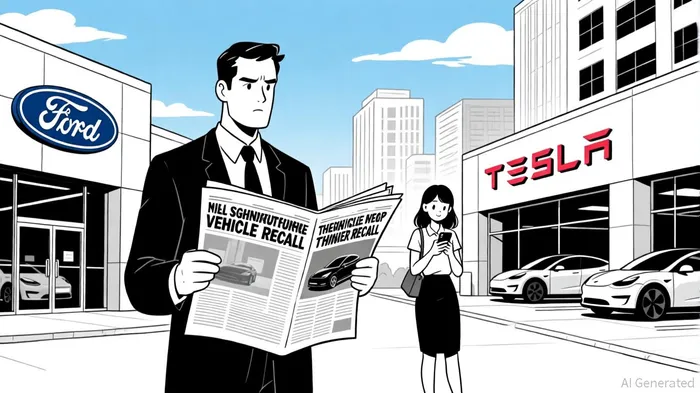
The automotive industry's ability to weather safety recall crises has become a critical metric for investors assessing long-term brand resilience and financial stability. In 2025, two of the sector's most prominent players-Ford and Tesla-exemplify divergent approaches to managing recall-related risks. While FordF-- grapples with a record 109 U.S. recalls in 2025, TeslaTSLA-- faces a singular but massive recall of 5.7 million Cybertrucks. This analysis evaluates how each company's strategies, financial health, and brand reputation are shaping their post-recall trajectories.
Ford: A Recall Crisis and Strategic Rebuilding
Ford's Q2 2025 recall of 3.3 million vehicles-45.3% of the quarter's total-exposed systemic quality control challenges. The company incurred a $570 million charge for repairs and a $36 million net loss, driven by issues ranging from fuel leaks to faulty instrument panels, according to a Bizzycar alert. These recalls, coupled with a catastrophic fire at key supplier Novelis, which halted F-Series production, triggered a 7% stock plunge, according to TS2.
Yet Ford's historical resilience offers a counterpoint. In 2006, the company secured a $23.6 billion credit line-two years before the 2008 financial crisis-enabling it to avoid government bailouts, as detailed in a Medium profile. Today, Ford is leveraging similar foresight: CEO Jim Farley has prioritized AI-driven quality checks, Gemba walks (on-site process audits), and over-the-air (OTA) software updates to address defects, according to the Brian Hoskins Ford blog. The F-Series' continued dominance-selling 222,459 units in Q2 2025-provides critical cash flow to offset losses in its struggling EV division, according to PickupTruckTalk.
However, Ford's brand reputation remains fragile. With 850,000 vehicles recalled in 2025 for defects like steering failures, customer trust is eroding. Warranty claims for one issue alone reached 44,000, and Farley admits quality improvements may take 18 months to materialize, according to Forbes. For investors, the key question is whether Ford's traditional manufacturing strengths can offset its EV unit's $1.3 billion Q2 2025 loss and a 31% drop in U.S. EV sales, as reported by TS2.
Tesla: Software-Driven Recall Efficiency and Brand Erosion
Tesla's 2025 recall of 5.7 million Cybertrucks-its largest single recall-highlights the risks of software-centric design. The stainless-steel trim detachment issue required free replacements, according to a GreenMatters report. Unlike Ford, Tesla's reliance on OTA updates reduces recall expenses, with 15% of Q2 2025 recalls resolved digitally, as noted in the Bizzycar alert. This efficiency has allowed Tesla to maintain a strong balance sheet, with $28 billion in cash and energy solutions contributing 20% of Q3 2025 revenue, according to a Tesla Accessories analysis.
Yet Tesla's brand value has plummeted. Its sustainability-driven brand value dropped from $58.3 billion in 2024 to $43 billion in 2025, a 26% decline attributed to Elon Musk's polarizing public persona and production delays, according to an Ilovetesla analysis. While Tesla's stock rebounded 19% in September 2025-driven by rate-cut expectations and autonomous driving progress-investors remain wary. The Cybertruck's eight recalls in two years, coupled with a 40% stock decline in 2025, underscore lingering quality concerns, as noted by Monexa.
Tesla's recovery hinges on balancing innovation with governance. Transparent communication and regulatory collaboration have mitigated some reputational damage, but Musk's leadership controversies continue to alienate consumers, according to an Rsquare Media case study. For Tesla to regain trust, analysts argue it must prioritize ESG alignment and product reliability over CEO-driven narratives, as the Ilovetesla analysis recommends.
Comparative Insights and Investment Implications
Ford and Tesla represent contrasting models of recall management. Ford's traditional approach-relying on dealership networks and physical repairs-incurs higher costs but leverages its core truck segment for stability. Tesla's software-first strategy reduces recall expenses but exposes it to brand erosion from CEO-driven risks.
Financially, Ford's stock underperformance (–15% YTD) reflects its recall crisis, while Tesla's volatility (19% monthly rebound in September) highlights its speculative appeal. For long-term investors, Ford's $5 billion recall costs and EV losses pose risks, but its $23.6 billion credit line and J.D. Power quality awards suggest resilience, as documented on the Brian Hoskins Ford blog. Tesla's strong cash reserves and energy diversification offer upside, but its brand fragility and governance issues demand caution.
Conclusion
Automotive recalls are no longer isolated events but systemic stress tests for brand resilience. Ford's struggle to balance legacy strengths with EV innovation and Tesla's quest to reconcile software efficiency with brand governance illustrate the sector's evolving challenges. Investors must weigh these dynamics against each company's strategic agility, financial buffers, and customer retention rates. In 2025, the auto industry's winners will be those who transform recalls from crises into opportunities for trust-building and technological leadership.





Comentarios
Aún no hay comentarios