
Automotive Safety Recalls: Assessing Brand Resilience and Stock Valuation Risks in 2025
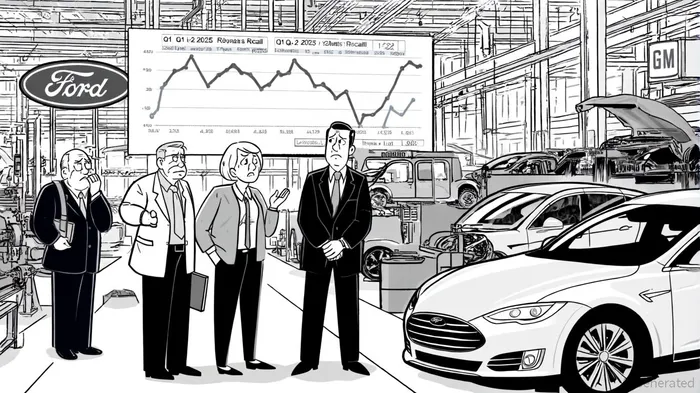
The automotive industry's 2025 safety recall landscape underscores a critical juncture for investor confidence, brand resilience, and long-term stock valuation. Recent data reveals a surge in recall frequency, with over 7.3 million vehicles recalled in Q2 2025 alone—nearly double the Q1 total—highlighting systemic quality challenges and evolving consumer expectations[1]. For investors, these events are not merely operational hiccups but signals of deeper risks to brand equity and financial performance.
The 2025 Recall Surge: A Double-Edged Sword
Ford's Q1 2025 recall of 1,057,229 vehicles—accounting for 30% of all U.S. recalls—exemplifies the sector's struggles. Defects in electrical systems, seat belts, and steering mechanisms have driven warranty costs up 22% to $6 billion in 2024, squeezing operating margins[2]. Ford's stock price fell 15% over the preceding 12 months, lagging the S&P 500's 11% gain, as investor concerns over EV strategy and quality control mounted[3]. TeslaTSLA--, too, faced a 661,810-vehicle recall for power steering issues, though its Q2 delivery drop may offer FordF-- a fleeting opportunity to regain market share[4].
Yet, the surge in recalls also reflects improved early detection of defects, potentially mitigating large-scale financial impacts in the long term[5]. Over-the-air (OTA) updates addressed 15% of Q2 recalls, signaling a shift toward cost-effective solutions[6]. However, safety-critical issues still require in-person repairs, straining dealership networks and customer trust.
Historical Lessons: Toyota vs. GM
Comparative case studies reveal stark contrasts in crisis management and long-term outcomes. Toyota's 2010 unintended acceleration recall—a $35 billion market value loss in a month—was exacerbated by delayed transparency and a reputation for quality[7]. Conversely, GM's 2014 ignition switch recall (30.4 million vehicles) saw minimal stock impact, partly due to less media visibility and a diversified product lineup[8]. These divergent outcomes highlight the interplay of brand perception, defect severity, and response efficacy.
Toyota's recovery, marked by a public apology, free repairs, and Smart Stop Technology, restored its market leadership by 2012[9]. GM's fragmented response, however, left lingering reputational scars despite a $4.1 billion financial hit[10]. For investors, these cases underscore the importance of proactive transparency and customer-centric solutions in mitigating long-term damage.
Stock Valuation Trends and Investor Implications
The 2025 recall surge has amplified stock volatility, particularly for high-profile automakers. BMW's 2024–2025 recalls—spanning braking systems and door locks—prompted an 8.9% stock decline and revised financial targets[11]. Similarly, Ford's 88 recalls in H1 2025—nearly double its 2024 count—raise concerns about its EV strategy and profitability[12].
However, recalls also present opportunities. Dealerships benefit from high-value service visits, and OTA solutions reduce repair costs. For investors, the key lies in assessing a company's ability to balance recall management with innovation. Tesla's Q2 delivery dip, for instance, may reflect short-term pain but could position it for long-term gains if its software-defined vehicle strategy proves resilient[13].
The Path Forward: Resilience in an Evolving Sector
As the industry shifts toward electrification and software-defined vehicles, recall risks will evolve. Ford's 18-month timeline for quality improvements and Toyota's post-2010 reforms illustrate the patience required for recovery[14]. Meanwhile, regulatory pressures—such as proposed U.S. tariffs and stricter safety standards—add layers of complexity[15].
For investors, the lesson is clear: prioritize companies with robust quality control, transparent crisis management, and agile recall response systems. Those that treat recalls as operational costs rather than existential threats will likely outperform in the long term.





Comentarios
Aún no hay comentarios