
Automotive Safety Liability Risks for EV Manufacturers: Tesla's Exposure and Industry-Wide Implications
The electric vehicle (EV) revolution has brought unprecedented innovation, but it has also exposed manufacturers to novel safety liability risks. TeslaTSLA--, the industry's most prominent player, faces mounting regulatory, legal, and reputational challenges stemming from product defects and autonomous driving controversies. For investors, understanding these risks-and how they compare to broader industry trends-is critical to assessing Tesla's long-term viability.
Tesla's Escalating Liability Exposure
Tesla's reliance on software-driven systems has been both a strength and a vulnerability. Between 2023 and 2025, the company has issued multiple large-scale recalls tied to its Autopilot and Full Self-Driving (FSD) systems. A landmark 2023 recall affected 2 million vehicles due to insufficient driver monitoring in Autosteer, while a 2025 recall of 376,000 vehicles addressed a power steering flaw caused by an overvoltage breakdown in the electronic power-assisted steering (EPAS) system, according to a CNBC report. These issues were resolved via over-the-air (OTA) software updates, a hallmark of Tesla's cost-efficient recall strategy. However, the frequency and scale of these actions have raised questions about the reliability of its autonomous systems.
Legal liabilities have compounded these operational risks. In a high-profile 2025 case, a Miami jury awarded $329 million in damages to victims of a 2019 fatal crash involving a Tesla Model S operating on Autopilot, finding Tesla 60% liable, according to NatLaw Review. Tesla's refusal to settle and its appeal of the verdict signal a combative legal stance, but the financial and reputational costs are already mounting. Additionally, class-action lawsuits over alleged odometer manipulation, privacy violations, and misrepresentation of Autopilot capabilities further strain the company's resources, as detailed in a NatLaw Review analysis.
Regulatory Scrutiny and Reputational Fallout
The National Highway Traffic Safety Administration (NHTSA) has intensified its scrutiny of Tesla's autonomous systems. Ongoing investigations include allegations of delayed crash reporting, obstacle detection failures during Smart Summon, and misrepresentation of FSD capabilities in low-visibility conditions, as described in a Nasdaq article. These probes threaten to impose stricter safety standards, potentially slowing Tesla's deployment of AI-driven features and increasing compliance costs.
Reputational damage is also a growing concern. A 2023 fire in a Tesla Model 3, where the electronic door-opening system allegedly malfunctioned, led to a wrongful death lawsuit and publicized safety doubts, as noted in a Fortune report. Such incidents erode consumer trust, particularly as competitors like BYD and Rivian gain traction with more conservative safety profiles.
Industry-Wide Trends and Comparative Risks
Tesla's challenges are not isolated. The EV industry has seen a 533% surge in recalls from 2018 to 2023, driven by battery defects, software glitches, and supply chain complexities, according to a Sedgwick analysis. For example, Ford's Mustang Mach-E faced a 350,000-vehicle recall for power loss and battery sensor failures, while Hyundai's Ioniq 6 and Kia EV6 were recalled for regenerative braking software issues, as previously reported by NatLaw Review. However, Tesla's exposure is amplified by its aggressive innovation strategy and reliance on OTA updates, which, while cost-effective, can mask underlying design flaws until they manifest widely.
Regulatory trends also highlight systemic risks. The U.S. Senate's proposed elimination of penalties for failing to meet fuel efficiency standards could devalue Tesla's $2.76 billion in regulatory credit revenue from 2024, a critical profit driver (reported earlier in Fortune). Meanwhile, global trade policies-such as the EU's 45% tariffs on Chinese EVs and U.S. bans on Chinese-made EVs-reshape competitive dynamics, forcing Tesla to navigate geopolitical and supply chain uncertainties (as discussed in NatLaw Review).
Financial and Strategic Implications for Investors
The financial toll of Tesla's liabilities is multifaceted. Direct costs include settlements (e.g., a $10.5 million payout in a 2023 Autopilot-related case) and legal fees, while indirect costs stem from stock price volatility and reputational damage. After the 2025 Miami verdict, Tesla's stock dropped 4%, reflecting investor fears of escalating liabilities (as reported in the Nasdaq article referenced above).
Comparatively, traditional automakers like Ford and Toyota face higher recall costs due to mechanical complexity, but their established supply chains and regulatory compliance frameworks mitigate some risks (per the Sedgwick analysis cited earlier). For Tesla, the challenge lies in balancing rapid innovation with safety rigor-a tightrope that could determine its dominance in the EV market.
Conclusion
Tesla's position at the forefront of EV innovation is both its greatest asset and its most significant liability. While its OTA recall strategy reduces repair costs, the company's exposure to regulatory, legal, and reputational risks remains unparalleled. For investors, the key question is whether Tesla can adapt its safety practices to match its technological ambitions-or if the growing scrutiny will erode its market leadership. As the EV industry matures, the balance between innovation and accountability will define the next chapter of automotive safety liability.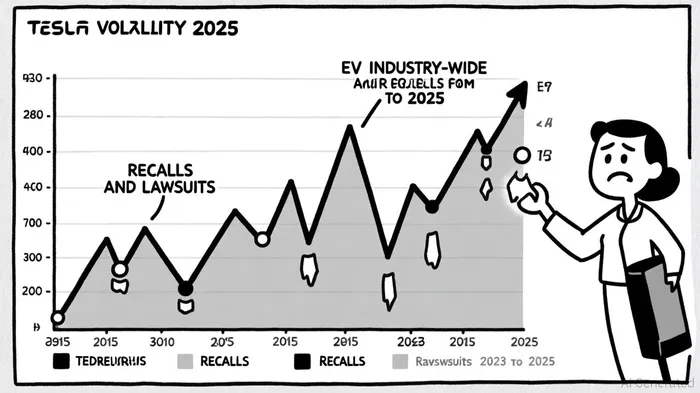





Comentarios
Aún no hay comentarios