
U.S. Automotive Market Dynamics in Q3 2025: EV Adoption Trends and Brand Competition
The U.S. automotive market in Q3 2025 witnessed a seismic shift in electric vehicle (EV) adoption, driven by a combination of federal incentives, competitive product launches, and shifting consumer preferences. As the federal EV tax credit neared its expiration on September 30, 2025, automakers and buyers alike accelerated activity, resulting in record sales and a reordering of market dynamics.
Tesla's Dominance Under Pressure
Tesla maintained its leadership in the EV segment with a 46% market share in Q3 2025, though this marked a decline from its 49% share in Q2 and a sharp drop from its 2022 peak of 62%, according to a CNBC report. The Cybertruck, launched in late 2024, became a key growth driver, with 16,692 units sold during the quarter, according to CBT News. However, Tesla's lead faces mounting challenges as traditional automakers close the gap. Analysts attribute this to Tesla's reliance on a limited product portfolio and the saturation of its early-adopter customer base, according to autoevolution.
GM and Ford: Closing the Gap
General Motors (GM) and FordF-- emerged as the most aggressive competitors, leveraging federal incentives and expanded EV lineups to capture market share. GM's EV sales surged by 105% year-to-date, with 66,501 units delivered in Q3 alone, driven by the Chevrolet Equinox EV-the top-selling non-Tesla model, according to autoevolution. Ford reported a 30.2% increase in EV sales, with 30,600 units sold, including 10,005 F-150 Lightning pickups and 20,177 Mustang Mach-Es, according to CarEdge. Both automakers benefited from the federal tax credit, which averaged 12% of the average transaction price (ATP) during the quarter, per CBT News.
The Role of Incentives and Post-Expiration Outlook
The impending expiration of the $7,500 federal tax credit catalyzed a sales surge, with Cox Automotive estimating 410,000 EVs sold in Q3-a 21% year-over-year increase and 10% of total vehicle sales, per CNBC. However, industry leaders warn of a post-incentive slump. Ford CEO Jim Farley projected a potential drop in EV market share from ~12% to as low as 5% after the tax credit lapsed, as reported by CNBC. GMGM-- and Hyundai have already begun mitigating this risk: Hyundai slashed the 2026 Ioniq 5's price by $9,800 and offered $7,500 cash incentives for 2025 models, according to autoevolution.
Broader Market Implications
The Q3 data underscores a maturing EV market, with automakers diversifying strategies. Tesla's focus on premium models contrasts with GM and Ford's emphasis on mainstream and commercial vehicles. Meanwhile, hybrid and plug-in hybrid sales-also eligible for incentives-grew by 18% year-to-date, indicating that electrification is expanding beyond pure battery-electric vehicles, according to CBT News. California's continued dominance in EV adoption (35% of national registrations) highlights regional disparities, though analysts expect broader adoption as battery costs decline, according to The Global Statistics.
Investment Considerations
For investors, the Q3 2025 data signals both opportunity and risk. Tesla's valuation remains tied to its innovation pipeline, while GM and Ford's stock performance hinges on their ability to sustain EV growth without subsidies. Automakers with diversified electrification strategies-such as Toyota's hybrid dominance-may offer more stability in a post-incentive landscape, per CBT News. However, the sector's long-term trajectory remains bullish, with the U.S. EV market projected to grow at a 10.54% CAGR through 2029, reaching $156.3 billion, according to The Global Statistics. 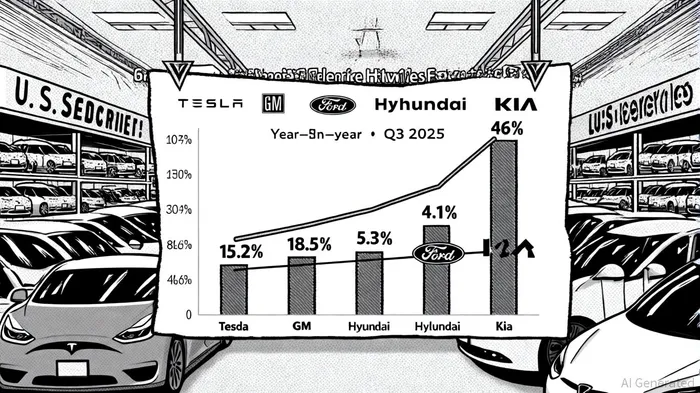







Comentarios
Aún no hay comentarios