
Automotive Industry Risk Management and Investor Confidence: The Cost of Product Recalls
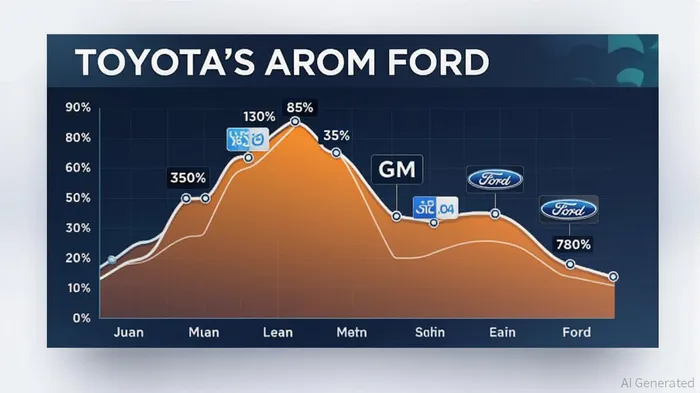
The automotive industry's ability to manage product recalls has emerged as a critical determinant of investor confidence, market valuation, and brand equity. Recent data underscores the profound financial and reputational consequences of recalls, with automakers facing not only immediate stock price volatility but also long-term erosion of consumer trust. This analysis examines how recalls impact valuation metrics, ESG scores, and brand loyalty, drawing on case studies from ToyotaTM--, General MotorsGM--, and FordF--, while highlighting the role of risk management in mitigating these effects.
The Financial Toll of Recalls: Stock Prices and Market Valuation
Product recalls often trigger sharp declines in stock prices, particularly when safety defects or fatalities are involved. For example, Toyota's 2009–2010 “unintended acceleration” recall led to a 20% drop in its stock price within a month and a 20% global sales decline, as reputational damage eroded consumer confidence [1]. Similarly, General Motors' 2014 ignition switch recall—linked to 124 deaths—resulted in a $675 million financial burden and a 15-executive purge, though its stock price fared better in the short term due to the recall's focus on older models [2].
Recent trends show no abatement. In Q1 2025, Ford led in recall volume, with 3.46 million vehicles affected by issues ranging from electrical systems to seatbelts [3]. While these recalls have not yet caused fatalities, the cumulative effect on public perception is evident. Ford's ESG score has declined due to its 2025 recall surge, reflecting heightened quality control concerns [4].
ESG Scores and Credit Ratings: The Governance Factor
ESG (Environmental, Social, and Governance) metrics have become pivotal in credit risk assessments. A 2024 study of European banks found that environmental factors positively influence credit ratings, while governance shortcomings—such as those exposed by Volkswagen's diesel emissions scandal—can trigger downgrades. Volkswagen's credit rating was slashed by S&P Global Ratings after the 2015 scandal, which revealed governance failures and environmental law violations [5].
Automakers with proactive ESG practices, such as Toyota's post-2010 recall quality reforms, recover faster. Conversely, companies with poor recall management face prolonged reputational damage. For instance, Ford's 2025 recalls have drawn scrutiny from ESG rating agencies, with its Upright Net Impact model showing a -83.0% score due to safety and emissions concerns [6].
Brand Equity and Customer Loyalty: The Long Game
Brand equity metrics are indirectly shaped by recall frequency and transparency. Toyota's brand equity plummeted from 83% positive sentiment in 2009 to 59% post-recall, recovering to 70% by 2011 but never regaining pre-crisis levels [7]. In contrast, brands like HondaHMC-- and Lexus have maintained loyalty through hybrid vehicle innovation, even amid industry-wide challenges [8].
Proactive recall strategies, such as full remedies and transparent communication, mitigate brand damage. A 2021 study found that companies offering free repairs or replacements recover customer satisfaction faster, particularly if they have strong pre-recall brand equity [9]. Ford's 2025 recall response, however, has been criticized for lacking urgency, risking long-term loyalty [10].
Strategic Implications for Investors
Investors must weigh recall risks against a company's ESG performance and crisis management capabilities. Automakers with robust quality control systems and transparent governance—such as Toyota's post-2010 reforms—demonstrate resilience. Conversely, firms with frequent recalls and weak ESG scores, like Ford in 2025, face heightened volatility.
Conclusion
Product recalls are not merely operational setbacks but systemic risks that ripple through financial, reputational, and ESG domains. For investors, the key lies in identifying automakers that prioritize proactive risk management, transparent governance, and customer-centric recall responses. As the industry transitions to electric vehicles—prone to software-related recalls—the ability to balance innovation with safety will define long-term market leaders.





Comentarios
Aún no hay comentarios