
Auto & Transport Roundup: Navigating the 2026 Market with a Value Lens
The auto industry is entering a new, more challenging cycle defined by a bifurcated consumer, policy-driven volatility, and margin compression. For a value investor, this environment is a classic test of . The structural forces at play will separate durable operators with pricing power and scale from those vulnerable to cost pressures and shifting demand.
The core thesis is one of a market cooling into a new, lower normal. Cox Automotive forecasts a . This follows a surprisingly strong 2025, which saw sales finish above year-ago levels. The 2026 slowdown is driven by a confluence of factors: slower economic growth, fewer job opportunities, and the expiration of key incentives. This sets the stage for a market where volume growth is no longer a given, forcing companies to compete more fiercely for each sale.
A critical structural shift is the end of federal EV tax credits. Their expiration at the end of September triggered a post-credit rush in the third quarter, creating a temporary sales spike. However, the long-term impact is a market adjustment. North American EV sales are expected to be down for the year, with Cox Automotive forecasting a . EV sales. Automakers are already recalibrating, with FordF-- redirecting billions from EV development toward gas and hybrid models. This policy-driven volatility introduces significant uncertainty, as future regulatory changes on tariffs and trade agreements could further disrupt pricing and production costs.
This volatility compounds with a deepening bifurcation in consumer demand. The market is splitting into two distinct segments. High-income shoppers, supported by wealth effects and lower taxes, continue to drive demand for premium vehicles. Meanwhile, affordability pressures are pushing lower-income buyers toward used vehicles, widening the gap between 'haves' and 'have-nots.' As Cox Automotive notes, the divide between high-income and low-income households is widening, accelerating trade-down behavior. This dynamic makes value perception critical across the market, but it also concentrates demand among a narrower, wealthier customer base.
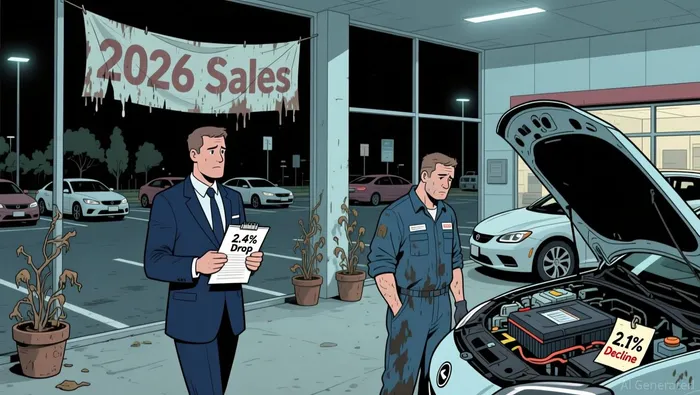
The bottom line for investors is that the 2026 landscape favors companies with wide moats. The combination of a lower-volume market, volatile policy, and a bifurcated consumer creates intense pressure on margins. Operators with strong brand loyalty, efficient scale, and pricing power will be best positioned to navigate this shift. Those without these advantages will face a relentless squeeze, as the industry settles into a more challenging, less forgiving cycle.
Assessing the Competitive Moats: GM's Discipline vs. Ford's Reset
The competitive landscape for American automakers is defined by two distinct approaches to navigating a turbulent transition. General MotorsGM-- is demonstrating the power of disciplined execution and a shareholder-focused capital return, while Ford is undergoing a costly strategic reset. The evidence points to GMGM-- holding a wider moat in the near term, built on operational consistency and a proven ability to protect intrinsic value.
GM's moat is operational. The company has beaten quarterly earnings estimates in all but one quarter over the past five years, a track record of resilience that has culminated in a . This performance is not a one-off; it is the result of relentless management of core business levers. Analysts credit GM's lead in steady unit sales growth, [average transaction price] growth, disciplined incentive spend, and inventory management, particularly on high-margin trucks and SUVs. This discipline has solidified its position as the top-selling automaker in the United States, . The company's strategic focus on profitable models and its recent recovery in China, , further reinforce this disciplined foundation.
Ford's path is one of reset. The company is shifting away from its previous, capital-intensive EV push, acknowledging slower adoption and regulatory shifts. This strategic pivot, however, comes with a significant near-term cost. , largely tied to rationalizing its U.S. EV assets. The company's new plan focuses on hybrids, gas-powered vehicles, and smaller EVs, with the goal of having its EV unit reach by 2029. This is a necessary but expensive adjustment, .
The divergence in capital allocation is stark. GM is returning excess cash to owners, , . This shareholder-friendly program is a clear signal of confidence in the company's undervalued stock. Ford, by contrast, is investing heavily in its reset, with its liquidity being used to fund the transition rather than buy back shares.
Beyond these core strategies, both companies are building future moats. GM is gaining meaningful momentum in software, . Ford's Ford Pro segment, driven by strong demand for Super Duty trucks and growing software services, remains a key growth engine. Yet, for now, GM's combination of disciplined operations, a clear capital return program, and a top-selling market position provides greater earnings visibility and downside protection. Ford's reset is a necessary strategic recalibration, but it is a costly one that will take years to fully play out.
Catalysts, Risks, and What to Watch
The path to compounding value in 2026 will be determined by how automakers navigate a bifurcated consumer and intense margin pressure. The industry's outlook hinges on a widening gap between high-income and low-income households, a dynamic that is accelerating trade-down behavior and making value perception critical. Cox Automotive forecasts that this divide will drive demand for affordable vehicles and used options, while simultaneously pressuring overall sales volume. Their new vehicle seasonally adjusted annual rate (SAAR) estimate for 2026 is , a decline from 2025 levels. This structural shift means companies must not only manage costs but also strategically position their portfolios to capture demand across this fragmented market.
Investors should watch two key execution metrics closely. For General Motors, the catalyst is the sustainability of its North American margin profile amid persistent cost pressures. The company has streamlined its lineup and focused on profitable models, but margins are being squeezed by tariffs, material costs, and the need to transition to EVs. GM's ability to maintain its strong domestic sales momentum while controlling fixed costs will be a key indicator of its profitability trajectory. For Ford, the near-term financial risk is the painful transition to its new EV strategy. The company expects to record roughly tied to rationalizing its U.S. EV assets, . The progress Ford makes in improving margins through its Universal EV Platform and battery energy storage systems will be critical to demonstrating that this costly pivot is moving toward the expected breakeven by 2029.
The overarching catalyst to watch is the evolution of tariff policy, which has already caused strategic paralysis. The Supreme Court heard arguments in November on whether President Trump can use emergency powers to impose broad tariffs, a ruling that could reshape the trade landscape. This uncertainty has delayed major investments and forced automakers into a wait-and-see posture. As 2026 unfolds, clarity-or continued ambiguity-on U.S. auto tariffs, Mexico's new regime, and European EV duties will directly influence vehicle pricing, manufacturing locations, and supply chain costs. In this environment, the ability to execute a disciplined, cost-conscious strategy while navigating a volatile policy landscape will separate companies that can compound value from those that get caught in the crossfire.





Comentarios
Aún no hay comentarios