
The Auto Supply Chain Crisis: Rising Debt, Tariffs, and Restructuring Risks in German Manufacturing
The German automotive supply chain, once a cornerstone of European industrial might, is now grappling with a perfect storm of financial strain, geopolitical tariffs, and structural reorganization. For investors, the sector's long-term viability hinges on navigating these interconnected challenges, which threaten to erode profitability, destabilize credit profiles, and reshape competitive dynamics.
Financial Strain: Debt, Margins, and Credit Downgrades
German automotive suppliers are facing a deteriorating financial landscape marked by stagnant growth, rising debt, and declining margins. According to IBISWorld, industry turnover is projected to contract by 2.2% in 2025, with annual growth since 2020 averaging a meager 1.4%. This trend reflects broader industry headwinds, including weak demand for electric vehicle (EV) components and aggressive cost pressures from original equipment manufacturers (OEMs).
Debt metrics further underscore the sector's fragility. Over 40% of the 25 largest European suppliers now hold non-investment-grade credit ratings, a sharp decline attributed to stagnant revenue and rising operational costs. EBIT margins for European suppliers fell to 3.6% in 2024, lagging behind Chinese peers, who achieved 5.7% during the same period. While some companies, such as Standard Profil Automotive GmbH, are projected to stabilize their interest coverage ratios by 2026, the immediate outlook for 2024–2025 remains bleak.
Tariff Pressures: A Geopolitical Tax on Profitability
The U.S. has emerged as a critical battleground for German automotive suppliers, with tariffs reshaping trade dynamics and squeezing margins. In 2025, U.S. tariffs on EU automotive imports surged to 13%, up from 1% in 2024, with German automakers reportedly incurring half a billion euros in costs by April alone. If a U.S.-EU trade agreement reduces tariffs to 15%, it would offer partial relief but still leave European exporters at a 12.5 percentage point disadvantage compared to pre-2024 levels.
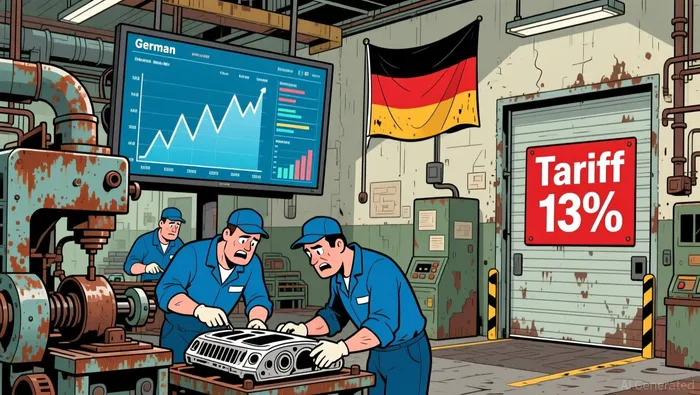
The financial toll is evident in corporate earnings. BMW reported a 16.2% year-on-year decline in operating profit for the first nine months of 2025, with tariffs reducing its EBIT margin by 1.75 percentage points in Q3 alone. Volkswagen's operating profit plummeted by 58% during the same period, with U.S. tariffs costing the company up to 5 billion euros annually. These pressures are compounded by the need to invest in EVs, which carry lower margins than traditional combustion engines.
Restructuring Challenges: Job Cuts, Strategic Shifts, and Industry Consolidation
German automotive suppliers are responding to these pressures with aggressive restructuring measures. Bosch and ZF Friedrichshafen, two industry giants, have announced over 20,000 job cuts combined to address cost gaps and declining demand. ZF has even pivoted away from pure electrification, halting internal EV component development and exploring partnerships with Chinese suppliers to reduce costs. Bosch, meanwhile, is refocusing on plug-in hybrid technologies and reevaluating its global workforce, particularly in Germany.
Structural challenges extend beyond labor. High energy and labor costs in Germany, coupled with global competition from Chinese suppliers, have forced companies to reconsider their value propositions. The European Association of Automotive Suppliers (CLEPA) has called for local content rules to protect industrial sovereignty, highlighting the risk of losing technological leadership. Meanwhile, industry consolidation is accelerating, as traditional suppliers struggle to match the agility of emerging competitors.
Strategic Adaptations: Can German Suppliers Survive the Transition?
To mitigate long-term risks, German suppliers are pursuing a mix of cost optimization and strategic innovation. Diversifying supply chains and increasing local production in the U.S. is one approach, though it requires significant capital investment. Others are accelerating investments in software-defined vehicles (SDVs) and digital user experiences, recognizing software as a key differentiator in the EV era.
Regionalization of supply chains within Europe and increased battery production are also gaining traction, aiming to reduce dependency on global logistics. However, these strategies face hurdles, including labor shortages and limited U.S. production capacity, which delay nearshoring efforts. For now, the industry remains in a state of flux, with companies balancing short-term survival with long-term reinvention.
Conclusion: A High-Risk, High-Stakes Sector
For investors, the German automotive supply chain presents a complex risk profile. While industry leaders like Bosch and ZF have the scale to weather short-term turbulence, the sector's structural challenges-rising debt, geopolitical tariffs, and margin compression-pose existential threats. Without decisive action to address cost structures, embrace innovation, and navigate trade uncertainties, European suppliers risk ceding ground to more agile competitors.
The path forward demands not just operational efficiency but a reimagining of value creation in an era defined by electrification, digitalization, and global competition. Until then, the auto supply chain crisis remains a cautionary tale for investors seeking stability in a rapidly shifting industrial landscape.







Comentarios
Aún no hay comentarios