
Auto-Parts Industry Fragility and Credit Risk: Early Warning Signals in Leveraged Corporate Behavior
The auto-parts industry, a cornerstone of global automotive manufacturing, is facing unprecedented fragility as it grapples with the dual pressures of technological disruption and financial overextension. Recent case studies and financial reports reveal a troubling pattern: leveraged corporate behavior—characterized by aggressive debt financing and opaque capital structures—is amplifying credit risk across the sector. For investors, these signals demand a closer examination of how operational and financial vulnerabilities are converging to create systemic instability.
Technological Shifts and Capital Pressures
The transition to new energy vehicles (NEVs) and autonomous driving technologies has forced auto-parts suppliers into a costly race to innovate. According to a report by McKinsey, capital expenditures for battery production and advanced driver-assistance systems (ADAS) have surged, straining cash flows for firms already burdened by legacy infrastructure costs[1]. This capital intensity is compounded by the need to navigate volatile supply chains and geopolitical tensions, which have disrupted raw material sourcing and increased production costs[1].
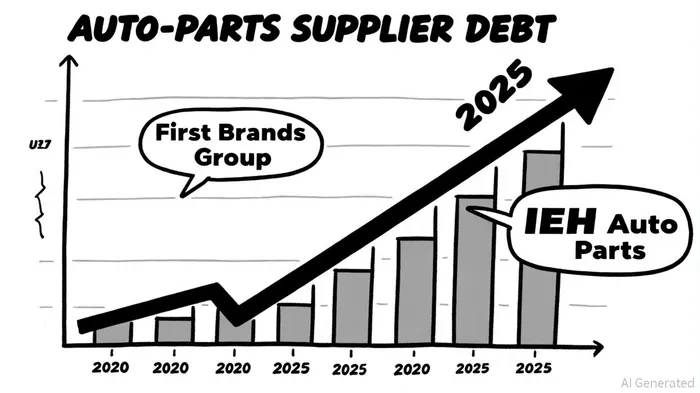
For example, IEH Auto Parts Holding LLC (Auto Plus) filed for bankruptcy in January 2023, a case that underscores the fragility of highly leveraged firms in this environment. Fitch Ratings notes that Auto Plus's restructuring highlighted how operational inflexibility and debt overhang can precipitate insolvency, even in firms with established market positions[1]. The case serves as a cautionary tale for investors: when technological pivots require rapid capital reallocation, companies with rigid balance sheets are disproportionately exposed to failure.
Supply Chain and Geopolitical Risks
The automotive supply chain has become a hotbed of financial distress. RapidRatings' analysis reveals that one-fifth of auto-parts suppliers were already in financial distress before the full impact of tariffs and inflationary pressures materialized[3]. This distress is exacerbated by opaque financing structures, as seen in the case of First Brands Group, a firm with $6 billion in debt whose loan value plummeted due to concerns over off-balance-sheet obligations tied to uncertain future revenues[1]. Bloomberg reports that such practices have eroded investor confidence, particularly in private suppliers, which are 27% more likely to face financial distress than their publicly traded counterparts[3].
The fragility is further amplified by the sector's reliance on just-in-time manufacturing models, which leave little room for error in the face of disruptions. Automotive Risk Digest #413 highlights how production delays at automakers like XpengXPEV-- and TeslaRACE-- have cascaded through the supply chain, exposing vulnerabilities in supplier liquidity and debt servicing capacity[2].
Early Warning Signals in Leveraged Behavior
For investors, the auto-parts industry's challenges present a litmus test for identifying early warning signals of credit risk. Key indicators include:
1. Elevated Debt-to-Equity Ratios: Firms with debt exceeding 80% of enterprise value are increasingly prone to insolvency, as seen in the 2024 surge of bankruptcy filings[4].
2. Opaque Financing Structures: Off-balance-sheet liabilities, such as revenue-linked loans or asset-backed securities, can mask true debt exposure until market conditions deteriorate[1].
3. Operational Inflexibility: Companies unable to pivot production to meet demand for NEVs or ADAS components face declining margins and liquidity crunches[1].
A visual representation of these trends could illustrate the correlation between supplier debt levels and bankruptcy rates over the past five years.
Implications for Investors
The auto-parts sector's fragility necessitates a recalibration of investment strategies. Diversification across suppliers with robust balance sheets and transparent capital structures is critical. Additionally, investors should prioritize firms with agile manufacturing capabilities, such as modular production systems or partnerships with NEV innovators.
However, the path forward is fraught with challenges. As Autonews notes, the sector's debt-driven dynamics are likely to accelerate consolidation, with weaker players exiting the market[4]. This could create opportunities for well-capitalized firms but also increase systemic risk if key suppliers collapse.
Conclusion
The auto-parts industry's current trajectory is a microcosm of broader financial and technological upheaval. For investors, the lesson is clear: leveraged corporate behavior, when combined with operational inflexibility and opaque financing, creates a volatile cocktail of credit risk. By scrutinizing early warning signals and favoring resilience over short-term gains, stakeholders can navigate this turbulent landscape with greater foresight.





Comentarios
Aún no hay comentarios