
Authoritarian Leadership Risks and Geopolitical Instability: Assessing the Vulnerability of Strongman Regimes
The global political landscape in 2025 remains dominated by strongman regimes, with leaders like Vladimir Putin, Xi Jinping, and Donald Trump entrenched in power. These regimes, characterized by centralized authority and weakened institutional checks, face mounting risks of sudden collapse or succession crises. For investors, understanding these vulnerabilities is critical to navigating the geopolitical and economic turbulence they generate.
Institutional Vulnerabilities in Strongman Regimes
Strongman regimes often lack formalized succession mechanisms, creating systemic fragility. As academic analyses note, authoritarian systems rely on personalized power structures, where leadership transitions depend on informal arrangements rather than institutionalized norms. This was evident in Russia, where President Vladimir Putin has empowered regional strongmen like Chechen leader Ramzan Kadyrov, who operates with significant autonomy despite nominal loyalty to Moscow. Such decentralized power dynamics create conditional allegiances, increasing the risk of internal conflict when central authority weakens.
Similarly, China's consolidation of power under Xi Jinping has eliminated term limits and marginalized potential rivals, centralizing decision-making within the CCP. While this has enabled aggressive economic and foreign policy initiatives, it has also eroded institutional depth, making the regime highly dependent on Xi's leadership. Scholars warn that this centralization exacerbates fragility, as sudden leader incapacitation or departure could trigger factional infighting.
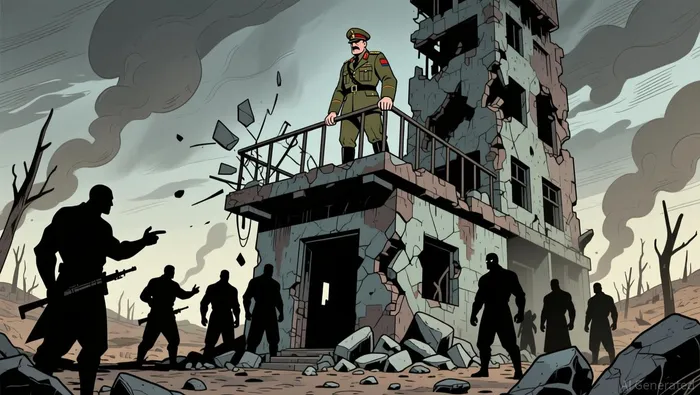
Succession Crises and Geopolitical Fallout
The absence of clear succession plans in strongman regimes raises the specter of instability. By 2025, Trump, Putin, and Xi-all in their seventies-show no signs of relinquishing power. Trump's potential violation of the two-term presidential limit, if re-elected, could ignite internal power struggles within his political movement. In Russia, Putin has explored unorthodox methods to prolong his rule, while in China, Xi's elimination of term limits has created a vacuum for post-Xi succession planning.
Historical patterns suggest that hereditary succession tends to stabilize authoritarian regimes, yet modern strongmen often lack such mechanisms. The absence of institutional constraints means power transitions are likely to be chaotic, with elites competing to fill the void. This dynamic was observed in Venezuela, where Hugo Chávez's death triggered a prolonged institutional collapse under Nicolás Maduro. For global markets, such crises could disrupt trade, escalate military tensions, and trigger capital flight from affected regions.
Economic and Investment Risks
The economic consequences of authoritarian instability are already manifesting. According to Coface, global political and social risk reached a record 41.1% in 2025, driven by armed conflicts and institutional fragility. Companies operating in these environments face heightened risks, including logistical disruptions, increased insurance costs, and contract breaches. For instance, U.S. trade policy uncertainty- marked by potential tariffs on Canada, Mexico, and China-has already caused market volatility, with tech stocks underperforming in 2025.
Strongman regimes often respond to economic shocks with deregulation and corruption, as seen in Trump's administration, where dismantling market guardrails fueled speculative bubbles. In China, state-led development programs under Xi have masked underlying economic fragility, raising concerns about long-term sustainability. Prolonged economic downturns in these regimes could provoke social unrest, further destabilizing investment climates.
Geopolitical Implications
The interplay of strongman politics and geopolitical rivalry exacerbates global instability. The U.S.-China rivalry, for example, has intensified as Beijing's Belt and Road Initiative challenges American hegemony. Meanwhile, Putin's reliance on regional strongmen has created fissures in Russia's federal system, complicating its ability to project power cohesively. For investors, these tensions translate into heightened risks of military escalation, sanctions, and trade wars, all of which disrupt global supply chains.
Conclusion
Strongman regimes, while appearing resilient, are inherently vulnerable to sudden collapse or succession crises. Their institutional weaknesses, coupled with economic and geopolitical risks, create a volatile environment for investors. As the 2025 landscape demonstrates, the absence of clear succession mechanisms and the erosion of institutional checks amplify the likelihood of instability. For investors, the imperative is clear: diversify portfolios, hedge against geopolitical shocks, and prioritize markets with stronger institutional foundations.







Comentarios
Aún no hay comentarios