
Australian Pension Fund Mega-Mergers and Their Global Investment Implications: Strategic Capital Reallocation and Enhanced Market Influence
The Australian superannuation industry is undergoing a seismic transformation. Driven by the need for operational efficiency, cost reduction, and long-term returns, pension funds are merging at an unprecedented pace. These mega-mergers are not merely consolidating assets but are reshaping the global investment landscape. As Australia's largest pension funds grow in scale and sophistication, they are reallocating capital with increasing boldness, targeting international markets-particularly the United States-and sectors like infrastructure, private equity, and real estate. The implications for global capital flows, market dynamics, and economic development are profound.
The Merger Wave: Efficiency and Scale
The recent surge in mergers reflects a strategic shift toward industry rationalization. A Deloitte report, Dynamics of the Australian Superannuation System, highlights that large funds such as AustralianSuper are leveraging their size to influence corporate dealmaking and reduce operational costs. For instance, the 2023 merger of CareSuper and Spirit Super, expected to create a fund with $40 billion in assets, underscores the industry's push to consolidate smaller players into fewer, more efficient entities, as reported by Investor Daily. Similarly, the planned 2025 merger of TelstraSuper and Equip Super-resulting in a $60 billion fund-demonstrates how scale is becoming a critical competitive advantage, according to PitchBook.
These mergers are not just about cost savings. They enable funds to pool resources for complex global investments. As KPMG's Super Insights 2025 notes, the eight largest Australian pension funds now hold over 93% of the market share, with assets exceeding $100 billion each. This concentration of capital allows mega-funds to pursue high-impact, long-term projects that smaller funds might struggle to finance.
Capital Reallocation: From Domestic to Global
The reallocation of capital is a defining feature of this new era. Australian pension funds are increasingly shifting away from traditional domestic equities and bonds toward private markets, including infrastructure, real estate, and private equity. By 2025, nearly half of Australian superannuation assets-approximately $800 billion-are already invested internationally, according to a Mandalapartners report. The United States has emerged as the primary destination, with projections indicating that Australian investments in the U.S. could surpass $1 trillion by 2035, based on an IFM Investors report.
This shift is driven by both necessity and opportunity. Domestic markets are becoming saturated, while global infrastructure gaps-particularly in the U.S.-offer attractive returns. For example, Australian Retirement Trust (ART) and Aware Super are expanding into U.S. multifamily housing and digital infrastructure, such as data centers, as SOSCIP notes. Macquarie Asset Management, a key intermediary, has facilitated investments in projects like the Long Beach Container Terminal and the Goethals Bridge Replacement Project, which combine stable cash flows with strategic economic value, according to Macquarie.
Strategic Partnerships and Sector-Specific Impacts
The influence of Australian pension funds extends beyond capital deployment. They are forming strategic partnerships with U.S. stakeholders to unlock new opportunities. A 2025 report by Mandalapartners notes that Australian funds could invest up to $240 billion in U.S. private markets by 2035 if collaboration deepens. These partnerships are not one-sided; they provide U.S. infrastructure developers with long-term, patient capital while offering Australian retirees stable returns.
Infrastructure is a prime example of this synergy. Australian investments in U.S. roads, ports, and energy projects are expected to grow from $20 billion to $110 billion by 2035, according to IFM Investors. The Indiana Toll Road and Freeport LNG are early successes, but the potential is vast. As the U.S. seeks to fund $7 trillion in infrastructure over the next decade, Australian capital is becoming an indispensable partner, as Macquarie has argued.
Measurable Market Influence
The economic impact of these investments is already measurable. For instance, AustralianSuper's $1.2 billion investment in the Transurban Chesapeake toll road network has generated consistent returns while improving regional connectivity, as reported by PR Newswire. Similarly, Aware Super's acquisition of a Brisbane office building and its plans for U.S. infrastructure projects highlight how Australian funds are diversifying their portfolios while supporting local economies, as SOSCIP has documented.
The ripple effects extend beyond infrastructure. Australian pension funds are also increasing their stakes in private credit and technology-driven sectors. For example, UniSuper's allocation to private credit and Colonial First State's pivot to unlisted infrastructure reflect a broader industry trend toward alternative assets, a trend explored by Mandalapartners. These moves are not only diversifying risk but also positioning Australian funds to capitalize on global innovation cycles.
Conclusion: A New Era of Global Capitalism
Australian pension fund mega-mergers are more than a domestic phenomenon-they are a catalyst for global capital reallocation. By consolidating assets, these funds are gaining the scale to compete with international institutional investors and fill critical infrastructure gaps in the U.S. and beyond. Their strategic focus on private markets, coupled with long-term investment horizons, positions them as key players in shaping the future of global economic development.
As these funds continue to grow, their influence will only intensify. For policymakers, investors, and economies alike, the message is clear: Australia's superannuation system is no longer just a domestic success story-it is a global force.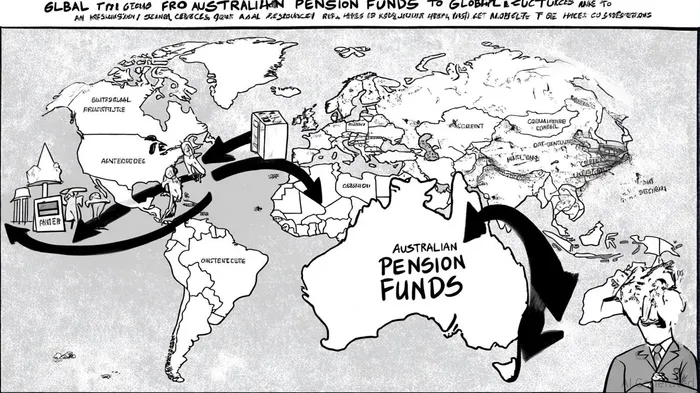







Comentarios
Aún no hay comentarios