
Australia-Singapore Defense Pact: Strategic Implications for Regional Security and Defense Stocks
The 2025 Australia-Singapore Comprehensive Strategic Partnership (CSP) marks a pivotal evolution in Indo-Pacific defense cooperation, with far-reaching implications for regional security and defense sector investments. By formalizing enhanced access to military facilities, joint training initiatives, and defense technology collaboration, the pact underscores a shared strategic vision to counter emerging geopolitical risks. For investors, this partnership creates a fertile ground for growth in defense stocks, particularly in companies positioned to benefit from expanded infrastructure, advanced manufacturing, and logistics networks.
Strategic Pillars of the 2025 CSP
The CSP 2.0 builds on the 2015 agreement, which established foundational projects like the Shoalwater Bay Training Area (SWBTA) in Queensland-a $2.25 billion joint venture that now supports large-scale training for both the Singapore Armed Forces (SAF) and the Australian Defence Force (ADF) a Ministry of Defence release. The 2025 iteration expands this cooperation to include new training areas, such as Greenvale, and formalizes access to Singapore's naval and air bases for Australian forces, enhancing regional operational flexibility, according to The Straits Times.
A key focus is defense science and technology collaboration, with both nations prioritizing breakthroughs in areas like counter-drone systems, autonomous platforms, and cyberCYBER-- resilience. For instance, Singapore's ST Engineering is producing the Titan infantry fighting vehicle, a 8x8 platform with advanced counter-drone capabilities, while Australia's DroneShield (ASX: DRO) has secured a $4.3 million U.S. government contract for its counter-drone solutions, as reported by Veye. These initiatives reflect a strategic shift toward technology-driven defense modernization.
Defense Sector Investment Opportunities
The CSP 2.0 is catalyzing growth in defense stocks across both markets. In Australia, companies like Austal Limited (ASX: ASB) are poised to benefit from increased naval procurement. Austal's FY24 EBIT surged to $61.3 million from a $4.8 million loss in FY23, driven by a $12.7 billion contract pipeline for shipbuilding and defense manufacturing, according to Stocks Down Under. Similarly, Elsight Limited (ASX: ELS) is capitalizing on demand for unmanned aerial vehicles (UAVs), with its AI-powered surveillance systems aligning with regional security needs.
Singapore's defense market is also expanding, with ST Engineering securing contracts to produce 580 Hunter Armoured Fighting Vehicles and six Multi-Role Combat Vessels, reported by Defense News. The company's expertise in advanced manufacturing positions it to capitalize on Singapore's $23.4 billion FY2025 defense budget, which includes procurement of F-35A fighter jets and Invincible-class submarines, according to The Straits Times coverage.
Broader Economic and Strategic Context
The CSP 2.0 extends beyond defense, addressing supply chain resilience, food security, and climate change-sectors that indirectly bolster defense investments. For example, Australia's $42.9 billion 2025 defense budget includes a 50% increase in acquisition spending, targeting platforms like aircraft and submarines, as noted in a GlobeNewswire report. This aligns with Singapore's push for economic resilience, ensuring uninterrupted access to critical goods during disruptions.
Analysts highlight the CSP's role in stabilizing supply chains for defense logistics. As stated by Singapore's Prime Minister Lawrence Wong on ABC News, the partnership aims to mirror the U.S.-Singapore defense facility arrangements, enabling Australia to leverage Singapore's strategic location for regional operations. This synergy is expected to drive demand for companies specializing in military logistics and infrastructure upgrades.
Risks and Considerations
While the CSP 2.0 presents compelling opportunities, investors must consider geopolitical uncertainties and regulatory risks. For instance, tensions in the South China Sea or shifts in U.S. Indo-Pacific policy could influence the pace of joint projects. Additionally, defense contracts often involve long lead times and regulatory approvals, which may affect short-term stock performance.
Conclusion
The Australia-Singapore Defense Pact represents a strategic deepening of ties that transcends traditional alliances. For investors, the CSP 2.0 offers a unique opportunity to capitalize on defense sector growth in two nations committed to regional stability. Companies like Austal, DroneShield, and ST Engineering are well-positioned to benefit from this collaboration, while broader economic initiatives under the CSP provide a tailwind for long-term value creation. As both countries navigate a complex geopolitical landscape, the defense sector stands to gain from their shared vision of innovation, resilience, and strategic trust.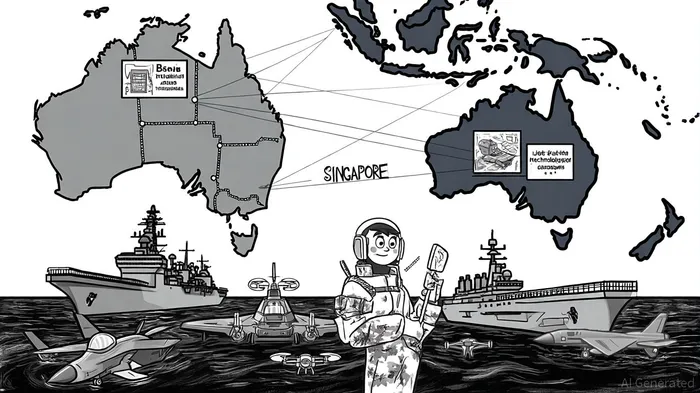







Comentarios
Aún no hay comentarios