
Australia's Iron Ore Quality Decline: Navigating the Shift to Low-Grade Opportunities and Infrastructure Plays
The global iron ore market is undergoing a seismic shift. Australia's dominance in high-grade hematite is waning as declining ore quality and evolving demand dynamics redefine industry priorities. With iron ore prices projected to fall to US$74/mt by 2027, investors must pivot toward strategic plays in low-grade reserves and logistics infrastructure to capitalize on this transition. This analysis explores how lower-grade ores are driving demand, the role of China's steel adjustments, and emerging pricing benchmarks—while identifying investments poised to thrive in this new era.
The Rise of Low-Grade Ores: From Liability to Opportunity
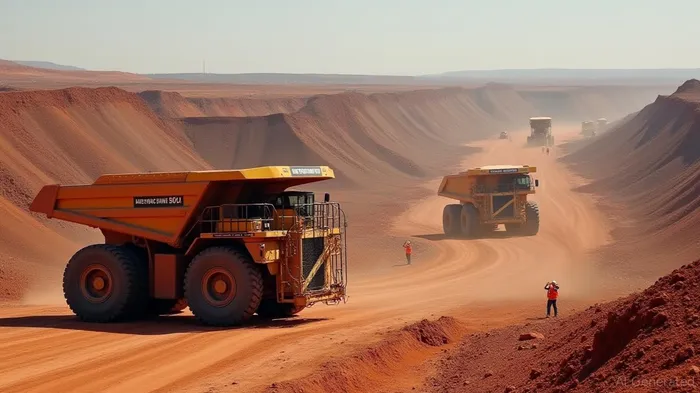
Australia's iron ore production has long relied on hematite, a lower-grade ore with ~62% iron content, which now accounts for 95% of output. Historically seen as less valuable than magnetite (a higher-grade, 65%-70% iron ore), hematite is now gaining traction due to two key trends:
1. Cost-cutting in Chinese steelmaking: Mills are blending lower-grade ores (e.g., 50.72% Fe) to reduce costs amid weak demand. This shift has driven a 28% drop in iron ore prices since 2024, favoring producers with cost-efficient low-grade reserves.
2. Adaptation for green steel: While magnetite is preferred for direct reduced iron (DRI) production—a cornerstone of low-carbon steel—technological advancements like electric smelting furnaces are enabling hematite to compete. Australia's renewable energy capacity (wind/solar) positions it to power this transition, potentially turning low-grade reserves into assets for green iron exports.
China's Steel Adjustments: A Double-Edged Sword
China's steel industry, which consumes ~70% of global iron ore, faces structural headwinds:
- Weak demand: China's construction PMI hit a one-year low in July 2024, with housing prices falling to 2015 levels. Steel production dropped 9% month-on-month, reducing iron ore purchases.
- Policy shifts: Beijing's reluctance to boost stimulus and focus on deleveraging debt have slowed infrastructure spending, further压制 demand.
However, this has accelerated cost optimization:
- Mills are blending lower-grade ores to reduce input costs.
- Stimulus measures, like a 50-basis-point reserve cut in early 2025, injected liquidity but failed to reignite steel consumption.
The result? A new pricing paradigm where iron ore's value depends less on pure iron content and more on consistency, supply reliability, and adaptability to green steel processes.
New Global Benchmarks: Beyond the Pilbara Blend
The traditional Pilbara Blend (PB) fines—long the mid-grade benchmark at 62% Fe—are losing relevance. In 2025, PB's iron content dropped to 60.8%, prompting calls to recalibrate indices to 61% Fe. This shift reflects two realities:
1. Lower-grade ores are here to stay: Mills are prioritizing cost-effective blends over pure Fe content.
2. Brand diversification: Buyers now evaluate suppliers based on chemical purity and logistical efficiency, not just grade.
This creates opportunities for miners with diverse, low-grade reserves and the infrastructure to deliver them reliably.
Investment Playbook: Miners and Logistics Firms to Watch
1. Miners with Low-Grade Reserves
Investors should target producers with cost-efficient, low-grade hematite reserves and exposure to green steel infrastructure:
- Fortescue Metals Group (FMG): Its Iron Bridge project prioritizes low-cost extraction and has partnerships (e.g., NeoSmelt) to transition to green hydrogen.
- BHP: The South Flank mine balances low-grade production with high operational efficiency, while its magnetite reserves position it for green steel demand.
- Mineral Resources (MRL): Onslow mine expansion focuses on low-grade hematite extraction at US$10/mt cash costs, one of the industry's lowest.
2. Infrastructure Plays
- Port operators: Increased trade of lower-grade ores requires robust logistics. Port of Dampier (owned by FMG) and Port Hedland (BHP/Rio Tinto) handle 80% of Australian exports—rising volumes will boost their margins.
- Rail and terminal operators: Champion Infrastructure and Aurizon benefit from higher freight volumes as low-grade ores require greater transport capacity.
- Renewable energy projects: Solar/wind facilities (e.g., Edify Energy) supporting green steel production align with miners' decarbonization goals.
Risks and Considerations
- Competition: Brazil (Vale) and Canada (Sherritt) are advancing green hydrogen-based steelmaking, while Guinea's Simandou project (set to add 70 mt/year by 2026) could flood markets.
- Policy uncertainty: China's stimulus timing and Australia's emissions regulations will influence the pace of green steel adoption.
- Price volatility: Falling iron ore prices (to US$85/mt in 2025) may pressure margins unless miners can reduce costs further.
Conclusion: Position for Resilience and Transition
The decline of Australia's iron ore quality is not an end but a pivot. Investors who focus on low-grade producers with cost discipline and logistics firms enabling global trade can profit from this transition. While risks exist, the structural shift to green steel and China's cost-driven strategies make this sector ripe for strategic bets.
Recommendation:
- Buy: FMG, BHP, MRL.
- Hold: Port operators and renewable energy infrastructure firms.
- Avoid: High-cost producers lacking low-grade reserves or green transition plans.
The iron ore market is evolving—adapt or be left behind.







Comentarios
Aún no hay comentarios