
Aurora Innovation: Assessing Its Position on the Autonomous Trucking S-Curve
The autonomous trucking sector is moving decisively from a technical experiment toward a foundational industrial system. This shift is driven by powerful, structural forces: chronic driver shortages, rising logistics costs, and the predictable nature of highway operations. For investors, the question is no longer about the technology's feasibility, but about which companies are building the essential rails for this paradigm shift in freight logistics.
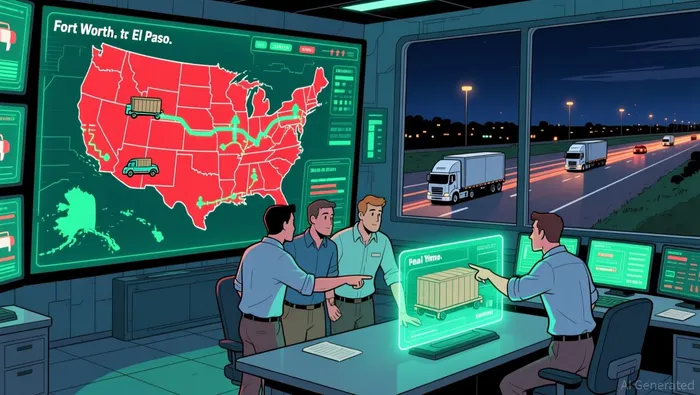
Aurora Innovation is positioning itself as that infrastructure layer. The company is validating commercial viability at an accelerating pace. It has just surpassed 100,000 driverless miles on public roads and rapidly scaled to a second commercial route, launching a 600-mile lane from Fort Worth to El Paso just six months after its initial Dallas-to-Houston run. This isn't incremental testing; it's the early construction of a repeatable, scalable network. The parallel progress at Kodiak AI, a key competitor, shows the sector's momentum, with the company reporting a 166% increase in paid driverless hours through the third quarter of 2025. Together, these milestones signal the industry is crossing the chasm from pilot programs to the first stages of deployment.
Yet, the market's current valuation tells a different story. Despite this operational progress, Aurora InnovationAUR-- scores a 3 out of 6 on our valuation checks. This score captures a common disconnect: the market is pricing the company based on its current losses and cash burn, while the long-term potential lies in its role as the foundational software and hardware platform for an entire new freight network. The company's plan to deploy hundreds of driverless trucks next year with its next-generation hardware underscores this infrastructure play. The bottom line is that the stock's volatility reflects this tension between near-term financial pressure and the exponential growth trajectory promised by a technology that is finally moving from the lab to the highway.
Building the Infrastructure Layer: Partnerships, Scale, and Compute Power
Aurora's recent moves are a clear blueprint for building the infrastructure layer. The company is no longer just testing technology; it's forging commercial partnerships, planning massive hardware scale, and embedding its platform into the logistics workflow. These are the critical steps for crossing the chasm from pilot to profitable deployment.
The first major validation came with its agreement with Detmar Logistics. This deal marks the first time frac sand will be hauled autonomously on public roads and highways in the Permian Basin. It's a significant commercial lane, not a lab experiment. By transporting proppants around the clock for a major energy producer, Aurora is delivering immediate, measurable value-doubling customer asset utilization and improving safety in a high-risk region. This partnership establishes a repeatable model for integrating autonomous trucks into specialized, high-utilization freight operations.
Scaling this model requires a leap in hardware and production. Aurora's plan to deploy hundreds of driverless trucks with its next-generation Aurora Driver hardware in 2026 is the key test of its infrastructure scalability. The new platform is designed to reduce overall cost by half while boosting performance. This cost reduction is essential for achieving the economics of scale. The integration of this hardware with multiple truck platforms, like the International LT Series, signals a move toward a standardized, deployable system rather than a bespoke solution for each customer.
Finally, Aurora is accelerating adoption by embedding its technology into the logistics ecosystem. Its partnership with McLeod Software, a major logistics management provider, allows customers to more easily integrate the AV firm's technology into their operations. This is a classic infrastructure play: by making the technology accessible through existing software platforms, Aurora lowers the barrier to entry for carriers and shippers. It turns autonomous driving from a standalone hardware purchase into a seamless operational upgrade.
The parallel progress at Kodiak AI, which recently partnered with Bosch to scale manufacturing, shows this is a sector-wide race to build the rails. For Aurora, the combination of a validated commercial route, a plan for massive, lower-cost hardware deployment, and deep software integration is the setup for exponential growth. The company is laying down the fundamental infrastructure for the next freight network.
Financial Reality vs. Exponential Potential: The Valuation Disconnect
The market's current skepticism is a direct reflection of Aurora's financial reality. The stock is down 31.8% year to date and has been volatile, with a 5.2% slip in the last week. This pressure is understandable; the company is burning cash, with a Free Cash Flow of about $614.5 Million over the last twelve months. The valuation checks show a 3 out of 6 score, highlighting the risks of its unprofitability and cash burn. Yet, this near-term pain is the cost of building the rails for a paradigm shift.
The long-term thesis, however, is priced for exponential growth. Despite the recent decline, the stock has still delivered a 249.6% gain over three years. This bumpy, speculative run captures the market's bet on autonomous trucking's infrastructure potential. The recent 10.1% rise over 30 days, followed by a pullback, shows how sentiment swings on news of partnerships and progress. This volatility is the hallmark of a stock caught between its current losses and its future promise.
Institutional interest provides a counterweight to retail skepticism. Cathie Wood's Ark Autonomous Technology & Robotics ETF holds Aurora, viewing it as a leader in the autonomous mobility infrastructure play. This isn't a bet on quarterly earnings; it's a strategic allocation to a foundational technology layer. The ETF's holdings are a portfolio of first principles bets on exponential curves, from reusable rockets to adaptive robotics. Aurora's inclusion signals that some of the smartest capital in the market sees the company as a core component of the next freight network.
The primary risk to this thesis is a slower-than-expected adoption rate. The entire investment case hinges on the autonomous trucking sector crossing the chasm from pilot to profitable deployment at scale. If regulatory hurdles, safety concerns, or economic hurdles extend the timeline for commercial viability, the period of unprofitability will lengthen. This would challenge the exponential growth narrative and put further pressure on a stock already priced for a steep adoption curve. The bottom line is that Aurora's valuation is a bet on the speed of that adoption.
Catalysts, Risks, and What to Watch: The Path to Exponential Adoption
The path from infrastructure builder to profitable network operator is now defined by a series of near-term milestones. For Aurora, the most critical test is the execution of its plan to deploy hundreds of driverless trucks with its next-generation Aurora Driver hardware in 2026. This isn't just a production target; it's the ultimate validation of its scalability thesis. Success here would demonstrate the company's ability to move from a handful of pilot trucks to a sizable, cost-optimized fleet. The integration of this new hardware with platforms like the International LT Series, slated for observer-free deployment in the second quarter, is a key technical checkpoint. Each delivered truck is a data point on the adoption curve.
Regulatory developments across states represent the next major uncertainty. While Aurora plans to launch its fully autonomous trucks on public roadways this year, as noted in recent industry updates, the pace of state-by-state legislation can either accelerate or delay mass deployment. The sector is navigating a patchwork of rules, and any significant regulatory hurdle in a key freight corridor could slow the commercial ramp. This creates a parallel timeline to watch: the company's operational readiness versus the legal framework enabling it.
The primary risk to the entire exponential growth narrative is a slower-than-expected adoption rate. The market's current skepticism, reflected in the stock's 31.8% year-to-date decline, is a direct bet on the speed of this adoption. If the transition from pilot programs to profitable, large-scale operations takes longer than anticipated, the period of unprofitability and cash burn will extend. This would challenge the foundational assumption of an accelerating S-curve and put further pressure on a stock already priced for a steep climb. The company's perfect driverless safety record and validated commercial routes are strong foundations, but the real test is whether these can be replicated at the scale required to turn the infrastructure play into a cash-generating network.







Comentarios
Aún no hay comentarios