
AUKUS and the Strategic Value of Defense Industrial Partnerships: Unlocking Long-Term Geopolitical Stability and Investment Potential in the Indo-Pacific Defense Sector
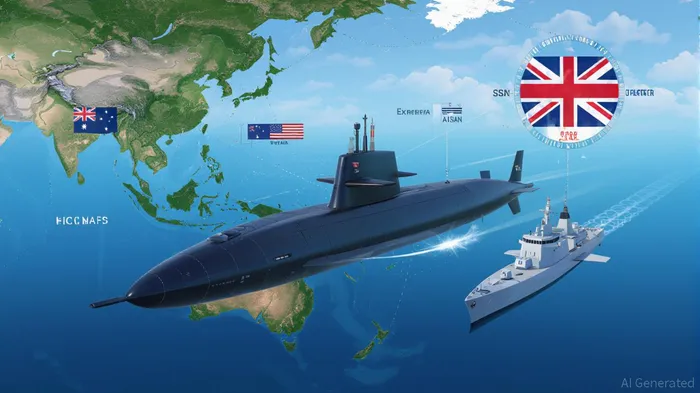
The Indo-Pacific is no longer just a region—it's a battleground for the 21st century. As China's military ambitions collide with U.S. strategic rebalancing, the AUKUS partnership has emerged as a cornerstone of stability. For investors, this isn't just about geopolitics; it's about a seismic shift in defense industrial collaboration that could redefine the global economy. Let's break down why AUKUS—and its sister initiative, the Partnership for Indo-Pacific Industrial Resilience (PIPIR)—are not just strategic necessities but golden opportunities for long-term gains.
The AUKUS Blueprint: A Fusion of Military and Industrial Power
AUKUS isn't just a security pact—it's a masterclass in industrial integration. Pillar I, the nuclear-powered submarine program, is a 20-year project with a $40 billion price tag for Australia alone. But the real magic lies in Pillar II: advanced technologies like AI, quantumQMCO-- computing, and autonomous systems. These aren't speculative bets; they're the bedrock of next-generation warfare.
Consider the Maritime Big Play exercise during Talisman Sabre 2025, where AUKUS partners demonstrated seamless control of uncrewed systems across continents. This isn't just interoperability—it's a glimpse into the future of warfare, where software and algorithms outpace traditional hardware. For investors, this means betting on the companies that can scale these technologies.
PIPIR: The Economic Engine Behind AUKUS
PIPIR is the unsung hero of this equation. By establishing secure supply chains and in-theater repair capabilities, it's reducing the Indo-Pacific's reliance on Chinese manufacturing. Projects like the P-8 radar repair hub in Australia and standardized small drone production are creating a regional industrial ecosystem. This isn't just about defense—it's about building a $500 billion defense industrial base by 2030.
Take the Replicator Initiative, a U.S. push to flood the battlefield with low-cost drones. AUKUS partners are already aligning their supply chains to counter China's dominance in this space. For investors, this means opportunities in firms like BAE Systems (BAESF) and Lockheed Martin (LMT), which are leading AUKUS's submarine and AI programs.
Risks and Realities: Not All That Glitters Is Gold
Of course, no investment is without risks. AUKUS's success hinges on political alignment. A shift in Australian or U.S. leadership could slow progress, as could budget shortfalls. Additionally, the SSN-AUKUS submarine program is still years from deployment, and delays are par for the course in defense procurement.
But here's the kicker: AUKUS is a long-term play. The U.S. has already allocated $79.8 million for AUKUS Pillar II in 2025, triple the 2024 budget. This isn't a flash in the pan—it's a sustained commitment.
The Investor Playbook: Where to Put Your Money
- Defense Tech Titans:
- Raytheon (RTX): Leading in AI and electronic warfare, RTXRTX-- is a Pillar II workhorse.
- Northrop Grumman (NOC): Its expertise in autonomous systems aligns perfectly with AUKUS's “Hellscape” vision of massed drones.
BAE Systems (BAESF): Co-building Australia's SSN-AUKUS submarines, BAE is a must-watch.
Emerging Innovators:
- Kratos Defense (KTOS): A key player in low-cost drone production for the Replicator Initiative.
L3Harris Technologies (LHX): Supplying secure communication systems for AUKUS's quantum computing projects.
Industrial Resilience Stocks:
- General Dynamics (GD): Managing the Virginia-class submarine sales to Australia.
- Boeing (BA): Involved in P-8 radar system upgrades under PIPIR.
The Bottom Line: AUKUS as a Macro-Play
AUKUS isn't just about countering China—it's about building a resilient, high-tech industrial base that can outperform rivals. For investors, this means capitalizing on the convergence of geopolitics, technology, and industrial policy.
The key is to think beyond quarterly earnings. AUKUS's submarine program will take decades to mature, but the intermediate wins in AI, quantum, and drones are already materializing. By 2040, the Indo-Pacific defense sector could be a $1 trillion market.
So, what's the takeaway? Diversify your portfolio with defense industrial partnerships. These aren't just “safe” stocks—they're the engines of a new geopolitical era. In a world where stability is bought with technology, AUKUS is the blueprint. And for those with the patience to ride the long game, the rewards could be monumental.





Comentarios
Aún no hay comentarios