
August PPI Surprise: A Turning Point in Inflation Dynamics?
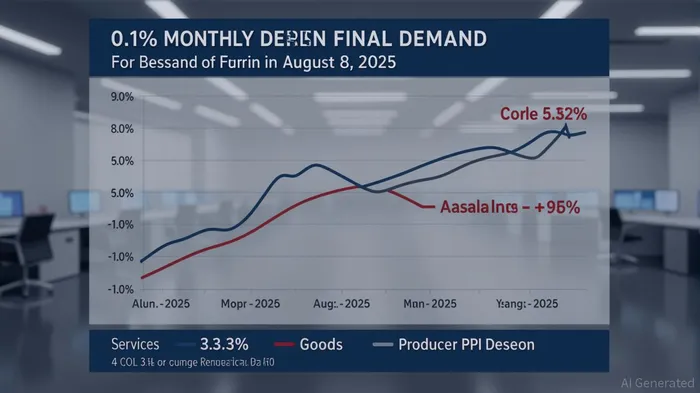
The August 2025 Producer Price Index (PPI) data has ignited a critical debate about the trajectory of U.S. inflation and its implications for Federal Reserve policy. According to the U.S. Bureau of Labor Statistics, the PPI for final demand fell by 0.1% on a seasonally adjusted basis in August, marking the first decline in four months[1]. This follows a 0.7% increase in July and a 0.1% rise in June, underscoring the volatility in producer-level inflation. While the annual rate of 3.3% remains near the highest levels since February 2025, the core PPI—excluding food and energy—eased slightly to 3.5% from 3.7%[2]. These figures suggest a nuanced picture: services inflation is cooling, but goods and structural bottlenecks persist.
The Fed's Dilemma: Tariffs, Services, and Structural Pressures
The Federal Reserve faces a complex calculus as it weighs the August PPI data against its dual mandate of price stability and maximum employment. Recent FOMC minutes reveal a committee deeply divided over the inflationary risks posed by tariffs[4]. While the July meeting left the federal funds rate unchanged at 4.25–4.5%, officials emphasized the need to monitor the full effects of tariffs on consumer prices[2]. The August PPI data, however, complicates this outlook. The 0.2% decline in services prices—driven by a 1.7% drop in trade services margins—signals some easing in service-sector inflation[1]. Yet, the 0.1% rise in goods prices, fueled by a 2.3% surge in tobacco product costs, highlights the stickiness of goods inflation[1].
Intermediate demand data further muddies the waters. Processed goods for intermediate demand rose 0.4%, led by a 5.5% jump in aluminum mill shapes, while unprocessed goods fell 1.1% due to a 2.8% drop in crude petroleum prices[1]. This duality reflects the Fed's challenge: addressing inflationary pressures from tariffs and supply bottlenecks without stifling economic growth.
Market Reactions: Gold, Equities, and the Yield Curve
Financial markets have responded to the PPI surprise with mixed signals. Gold, a traditional inflation hedge, rebounded above $3,650 as traders priced in the possibility of delayed rate cuts and a weaker U.S. dollar[2]. Meanwhile, equity markets showed resilience, with the S&P 500 hitting all-time highs on expectations of lower borrowing costs[1]. However, rate-sensitive sectors like technology and real estate faced headwinds, as investors anticipated a potential "sell-the-news" reaction if the Fed adopts a more cautious stance[1].
Bond markets told a different story. U.S. Treasury yields, particularly short-term ones, edged higher, reflecting a recalibration of Fed policy expectations[5]. The 2-year Treasury yield, a proxy for near-term rate expectations, surged as markets digested the PPI data[5]. This contrasts with earlier trends of easing yields, underscoring the market's skepticism about a swift return to the Fed's 2% inflation target.
Commodities, meanwhile, were shaped by geopolitical tensions. Crude oil prices fluctuated amid Trump's proposed tariffs on India and China, while gold benefited from central bank purchases and economic uncertainty[2].
Is This a Turning Point?
The August PPI data may represent a pivotal moment in the inflation narrative. While services inflation is showing signs of moderation, core PPI remains stubbornly high at 3.5%, indicating that structural bottlenecks—such as supply chain disruptions and tariff-driven costs—continue to anchor inflation[4]. For the Fed, this creates a dilemma: cutting rates too soon risks unanchoring inflation expectations, while delaying cuts could exacerbate labor market weaknesses. August non-farm payrolls added only 22,000 jobs, far below expectations[3], adding urgency to the Fed's decision-making.
The September 16–17 FOMC meeting will be critical. While markets currently price in an 88.2% probability of a 25-basis-point rate cut, the PPI data may push officials toward a more cautious approach[4]. If the upcoming CPI report confirms sticky inflation, the Fed could delay rate cuts, further pressuring risk assets. Conversely, a dovish pivot could spur a rally in equities and commodities but risk prolonging inflationary pressures.
Conclusion
The August PPI surprise underscores the fragility of the Fed's balancing act. While services inflation is cooling, goods inflation and structural bottlenecks remain entrenched, complicating the path to the 2% target. For investors, the key takeaway is to brace for volatility as the Fed navigates this complex landscape. The coming months will test whether this PPI data marks a turning point—or merely a pause in the broader inflationary trend.







Comentarios
Aún no hay comentarios