
The August Jobs Report and Fed Easing: A Bullish Case for Treasuries and AI-Driven Tech Exposure
The August 2025 U.S. Jobs Report has ignited a pivotal debate about the Federal Reserve’s next move, with implications cascading across asset classes. Nonfarm payrolls added just 22,000 jobs, far below the projected 75,000, while the unemployment rate climbed to 4.3%—the highest since 2021 [1]. This data, coupled with sectoral shifts (healthcare gains offsetting losses in manufacturing and government), signals a labor market losing steam. For investors, the report crystallizes a strategic inflection point: a Fed easing cycle that could simultaneously bolster Treasuries and supercharge AI-driven tech equities.
Fed Policy and the Case for Treasuries
The Fed’s dual mandate—price stability and maximum employment—now faces a delicate balancing act. While average hourly earnings rose 0.3% (in line with forecasts), the weak payroll numbers and rising unemployment have pushed markets to price in a 100% probability of a 25-basis-point rate cut in September, with a 12% chance of a 50-basis-point move [1]. Historically, rate cuts have supported bond markets by reducing the opportunity cost of holding fixed-income assets.
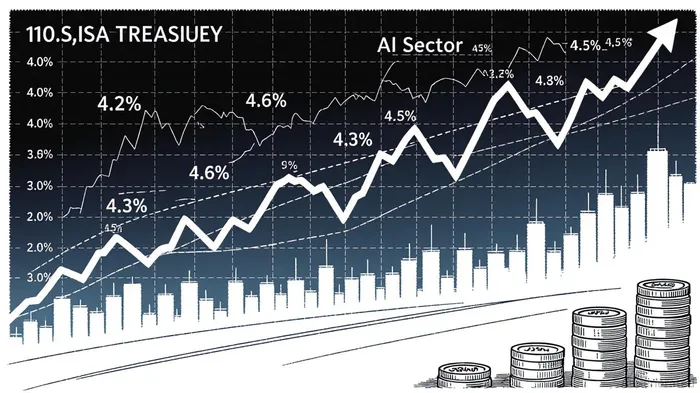
For Treasuries, the August report strengthens the case for tactical allocation. The 10-year Treasury yield, rangebound between 4.2% and 4.6% since April 2025, may face downward pressure as rate-cut expectations intensify [4]. A 25-basis-point cut would likely trigger a yield inversion correction, with long-term yields falling faster than short-term ones, steepening the yield curve. This dynamic benefits long-duration bonds, particularly as inflation expectations remain anchored. According to a report by S&P GlobalSPGI--, the 10-year yield closed August at 4.2%, while the 2-year yield stood at 3.89%, creating a 32-basis-point positive spread—a rare sign of optimism in a tightening cycle [5]. Investors should prioritize Treasury ETFs and long-dated bonds, leveraging the Fed’s dovish pivot to lock in higher yields before further cuts.
AI-Driven Tech: The New Inflation Hedge
While Treasuries offer defensive appeal, the AI sector presents a compelling offensive case. The anticipated rate cuts will lower borrowing costs for capital-intensive industries, directly benefiting AI, cloud computing, and semiconductor firms. As UBSUBS-- notes, companies like NVIDIANVDA-- and cloud providers are already capitalizing on reduced financing costs to accelerate R&D and infrastructure expansion [1]. This aligns with broader macro trends: global fiscal easing and fading trade tensions have bolstered risk appetite, with AI-driven earnings growth outpacing traditional sectors [3].
The macro-sectoral divergence is stark. Traditional sectors like consumer staples and utilities may benefit from lower rates, but AI’s structural tailwinds—driven by productivity gains and cross-industry adoption—are more profound. For instance, the S&P Global AI Technology Index has outperformed the S&P 500 by 18% year-to-date, reflecting capital flows toward innovation [2]. Morgan StanleyMS-- analysts caution that not all sectors will thrive in a rate-cut environment; financials and consumer discretionary stocks could lag due to compressed margins and persistent long-term borrowing costs [2]. However, AI’s ability to scale with minimal marginal costs makes it uniquely positioned to capitalize on cheaper capital.
Strategic Allocation Amid Divergence
The August jobs report underscores a critical juncture for asset allocators. A Fed easing cycle, while supportive of Treasuries, also creates a fertile environment for AI-driven equities. The key lies in balancing duration risk in fixed income with high-conviction tech exposure.
- Treasuries as a Safe Haven: Allocate 20–30% of fixed-income portfolios to long-duration Treasuries, leveraging the yield curve’s steepening potential.
- AI-Linked Equities: Overweight AI infrastructure (semiconductors, cloud services) and applications (generative AI, robotics) in equity portfolios.
- Hedging Divergence: Use sector rotation to underweight rate-sensitive financials and consumer discretionary stocks, which face margin compression.
The Fed’s pivot, combined with AI’s transformative potential, creates a rare alignment of macro and sectoral forces. Investors who act decisively can harness this divergence to build resilient, high-conviction portfolios.
**Source:[1] Jobs report August 2025: Payrolls rose 22000 in ... [https://www.cnbc.com/2025/09/05/jobs-report-august-2025.html][2] Where Smart Money is Flowing as AI and Rate Cuts Loom [https://markets.financialcontent.com/wral/article/marketminute-2025-9-4-sector-spotlight-where-smart-money-is-flowing-as-ai-and-rate-cuts-loom][3] Analysis of the international stock market situation (2025) [https://isdo.ch/analysis-of-the-international-stock-market-situation-summer-2025/][4] How Changing Interest Rates Impact the Bond Market [https://www.usbank.com/investing/learning-and-insights/market-news/interest-rates-affect-bonds.html][5] Q1 2025 Quarterly Market Review | TD Wealth [https://www.td.com/us/en/investing/learning-and-insights/quarterly-market-review-q125]





Comentarios
Aún no hay comentarios