
Atrae Inc's Treasury Share Retirement: Strategic Moves to Boost Shareholder Value and EPS Growth
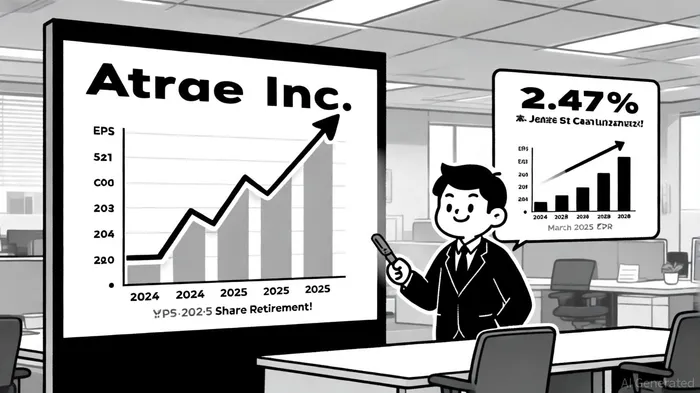
Atrae Inc's recent announcement to retire treasury shares worth 2.47% of its outstanding stock by March 31, 2025, underscores a calculated effort to optimize its capital structure and enhance shareholder value[1]. With 23.25 million shares outstanding as of March 2025[2], the retirement of approximately 573,000 shares (calculated from 2.47% of 23.25 million) will directly reduce the denominator in earnings per share (EPS) calculations, potentially amplifying EPS growth. This move aligns with the company's broader strategy to reward shareholders through capital efficiency, particularly in its staffing and employment services sector, where competitive differentiation is critical[3].
Strategic Impact on Earnings Per Share (EPS)
The retirement of treasury shares is a textbook method to elevate EPS, assuming net income remains constant. Atrae's Q1 2025 financial results provide a compelling baseline for analysis: the company reported a net income of ¥430.38 million and an EPS of ¥18.22, reflecting a 109.44% quarter-over-quarter surge in consolidated net profit[4]. By reducing the share count, the same net income will be distributed across fewer shares, mechanically increasing EPS. For instance, if Atrae maintains its Q1 2025 net income in subsequent quarters, the post-retirement EPS could rise by approximately 2.5% (calculated as 1 / (1 - 0.0247) - 1), assuming no additional share issuance.
Longer-term forecasts further validate this trajectory. Analysts project an annual EPS growth rate of 19.2% for Atrae, outpacing the Japanese market average[5]. This growth is underpinned by a forward price-to-earnings (PE) ratio of 13.96[6], suggesting the market anticipates robust earnings expansion. The share retirement, combined with a projected return on equity (ROE) of 24.2% in three years[5], positions Atrae to deliver compounding value to shareholders through both earnings growth and a shrinking share base.
Shareholder Value Enhancement and Capital Allocation
Atrae's decision to retire shares reflects disciplined capital allocation, a critical factor in sustaining investor confidence. The company has also demonstrated a commitment to shareholder returns through dividend increases, including a recent hike to ¥31.00 per share[5]. This dual approach—reducing shares while raising dividends—signals management's confidence in its cash flow generation and long-term profitability.
The staffing and employment services sector, in which Atrae operates, is highly sensitive to labor market dynamics. By shrinking its share count, Atrae not only boosts EPS but also strengthens its balance sheet, enabling greater flexibility to invest in its Sports Tech segment, which aims to build globally scalable services[3]. This strategic reallocation of resources could further diversify revenue streams and insulate the company from sector-specific volatility.
Accounting and Market Implications
From an accounting perspective, retiring treasury shares permanently reduces the number of issued shares, unlike buybacks, which hold shares in treasury. This adjustment affects both basic and diluted EPS calculations, as the weighted average shares outstanding are recalculated from the retirement date[7]. For Atrae, this means the March 2025 retirement will immediately impact Q2 and subsequent earnings reports, potentially accelerating EPS growth visibility for investors.
Market reactions to such moves are often positive, particularly when executed alongside strong earnings performance. Atrae's Q1 results, coupled with its share retirement plan, have already driven a forward PE contraction from its trailing 27.69 multiple[6], indicating improved valuation metrics. This suggests that the market is pricing in the anticipated EPS uplift and the company's broader capital efficiency initiatives.
Conclusion
Atrae Inc's treasury share retirement is a strategic lever to enhance shareholder value through EPS growth and capital efficiency. With a proven track record of earnings acceleration, a forward-looking capital structure, and a diversified business model spanning staffing and Sports Tech, the company is well-positioned to capitalize on its current momentum. Investors should closely monitor the post-retirement EPS trajectory and the execution of its Sports Tech initiatives, which could further unlock long-term value.







Comentarios
Aún no hay comentarios