
Atlassian's AI-Driven Transformation: A Strategic Path to Long-Term Value Creation in Enterprise SaaS
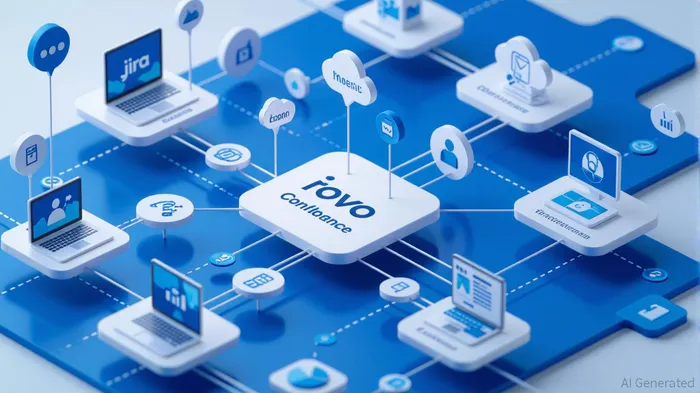
Atlassian, a cornerstone of the enterprise SaaS sector, is undergoing a strategic metamorphosis that positions it as a leader in AI-native collaboration tools. With a 25% year-over-year cloud revenue growth in Q3 FY2025[1] and a customer base of 49,449 paying over $10,000 in Cloud ARR[2], the company is leveraging its product innovation and AI integration to address evolving enterprise needs. This analysis explores how Atlassian's strategic bets on AI, cloud-first execution, and enterprise-grade solutions are driving long-term value creation in a competitive market.
Product Innovation and AI Integration: The Rovo Revolution
Atlassian's 2024-2025 product roadmap underscores its commitment to AI-driven workflows. The launch of the Customer Service Management app[3] and Teamwork Collection[3]—a suite of integrated apps powered by Rovo agents—demonstrates the company's focus on cross-functional collaboration. Rovo, now embedded in all Premium and Enterprise editions of Jira, Confluence, and Jira Service Management[3], automates tasks such as generating release notes from sprint data[5], reducing manual effort and accelerating delivery cycles.
The company's AI ambitions extend beyond automation. Atlassian Intelligence[5] and Atlassian Studio[5], a no-code/developer-friendly hub for building AI agents, signal a shift toward democratizing AI access. By Q4 2025, AtlassianTEAM-- aims to make agents handle a significant portion of routine tasks[5], a move that could redefine productivity benchmarks in enterprise workflows.
Financial Performance and Customer Growth: Cloud-First Momentum
Atlassian's financials reflect the success of its cloud transition. Q3 FY2025 revenue hit $1.4 billion[1], with cloud revenue growing 25% year-over-year[3]. Subscription growth in Q2 2025 surged 30%[2], driven by seat expansion and rising ARPU. The customer base has expanded 15% year-over-year[2], with 49,449 customers now paying over $10,000 in Cloud ARR.
However, the company's pricing strategy has drawn scrutiny. Data Center pricing increased 15-30% in February 2025[4], while Cloud products saw 5-10% hikes in October 2025[6]. These adjustments, though potentially short-term revenue headwinds, align with broader SaaS industry trends where companies leverage AI-driven features to justify premium pricing[4].
Strategic Positioning in a Competitive Landscape
Atlassian faces stiff competition from MicrosoftMSFT--, SalesforceCRM--, and ServiceNow[2], but its unique value proposition lies in its Teamwork Graph[3], a proprietary data asset that maps relationships across teams, projects, and workflows. This differentiator, combined with AI integration, enhances platform stickiness. For instance, HarperCollins reported a 30% efficiency gain after adopting Atlassian's AI-powered tools[3], illustrating the tangible ROI enterprises can expect.
The company's expansion into Government Cloud and Isolated Cloud[3] also addresses niche markets requiring stringent compliance, broadening its enterprise appeal. A partnership with WilliamsWMB-- Racing[3] further cements Atlassian's reputation as a digital transformation enabler in high-stakes environments.
Industry Challenges and Atlassian's Response
The SaaS sector is grappling with inefficiencies: organizations use only 47-49% of their SaaS licenses[1], and cybersecurity risks have surged 300%[6]. Atlassian's focus on AI-driven automation and governance tools—such as Confluence Readability AI[5]—addresses these pain points by optimizing license utilization and enhancing content accessibility.
Moreover, Atlassian's pricing strategy mirrors industry trends where SaaS providers raise prices to offset AI R&D costs[4]. While this could lead to short-term churn, the company's 3.5% average churn rate in 2025[3] suggests strong customer retention, likely bolstered by its AI-enhanced value proposition.
Long-Term Value Creation: Fair Value and Future Outlook
Analysts project Atlassian's fair value at $204.74[5], reflecting confidence in its cloud and AI strategies. The company's shift to Collections—purchasable bundles of apps and agents—creates a scalable revenue model while reducing customer complexity[3]. With AI MAU surpassing 1.5 million[3] and plans for a Jira Data Center Connector[5], Atlassian is poised to capitalize on hybrid cloud demand.
Conclusion
Atlassian's strategic pivot to AI-native workflows, coupled with its cloud-first execution and enterprise-grade security offerings, positions it as a formidable player in the $295 billion SaaS market[1]. While pricing pressures and industry-wide challenges persist, the company's focus on productivity gains, platform stickiness, and data-driven innovation ensures its long-term value creation remains robust. For investors, Atlassian's current valuation and execution trajectory suggest a compelling opportunity in a sector poised for sustained growth.





Comentarios
Aún no hay comentarios